900 million galaxies, 9,500 full moons: Euclid releases first major data of sky survey
The European Space Agency’s Euclid space telescope has released its first major batch of data,...
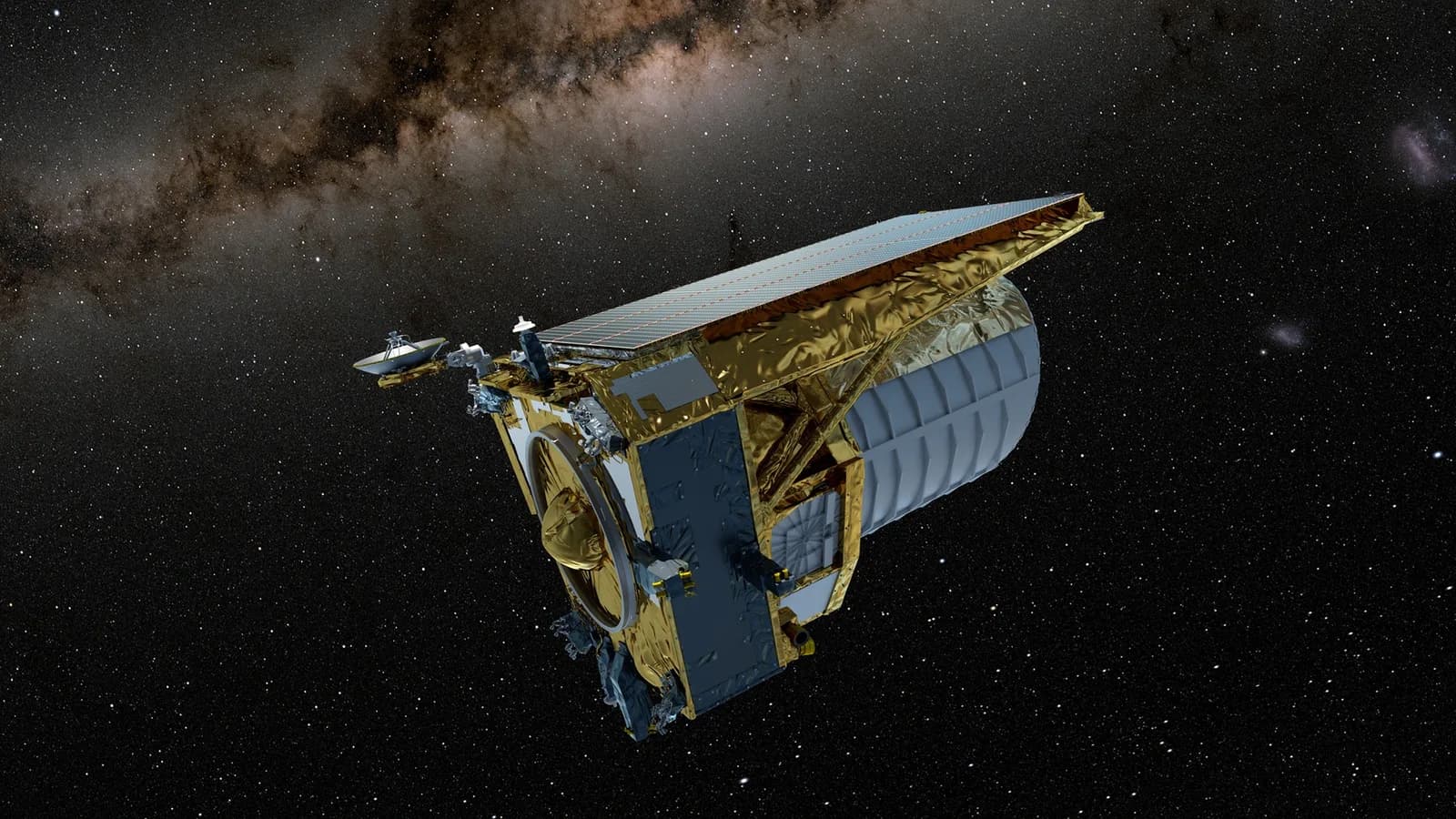
The European Space Agency’s Euclid space telescope has released its first major batch of data, a catalog of more than a billion cosmic objects across a patch of sky as big as 9,500 full Moons, and the first big step toward the largest 3D map of the universe ever made.
The release, called DR1-Foundation, covers about 13 months of observations. It’s the first major release of mission data since Euclid launched in mid-2023, and it gives scientists the pieces they need to start building a detailed 3D map of the cosmos, which is key to solving the mysteries of the dark universe.
The numbers
The data release includes over 900 million galaxies, around 15,000 strong gravitational lensing candidates, more than 60 million quasar candidates (the bright cores of distant galaxies) and spectra from more than 160 million sources. The Euclid Wide Survey portion covers 1,900 square degrees of sky and comes to 1.7 million gigabytes of data. It also includes images and large sky mosaics.
That’s a big jump in scale. Euclid’s earlier releases covered just a few days of observations over about 60 square degrees, project scientist Valeria Pettorino said. This one holds more than a year of data over a far larger area. A March 2025 release, by comparison, reported about 500 strong lens candidates.
Rare objects by the thousands
From above Earth’s blurring, dimming atmosphere, Euclid can survey the sky deeply and widely in ways ground telescopes can’t, which pushes detection limits for rare, distant objects. The release includes the largest catalog of strong gravitational lenses ever, bigger than all earlier catalogs combined. These lenses form when a foreground galaxy strongly distorts light from a more distant one, and they’re extremely rare.
Natalie Lines of the University of Portsmouth said strong lensing lets astronomers “weigh” individual galaxies, including their invisible dark matter, and study how the universe is expanding.
Galaxy clusters are the other highlight. Barbara Sartoris of the JL Lagrange laboratory in Nice, France, said Euclid sees large samples of ancient clusters across huge areas, which were previously out of reach. Her team will study in the coming months how these giants grew.
From pictures to a 3D map
Mapping depends on spectroscopy: splitting a galaxy’s light into a “rainbow” that reveals its distance. With distances in hand, scientists can place galaxies in the universe’s 3D structure and connect them to the invisible mesh of the cosmic web. For especially bright galaxies, the rainbows also reveal origin and composition.
Only the beginning
The dataset covers only about 14% of the total sky Euclid will survey. The full Data Release 1, due in mid-2027, will add weak-lensing observations to complement the strong lenses, along with calculations of how galaxies and clusters fit into the cosmic web.
Carole Mundell, ESA’s director of science, called the release “far more than beautiful pictures,” a scientific milestone and the largest space-based survey of its kind. Pettorino said the dataset has enough statistics to uncover even rare objects, and that “so much discovery is yet to come.”
Get the latest news delivered to your inbox.
Related articles