MIT scientists design impact-resistant materials inspired by leaves and dragonfly wings
Advancement in various fields hinges on the best quality materials. Now, a new class of...
Advancement in various fields hinges on the best quality materials. Now, a new class of “scale-rich metamaterials” has been designed by introducing controlled disorder inspired by natural networks such as leaf vasculature and dragonfly wing veins.
Engineers have spent decades chasing mathematical perfection when designing synthetic “metamaterials,” mimicking identical microscopic building blocks to create rigid honeycombs and lattices. A new collaboration between MIT and Northeastern University just proved that a little chaos works much better.
Physical tests proved these irregular materials resist impacts better, offer tunable stiffness, and protect fragile embedded objects.
This technology could advance the development of safer sports helmets and lightweight body armor. It may also enable precision acoustic lenses that control sound waves and vibrations with high accuracy.
Little disorder to make synthetic materials
The research introduces “scale-rich metamaterials.” These synthetic structures abandon uniform grids for messy, sprawling physical networks modeled after leaf vasculature, neural connections, and even the internet.
Uniform metamaterials share a weak spot. When a single cell in a repeating lattice cracks or punctures, the surrounding identical cells immediately follow suit, causing a chain-reaction collapse. MIT associate professor Carlos Portela and his team wanted to cut this localized failure, so they teamed up with Northeastern physicist Albert-László Barabási, a pioneer in network science.
Barabási spent his career mapping invisible webs — from social media links to financial markets — to see how networks resist collapse. Together, the researchers turned those abstract mathematical rules into tangible, physical matter.
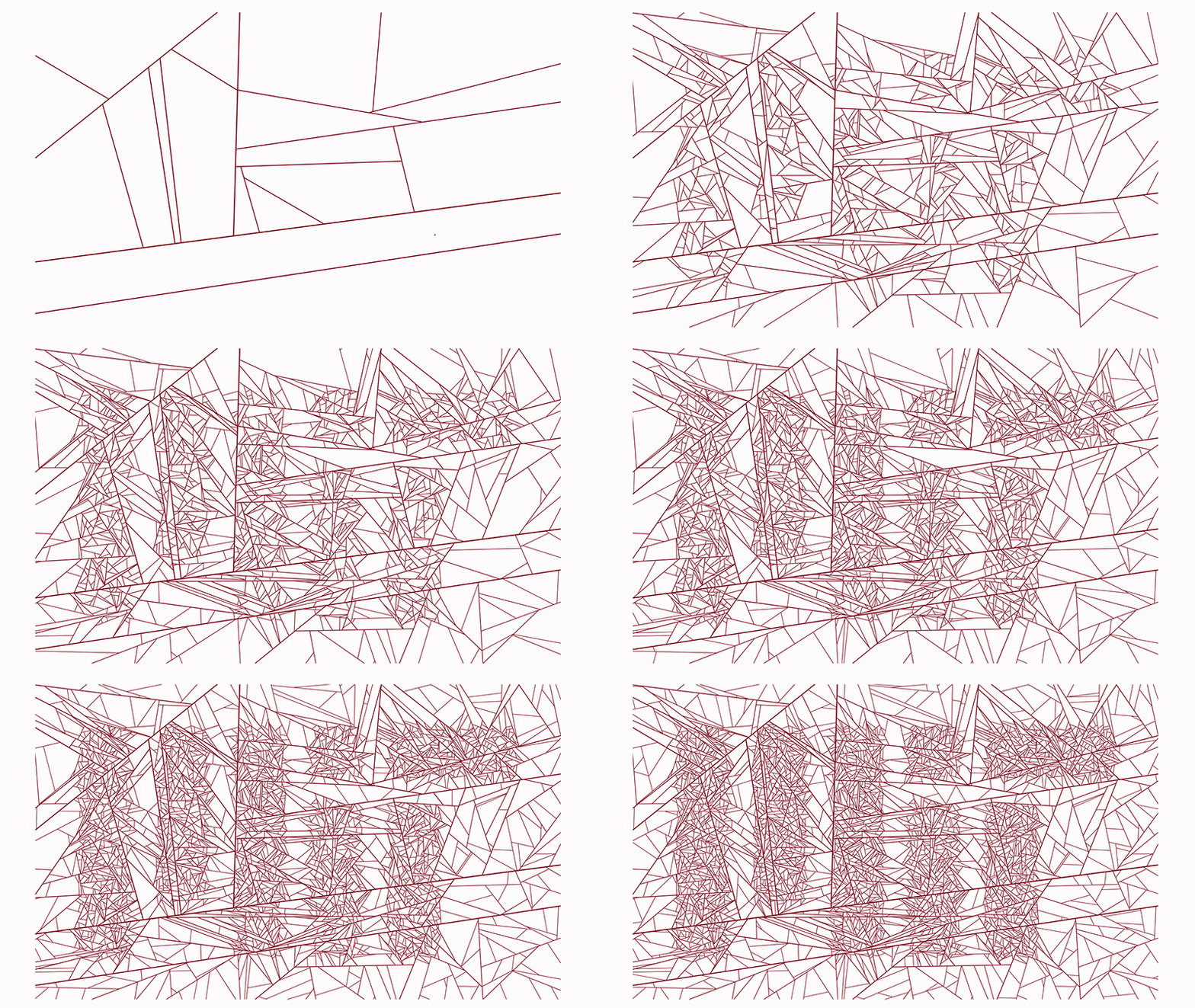
The team wrote an algorithm that generates a virtual blueprint for a material without using a single repeating pattern. The program picks a random point in space and draws a line across the entire domain.
The press release explained that it then picks a second random point and draws a line that stops the moment it hits the first line or an outer edge. Repeating this process thousands of times creates a dense, web-like architecture of intersecting support beams in wildly varying sizes and thicknesses.
The team developed an algorithm to virtually generate a network of beams with the constraints of a physical material. Here, the network of beams creates the MIT logo.
Impact-proof metamaterials
Scientists can customize a material‘s stiffness simply by adjusting two parameters in their algorithm: the thickness of the initial line and how quickly subsequent lines get thinner.
After simulating these variations, the researchers 3D-printed credit-card-sized polymer samples with interconnecting beams ranging from microns to centimeters.
Further, physical tests confirmed that these chaotic networks outperform usual ordered materials across the board. The scale-rich designs absorbed sudden, violent impacts without buckling, offered a massive range of tunable stiffness, and successfully cushioned delicate objects embedded deep inside them.
“This is a completely new way of thinking for metamaterials,” Portela said. “Unlocking this network design for materials really frees us to think of new microstructures and mechanical benefits that haven’t been possible before.”
In practical applications, manufacturers could soon use the algorithm to print next-generation sports helmets, lightweight body armor, and precision acoustic lenses that focus sound waves and vibrations with unprecedented control.
The findings were published in the journal Nature.
Source: https://interestingengineering.com/innovation/impact-resistant-materials-inspired-by-leaves
Get the latest news delivered to your inbox.
Related articles