Mapped: Where Americans Have Paid Off Their Homes
West Virginia leads the U.S. in mortgage-free homeownership, while age creates an even wider divide than geography.
Where Americans Are Paying Off Their Mortgages
Key Takeaways
West Virginia leads the country, with 56.6% of owner-occupied homes mortgage-free, compared with 41% nationwide.
About 64% of homeowners age 65 and older have no mortgage, versus 20% of those under 35.
Roughly two in five owner-occupied homes in the U.S. are owned free and clear. In some states, more than half of homeowners have no mortgage at all.
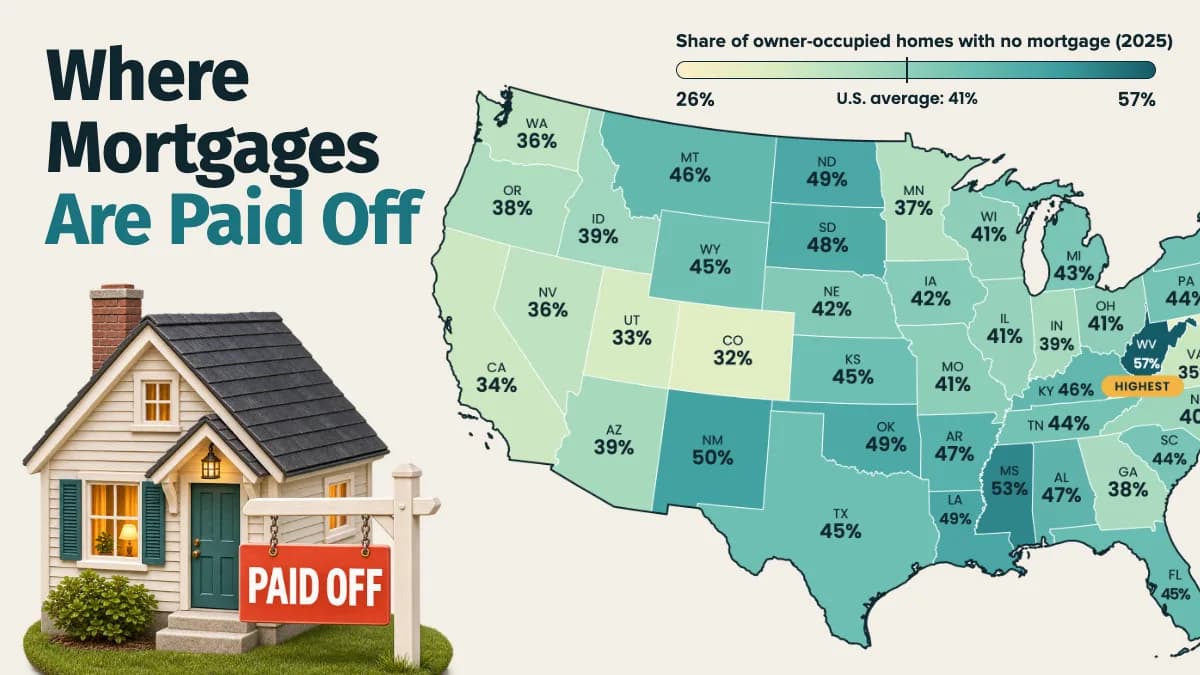
This map shows the share of owner-occupied homes without a mortgage in all 50 states and Washington, D.C., using the U.S. Census Bureau’s 2025 American Community Survey. Mortgage-free homes have no mortgage, home equity loan, or similar debt secured by the property.
West Virginia Has the Highest Share of Paid-Off Homes
West Virginia leads with 56.6% of owner-occupied homes mortgage-free, 3.9 percentage points ahead of Mississippi at 52.7%. They are the only two states where more than half of owner-occupied homes have no mortgage.
Lower home prices may help explain part of the difference. The median owner-occupied home in West Virginia is worth about $176,000, less than a quarter of California’s $771,000. In California, just 34.4% of owner-occupied homes are mortgage-free.
Here are all 50 states and Washington, D.C., ranked by the share of owner-occupied homes without a mortgage in 2025:
RankState or DistrictMortgage-Free Owner-Occupied Homes, 2025 (%)
1West Virginia56.6
2Mississippi52.7
3New Mexico50.0
4Louisiana49.1
5North Dakota48.9
6Oklahoma48.6
7South Dakota48.4
8Arkansas47.3
9Alabama46.7
10Kentucky46.2
11Montana46.1
12Florida45.3
13Texas44.7
14Kansas44.7
15Wyoming44.5
16New York44.4
17Maine44.2
18Tennessee44.1
19Pennsylvania44.0
20Alaska43.8
21South Carolina43.8
22Michigan43.4
23Vermont43.4
24Nebraska42.4
25Iowa42.2
26Missouri41.4
27Wisconsin41.3
28Ohio41.3
29Hawaii40.6
30Illinois40.5
31New Hampshire40.5
32North Carolina39.8
33Idaho39.5
34Indiana38.9
35Arizona38.7
36Georgia38.5
37Delaware38.2
38Oregon37.8
39New Jersey37.5
40Minnesota37.4
41Connecticut37.1
42Washington36.1
43Rhode Island35.9
44Nevada35.9
45Massachusetts35.2
46Virginia34.8
47California34.4
48Utah33.2
49Colorado31.6
50Maryland30.6
51District of Columbia26.5
-- U.S. Average41.0
Seven of the top 10 states are in the South. The Census Bureau also found that rural counties were more likely than urban counties to have high shares of mortgage-free homes, based on its 2024 five-year estimates.
Maryland has the lowest share among states, at 30.6%, while Washington, D.C., is lower still at 26.5%. Both have relatively expensive housing: typical home values reached about $428,000 in Maryland and $570,000 in D.C. in August 2026, compared with $369,000 nationally.
Higher home prices generally mean larger loans for buyers making the same percentage down payment, potentially making it harder to pay off a mortgage.
Older Homeowners Are Far More Likely to Be Mortgage-Free
Nationally, about 64% of homeowners age 65 and older own their homes free and clear, compared with 20% of homeowners under 35.
Older homeowners have had decades to pay down their loans. With a typical fixed-rate mortgage, early payments go largely toward interest, while later payments increasingly reduce the principal. This gives long-established owners an advantage over recent buyers.
Owning a home outright can also make retirement more affordable by eliminating monthly mortgage payments. The Federal Reserve finds that even among lower-income adults, older people are much more likely to own their homes outright.
However, mortgage-free doesn’t mean housing-cost-free. In 2025, median monthly owner costs were $703 for homes without a mortgage, compared with $2,163 for those with one. Even homeowners who have paid off their loans must still cover property taxes, insurance, utilities, and other expenses.
Still, eliminating a monthly mortgage payment can make a substantial difference to household finances, particularly for retirees living on fixed incomes.
Learn More on the Voronoi App
If you enjoyed today’s post, check out Why Can’t Americans Pay Their Mortgage? on Voronoi.
Get the latest news delivered to your inbox.
Related articles