Ranked: The World’s Largest Copper Producers
See why Chile leads global copper output and which countries rank among the world's top producers.
Which Countries Produce the Most Copper?
Key Takeaways
Chile produced 5.3 million tonnes of copper in 2025, accounting for 23% of global production.
The Democratic Republic of the Congo ranks second, producing more copper than China and the United States combined.
Chile and Peru together account for nearly 35% of global copper output, highlighting South America’s importance to global supply.
Copper is essential to the modern economy, powering everything from electrical grids and industrial machinery to electric vehicles and data centers.
As demand for electricity and infrastructure grows, the countries supplying this critical metal are becoming increasingly important to global industry and supply chains.
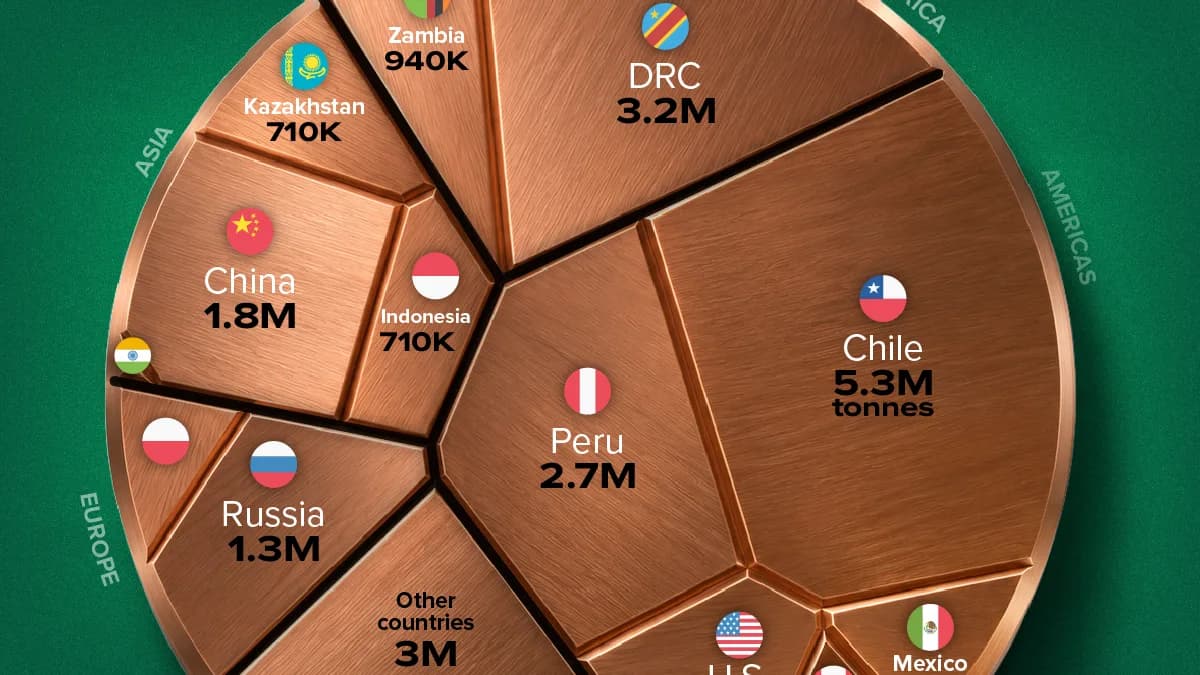
This visualization ranks the world’s largest copper producers in 2025, based on data from the U.S. Geological Survey’s Mineral Commodity Summaries 2026. Figures represent estimated mined copper content, not total ore extracted or refined copper production.
Chile Dominates Global Copper Production
Chile’s lead in copper mining is substantial. Its 5.3 million tonnes of production in 2025 exceeded the combined output of the Democratic Republic of the Congo and China, the world’s second- and fourth-largest producers.
CountryCopper production (tonnes)Percent (2025)
Chile5,300,00023.0%
DR Congo3,200,00013.9%
Peru2,700,00011.7%
China1,800,0007.8%
Russia1,300,0005.7%
United States1,000,0004.4%
Zambia940,0004.1%
Australia730,0003.2%
Indonesia710,0003.1%
Kazakhstan710,0003.1%
Mexico690,0003.0%
Canada500,0002.2%
Poland410,0001.8%
India23,0000.1%
Other countries3,000,00013.0%
World total (rounded)23,000,000100.0%
Chile’s copper industry has roots in the early 20th century, when the country’s vast mineral deposits attracted major American mining companies.
Operations at El Teniente began in 1904, while development of Chuquicamata started in 1910. A major turning point came in 1971, when Chile nationalized its largest copper mines, followed by the creation of state-owned Codelco in 1976.
Chile’s biggest production boom came during the 1990s, fueled by foreign investment and the development of new mines.
One major milestone was the opening of Escondida in 1990, which became the world’s largest copper mine.
According to Chile’s National Productivity Commission, annual copper production nearly tripled from 1.6 million tonnes in 1990 to 4.6 million tonnes by 2000.
Neighboring Peru ranks third with 2.7 million tonnes, making South America a major center of global copper production.
Chile also holds approximately 18% of global copper reserves, reinforcing its central position in the international copper market.
Africa’s Growing Role in Copper Supply
Central Africa has become one of the world’s most important copper-producing regions.
The Democratic Republic of the Congo and neighboring Zambia produced a combined 4.14 million tonnes of copper in 2025, exceeding the combined output of China and the United States by more than 1.3 million tonnes.
Both countries are part of the Central African Copperbelt, a mineral-rich region that has attracted substantial international mining investment.
Chinese companies also play a major role in the region, holding significant ownership stakes in copper mining operations across both countries.
Why Copper Is Becoming a Strategic Resource
In November 2025, the U.S. government officially added copper to its Critical Minerals List, recognizing its economic importance and vulnerability to supply chain disruptions.
The designation came as U.S. net import reliance for copper reached 57% of apparent consumption in 2025, up from 45% in 2024, according to the USGS.
Despite being one of the world’s largest economies, the U.S. mined approximately 1 million tonnes of copper in 2025, accounting for just over 4% of global production.
Copper is also deeply embedded in the American economy, with building construction accounting for 42% of domestic copper and copper-alloy product use, followed by electrical and electronic products at 23%.
As electricity demand, data center construction, and grid investment expand, securing reliable copper supplies will remain an important priority for American industry and infrastructure development.
Learn More on the Voronoi App
If you enjoyed today’s post, check out Visualizing the Growth of Chinese Copper Miners on Voronoi.
Get the latest news delivered to your inbox.
Related articles