China’s next aircraft carrier could rival US Ford class in size, with likely nuclear power
Satellite images from Nov. 12 show added hull and flight-deck sections on China’s fourth aircraft...
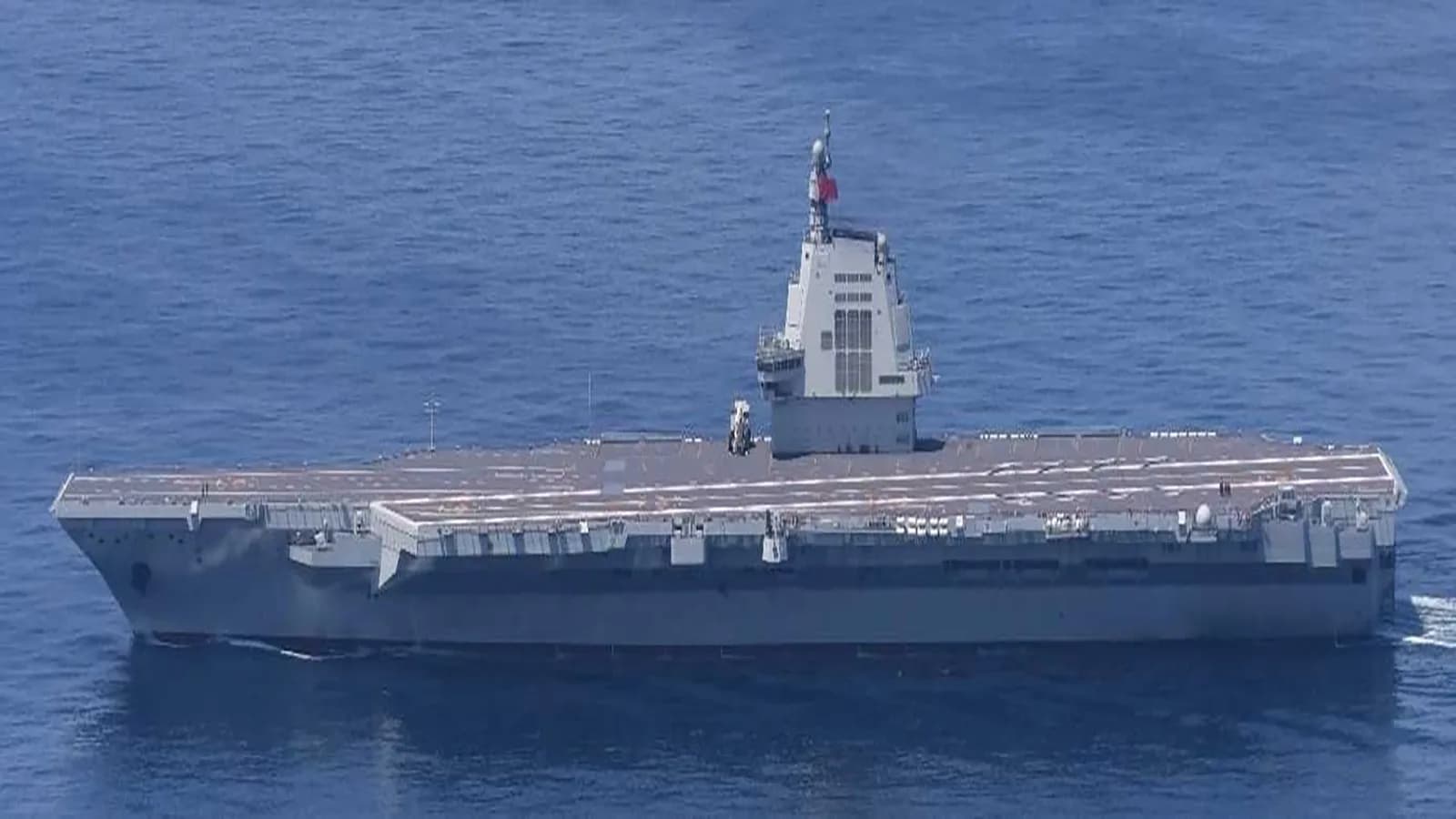
Satellite images from Nov. 12 show added hull and flight-deck sections on China’s fourth aircraft carrier at Dalian Shipyard, while the Center for Strategic and International Studies (CSIS) rates nuclear propulsion as likely for the ship..
The Aviationist reported the new imagery on Nov. 16, citing images shared on X. Analysts call the ship Type 004, a label Beijing has not confirmed. China has acknowledged that a fourth carrier program is underway but has declined to say how it will be powered, according to CSIS.
A nuclear reactor would let the carrier sail without refueling its own engines, CSIS said, and would supply more electricity for electromagnetic catapults, which launch aircraft using magnets instead of steam. CSIS, a Washington-based policy research group, also said the hull already looks longer than that of China’s largest current carrier, the Fujian.
Reactor-like compartments in the hull
In its CSIS assessment, CSIS pointed to imagery from May 4 showing two compartments, each about 49 feet (15 meters) on a side, that resemble shielded reactor containment spaces. The conventionally powered Fujian had no similar openings at a comparable stage of construction, CSIS said. Reports of a reactor-like structure in the hull date to at least November 2025.
CSIS also cited a late-2024 Associated Press investigation that indicated China built a land-based prototype naval reactor in Sichuan province. As of October, the hull measured 1,056 feet (about 322 meters) long and 151 feet (46 meters) wide, against roughly 1,037 feet (316 meters) for the Fujian, the assessment said. The finished ship could approach or exceed the U.S. Navy’s Ford class, which CSIS puts at about 1,106 feet (337 meters).
The Aviationist said the Nov. 12 images, captured by a Vantor satellite, show extensions along both sides of the hull. CSIS has tied such work to weapons platforms called sponsons and to a starboard-side superstructure, the tower that rises above the flight deck.
Launch timing and what is unproven
As of October, CSIS said, the ship was at a stage similar to Fujian’s in May 2021. The Fujian was launched about a year later, so the Type 004 could follow a similar timeline, though its size and design could change that. A launch is not a commissioning: fitting out and sea trials would follow, and CSIS said construction will take several more years.
Nuclear propulsion is an assessment drawn from imagery, and CSIS said it is too early to be certain either way. The catapult count, three or four, and a possible third aircraft elevator are rated plausible, not confirmed. Final dimensions are unknown. Carriers also depend on escorts and replenishment ships, and CSIS noted that China recently launched a large new replenishment vessel near Guangzhou.
CSIS said it will update the page as new information becomes available, and the flight deck should show whether the ship has three or four catapults. The assessment, from CSIS’s Hidden Reach initiative, was last updated Oct. 27.
Source: https://interestingengineering.com/military/china-type-004-aircraft-carrier-csis
Get the latest news delivered to your inbox.
Related articles