Digital twin tech from US, Korea could predict toxic ammonia leaks on new ships
The US, South Korea and Germany have recently joined forces in order to develop a...
The US, South Korea and Germany have recently joined forces in order to develop a new digital twin technology that could predict how toxic ammonia leaks spread aboard ships.
The American Bureau of Shipping (ABS), Siemens and HD Korea Shipbuilding & Offshore Engineering (HD KSOE), announced the agreement at Gastech 2026 in Bangkok. They reportedly signed the memorandum of understanding (MOU) at the end of the month.
The initiative will bring together computational fluid dynamics (CFD) simulations with digital twins to rapidly model ammonia dispersion following a leak. It could allow engineers to test a wide range of leak and accident scenarios early in the vessel design process. This could identify safety risks before construction begins.
“By pairing CFD analysis with digital twin technology, this project gives designers a faster, more rigorous way to understand leak behavior,” Patrick Ryan, ABS CTO and Senior Vice President, pointed out.
Tracking toxic leaks
The shipping industry has been exploring ammonia as an alternative marine fuel as it looks for new ways to power vessels. Green ammonia could significantly cut the sector’s reliance on fossil fuels and reduce emissions from shipping.
Still, the fuel also poses safety challenges, particularly if it leaks. The chemical is highly corrosive, toxic when inhaled or touched, and flammable under specific concentrations. The new project aims to predict how it could spread after a leak.
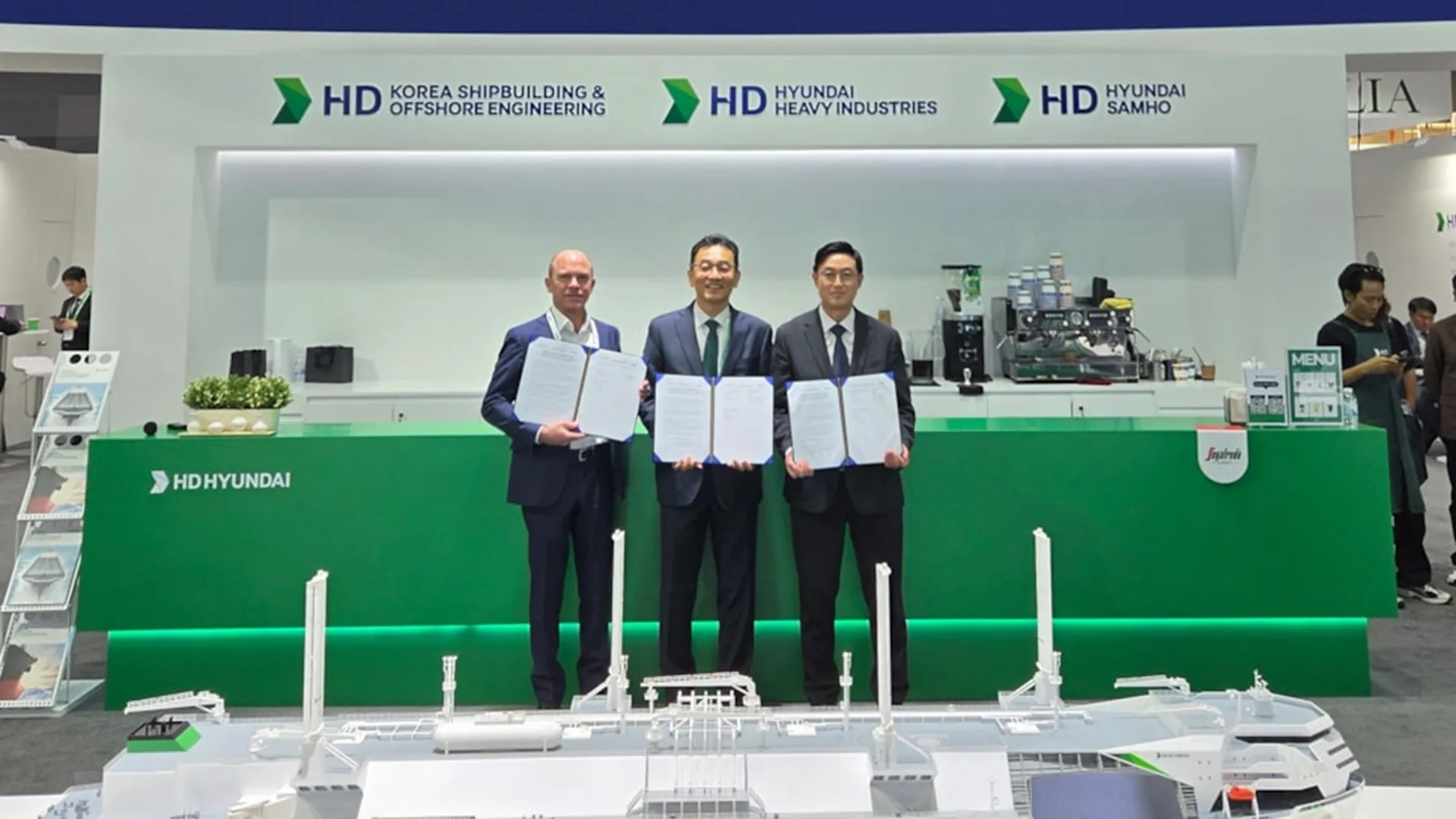
ABS, HD KSOE and Siemens signed a memorandum of understanding (MOU). Credit: ABS
Ryan stressed the partnership’s significance. “ABS is proud to bring our technical authority to this collaboration with HD KSOE and Siemens.” Each company will contribute a different part of the project.
HD KSOE will develop ammonia safety systems and lead experimental research. Siemens will provide simulation analysis and digital twin technology, while ABS will supply a safety assessment methodology built around digital twins.
Chang Kwangpil, head of the Future Technology Institute at HD KSOE, said AI and digital twin technologies are set to play an key role in shipbuilding research and development. “The AI transformation of the shipbuilding industry is not simply about applying new technologies; it is a process of innovating the way we work,” Kwangpil noted.
Safer ship designs
A digital twin is a virtual model that mirrors a real-world physical object, system, or process using live data. It can be utilized to simulate and study how it behaves under different conditions, such as potential failures, accidents, or environmental changes.
Combining this method with CFD could model how ammonia moves through and around a vessel after a leak. Engineers can then study multiple potential accidents without physically recreating every scenario. The findings can be used to assess safety measures while a vessel is still being designed.
Physics-based simulation and digital twins could play a key role in ensuring the safety and reliability of vessels. “Through close technical collaboration with HD Korea Shipbuilding & Offshore Engineering and ABS, we will accelerate safety validation for ammonia-fueled vessels and continue to support digital innovation across the global marine industry,” Byung Joon Oh, country manager of Siemens Digital Industries Software Korea, concluded in a press release.
ABS is also working with the maritime industry on the safe use of ammonia as a marine fuel. “
Related articles

New center bids to supercharge nuclear isotope production for deep-space missions
Canada is moving to expand its role in supplying nuclear isotopes that could power spacecraft...
Schneider tests quantum chip that improves home energy forecasting by up to 41%
Australian government-backed Silicon Quantum Computing (SQC), whose investors include telecom giant Telstra and Commonwealth Bank,...
Mapped: The World’s Digital Leaders in 2026
Which economies are the most digitally connected? See how 159 economies rank in the ITU’s 2026 ICT Development Index.

Breaking up (with Elon Musk) is hard to do
In a throwback to MySpace-style internet drama, Shivon Zilis announced that she and the father of four of her children, Elon Musk, had broken up on X.

OpenAI’s Dot agent is enterprise software that can also order your dinner
It's a tale as old as last week: OpenAI's new agent platform, called Dots, is full of cute little guys who can do your bidding.