
Driverless resupply vehicle pairs 500-mile range with drone-killing shotgun
Moving military supplies through areas under fire puts drivers directly in danger. Forterra and Hypercraft...
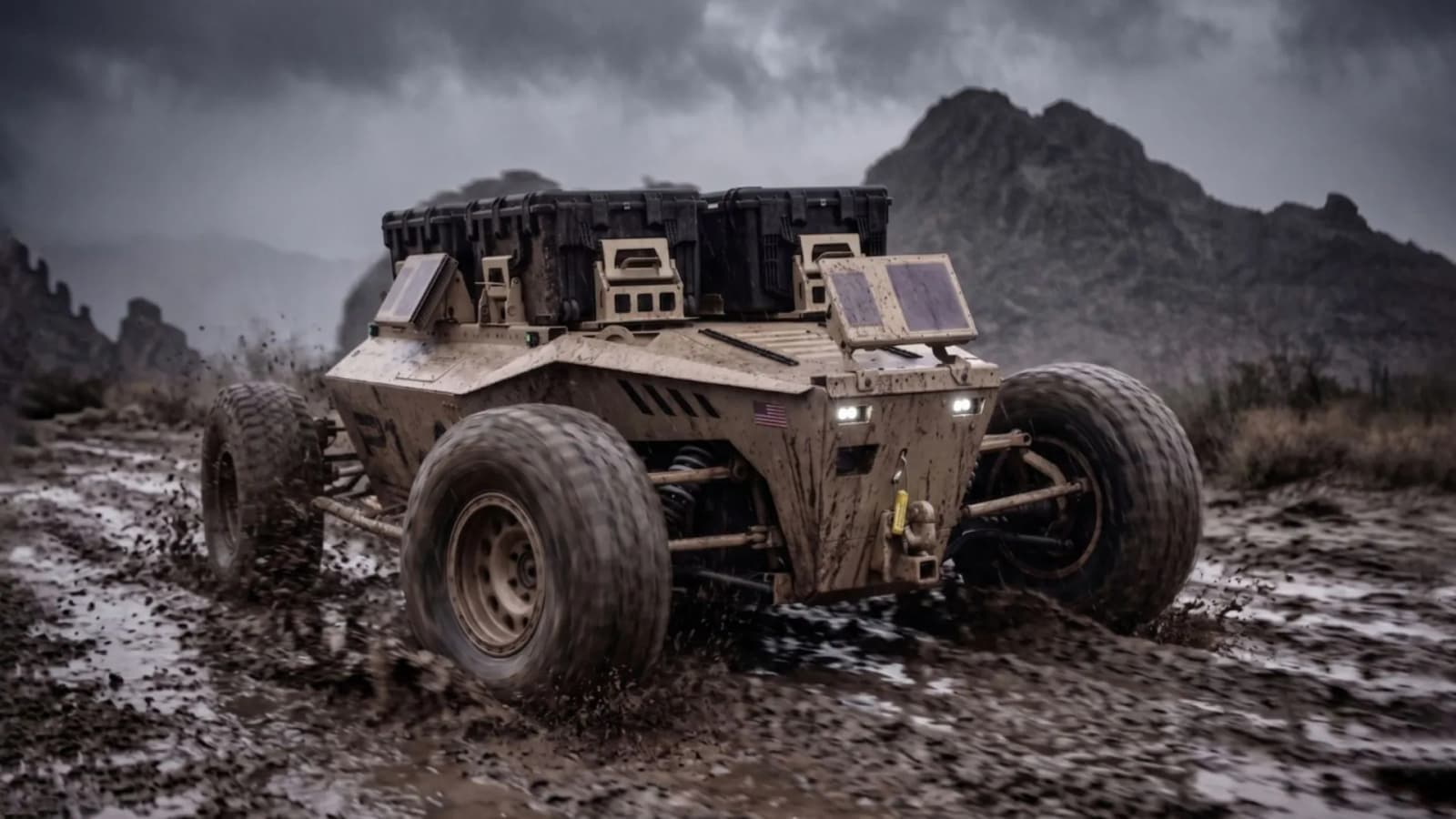
Moving military supplies through areas under fire puts drivers directly in danger. Forterra and Hypercraft are showcasing a driverless off-road vehicle designed for those missions at the Association of the U.S. Army’s annual meeting in Washington.
The platform combines Hypercraft’s Razorback unmanned ground vehicle with Forterra’s AutoDrive self-driving system. It also carries a counter-drone turret from 9 Mothers, bringing autonomous resupply and drone defense onto the same vehicle.
The companies describe contested logistics as a primary mission, although neither has announced a military customer, contract, or price for the combination.
Forterra, previously known as Robotic Research, develops autonomy technology rather than manufacturing vehicles. AutoDrive combines software, sensors, and computers to enable existing vehicles to operate without a driver.
A 4,000-pound payload without a driver
Razorback is the first complete vehicle developed by Hypercraft, based in Provo, Utah. The company initially built electric powertrains for commercial vehicles before expanding into defense and unveiling Razorback earlier this year.
Measuring more than 13 feet (4 meters) long, the vehicle can carry up to 4,000 pounds (1,814 kg), according to Hypercraft. The company reports a driving range of about 500 miles (800 km) and the ability to supply up to 38 kilowatts of electricity to external equipment.
Its design accommodates third-party sensors, radios, weapons, and mission payloads. Hypercraft has already displayed Razorback with counter-drone radar from Fortem Technologies.
“We’re going after contested logistics and other missions where a driver is the most exposed person on the battlefield,” Forterra Chief Growth Officer Scott Sanders told Tectonic.
“Razorback and AutoDrive combine to deliver a platform that can go further, over more complicated terrain, and power platforms in ways that traditional UGVs cannot,” he added.
Autonomy built into the platform
Sanders said Razorback was designed for autonomy from the outset, making integration straightforward. He contrasted that approach with unmanned ground vehicles derived from crewed trucks fitted with self-driving equipment after production.
According to Forterra, the system has been integrated into more than 50 vehicle types, used on over 1,100 missions, and placed under contract for more than 258 systems.
Applications include Polaris Ranger 1500 utility vehicles used in Ukraine and Ford F-250 pickups for the U.S. Army. AutoDrive also equips Oshkosh Joint Light Tactical Vehicles used in the U.S. Marine Corps’ ROGUE-Fires anti-ship missile launcher.
A shotgun turret for small drones
The Razorback displayed at AUSA carries Edda, a roughly 50-pound (23 kg) counter-drone turret developed by Austin, Texas-based 9 Mothers.
Edda detects the sound of small drone rotors, uses cameras to track targets and fires a shotgun. It is designed to engage drones approximately 7 inches (18 cm) across at distances between 33 and 328 feet (10–100 meters).
In August, the U.S. Army tested the same turret on a self-driving Ford F-250 equipped with Forterra technology during a live-fire exercise at Fort Bragg, North Carolina.
Forterra said its partnerships prioritize operational needs and production scalability, with autonomy requiring coordination across the vehicle, sensors, computers, communications, and operator.
The Razorback pairing brings those elements together for contested resupply missions.
Related articles
Anthropic adds live dashboards and animated explainers to Claude with Dashboards and Motion
Anthropic launched Claude Dashboards, which builds auto-updating dashboards from data platforms and CRMs, and Claude Motion, which turns reports and charts into editable animations, in beta, while making Docs, Slides and Design available on every plan.
Microsoft launches Microsoft-Decision-1, a fast decision-scoring model, on Foundry and OpenRouter
Microsoft released Microsoft-Decision-1, a model that returns calibrated probabilities over fixed options instead of generating text. Microsoft says it topped a 36-benchmark comparison and ran 35 times faster than GPT-6 Sol.
Microsoft’s Satya Nadella says advanced AI needs a human-controlled ‘emergency brake’
Microsoft CEO Satya Nadella urged the industry to treat frontier AI models like insider risks, wrapping them in containment, independent controls and an “emergency brake” that lets an authorized person pause or shut down a model mid-task.
Amazon in talks to buy AI startup Decart for around $7 billion, WSJ reports
Amazon is negotiating to acquire Decart, maker of real-time video-editing and robotics-simulation AI models, in a deal that could be valued at about $7 billion, The Wall Street Journal reported. Decart was valued at nearly $4 billion in May.

A college in Illinois tried to cancel its Flock contact and it refused
In April of 2025, Elgin Community College had six Flock safety cameras installed to "enhance the safety and security of students.

Silicon Valley is falling in line with Trump’s attempt to rename AI
When President Donald Trump announced his plans to rebrand artificial intelligence as "super intelligence," you'd be forgiven for being skeptical that it would catch on.