Elephant trunk-inspired robots bend, grip, and connect to work together in teams
Researchers at Colorado State University have developed flexible robots inspired by elephant trunks that can...
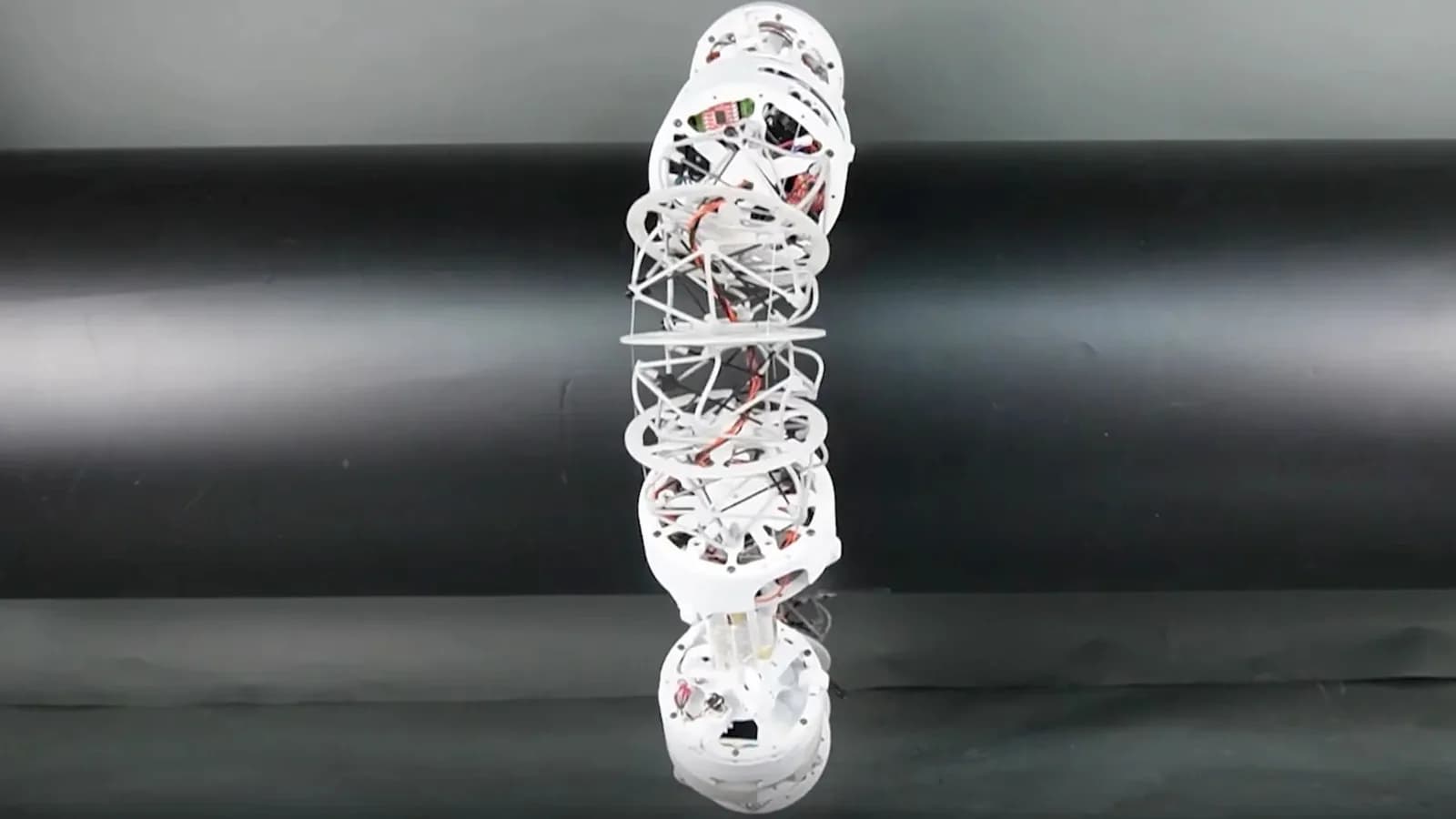
Researchers at Colorado State University have developed flexible robots inspired by elephant trunks that can bend, grip objects, and connect with other machines. The robots use a structural design called tensegrity, in which rigid rods are held together by tensioned cables rather than fixed joints.
The construction allows them to collapse, bend, and change shape while using gripping claws at both ends of their tube-like bodies to manipulate objects or attach to other robots.
The technology could eventually enable teams of robots to support space exploration and other complex tasks.
Shape-shifting robotic teams
The system combines a flexible body with mechanical claws, allowing individual robots to operate independently or assemble into larger configurations.
The technology addresses a limitation in existing modular robots, which typically use rigid components that restrict their ability to adapt to different environments and tasks. The researchers aim to combine the flexibility of soft robots with the reconfigurability of modular robotic systems.
The new machines use a structural design called tensegrity, in which rigid rods are held together by a network of tensioned cables rather than being permanently fixed to one another. This arrangement allows the robot’s body to bend, stretch, collapse, and change shape while maintaining its structural integrity.
Joint-free, tentacle-like bodies feature claws at both ends to grip objects and connect with other robots.
Unlike conventional robotic arms, which rely on fixed joints to control movement, the tube-like machines have flexible bodies that can deform continuously. They also feature mechanical gripping claws at both ends, allowing them to grasp objects and connect with other robots.
The dual-claw arrangement is central to the system’s modular design. Individual robots can use their claws to attach, creating larger structures without relying on magnetic connections. This mechanical attachment approach also helps reduce alignment problems when multiple units connect.
Once joined, the robots can form different configurations, including chains, loops, and branching structures. Each arrangement offers different possibilities for movement and manipulation, allowing the collective to adapt its physical structure to the requirements of a task.
The researchers demonstrated that individual units could perform manipulation and locomotion independently, while connected groups could coordinate their movements to transport objects. The machines also demonstrated multimodal locomotion, using different movement strategies to navigate varied environments.
Another capability is loco-manipulation, which combines movement and object handling. Rather than relying on separate mechanisms for navigating terrain and manipulating objects, the robots can use their flexible bodies and gripping claws to perform both functions. Their ability to bend around objects could also help them lift and carry loads of different sizes.
Robots prepare for autonomy
The team tested the robots across laboratory and real-world scenarios, including natural landscapes. These experiments explored how different configurations could support coordinated object handling, transportation, and movement across challenging terrain.
According to the team, developing the system required overcoming several engineering challenges, particularly in selecting motors. The actuators needed to be compact enough to fit within the robots while providing sufficient power and reliability for different movements. The team also tested multiple structural configurations to determine how the machines performed during practical trials.
Despite the demonstrations, the robots are not yet fully autonomous. They currently require human piloting for most operations, although the researchers have demonstrated that two units can independently locate one another and establish a connection.
Future development will focus on improving their autonomy, increasing operating speeds, and enabling them to work alongside humans with less supervision. The researchers also envision deploying larger groups of the machines, potentially involving tens or hundreds of interconnected units.
Such robotic collectives could travel to a designated location before rearranging themselves into configurations suited to specific operations. Potential applications include manufacturing, space exploration and search-and-rescue missions, where robots may need to navigate unpredictable environments, manipulate objects and adapt to changing requirements.
Researchers said that by combining a compliant tensegrity structure with mechanical docking mechanisms, the system offers an alternative to robots built around fixed geometries. It could provide a foundation for multifunctional robotic teams capable of changing both their physical arrangement and how they move to tackle different tasks.
Get the latest news delivered to your inbox.
Related articles