
Google Cloud launches a unified Gemini agent for enterprise work that plans tasks and connects to business systems
At Gemini at Work 2026 on October 8, Google unveiled a universal Gemini agent that can take objectives, plan work, connect to enterprise systems and return finished results from a single prompt—initially in private preview for businesses.
Google Cloud on October 8 introduced a universal Gemini agent for work at its Gemini at Work 2026 event, according to Google’s blog, TechCrunch and The Verge. The company says the agent goes beyond answering questions: it can take objectives, plan the work, use skills and tools, connect to internal systems and bring back finished output inside documents, inboxes and developer environments.
Capabilities. Google says a single prompt box can cover knowledge work, Q&A, content creation and coding. TechCrunch reported connectors for Google Workspace, Microsoft 365, Slack, Jira, Confluence, Git, BigQuery, Databricks, Postgres, Snowflake and Model Context Protocol (MCP) servers inside or outside the company network. By default the agent picks the best model for the job; users can also choose third-party models starting with Anthropic’s Claude, with open-source and private models planned later.
Coworker identity. The Verge said the agent can spin up job-specific sub-agents and operate as a “coworker” with its own Workspace identity and an @agents.company.com email. Google Cloud CEO Thomas Kurian said it can be given “objectives, not just instructions.” A tasks inbox shows thinking, delegation to sub-agents, skills loading, code and progress. Access spans iOS, Android, Windows, Mac, the CLI, Workspace, Microsoft 365, ServiceNow and Slack.
Customers and rollout. Early testers included On, Shopify and PayPal; Gemini Enterprise customers cited by Google include BNP Paribas, Merck and Ulta Beauty. CEO Sundar Pichai said Gemini has more than 1 billion monthly active users and that nearly 90% of Fortune 100 companies use Gemini Enterprise. The Verge reported the agent is in private preview for enterprise customers first, with a later consumer rollout. Google also announced flexible spending controls including multi-model orchestration, smart routing and real-time spend caps.
The launch intensifies competition in enterprise agents—where Google is leaning on workplace distribution, governance and security as differentiators against consumer-facing agents from rivals.
Related articles

Soft sensor recreates 3D shapes through bending and twisting despite fiber damage
MIT researchers have developed a soft sensor that recreates its own three-dimensional shape as it...

Green hydrogen process reaches 98% efficiency while producing valuable chemicals
A new electrochemical process developed by researchers at the Technion, Israel Institute of Technology, could...

Biohub, DOE, NIH and Meta/DeepMind back $1.8B virtual-biology data push for predictive AI models of disease
On October 7, Biohub said it, the U.S. Department of Energy, the NIH and new partners are committing $1.8 billion in funding, data, compute and measurement technology to build open, AI-ready biological datasets for predictive models of cells and disease.

AWS launches open-source Physical AI Toolchain with NVIDIA stack for robotics development
Amazon Web Services on October 8 released an open-source Physical AI Toolchain that ties together synthetic data, training, simulation, validation and edge deployment with NVIDIA’s Isaac and Cosmos software for industrial automation, mobility and humanoid robotics.
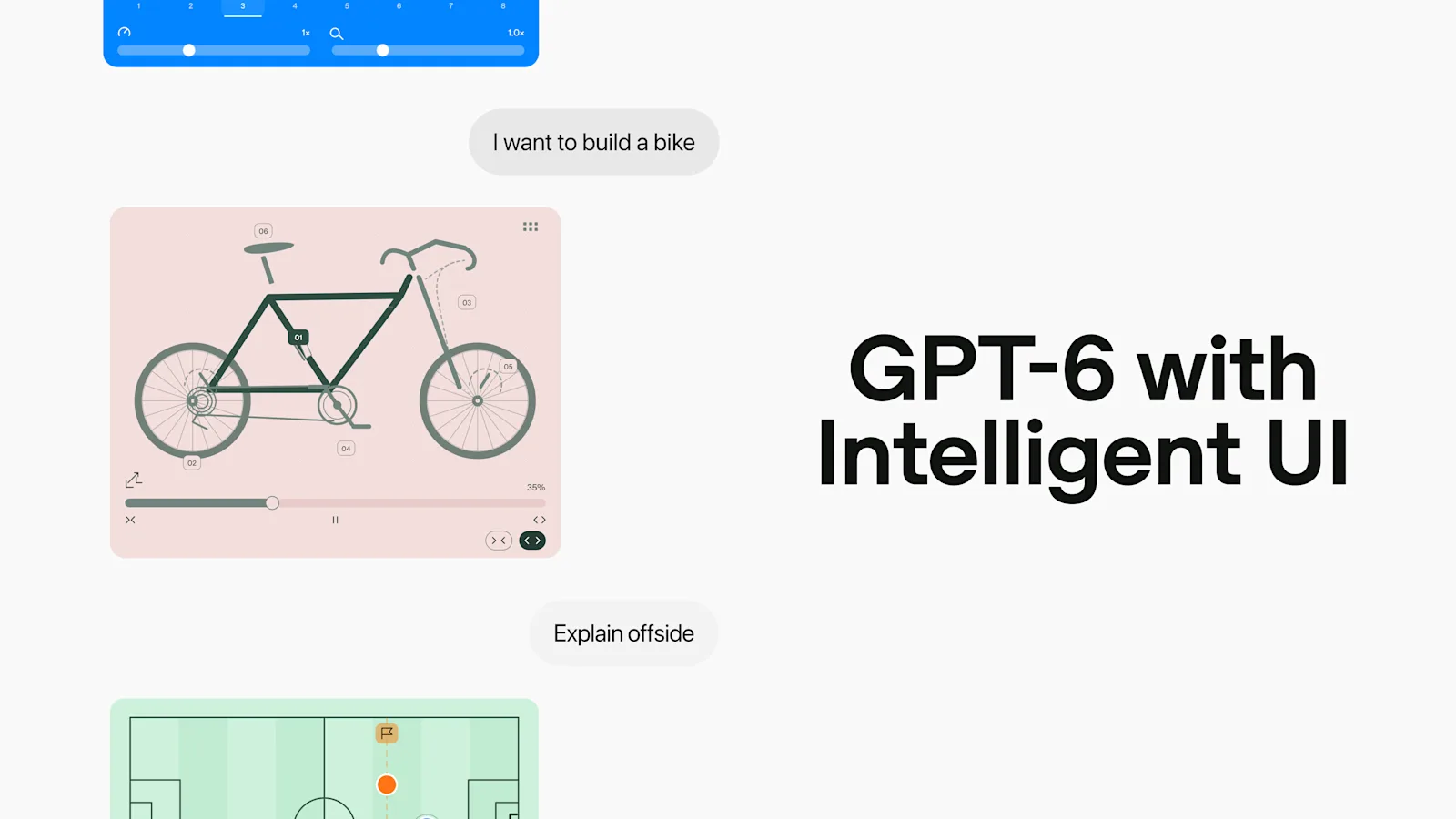
OpenAI rolls out GPT-6 and Intelligent UI in ChatGPT, adding interactive charts, forms and in-chat tools
OpenAI began rolling out GPT-6 with Intelligent UI on October 7 to Plus, Pro, Business and Enterprise users, expanding to Free and Go on October 8, so ChatGPT can answer with interactive graphics, buttons, forms and tools inside the conversation.
White House: 11 firms including NVIDIA, OpenAI and Anthropic pledge $2.4B in AI tools and compute for Genesis Mission
At a science summit on October 8, the Trump administration said eleven industry partners will provide $2.4 billion in super-intelligence tools and compute credits for the Genesis Mission Consortium, led by NVIDIA’s $1 billion commitment.