
UK steps up cyber defences against AI risks and explores reporting of serious AI incidents and near misses
UK AI Minister Kanishka Narayan announced plans to scale pilots that helped fix more than 1,000 government cyber vulnerabilities, explore stronger protections under the Cyber Security and Resilience Bill regime, including how serious AI incidents and near misses are reported, and prepare for incidents involving autonomous AI agents.

The UK government on Monday, October 12, 2026, announced a suite of measures to better protect Britain from the risks posed by increasingly powerful AI. Speaking at Base One, Imperial College London's science and tech incubator, AI Minister Kanishka Narayan argued for a whole-society approach to resilience against emerging AI risks.
Key measures
- Scaling AI cyber pilots. The government will extend two pilots that have already helped identify and fix more than a thousand potential cyber vulnerabilities across government systems and detect potential threats.
- Stronger legal protections. It will explore strengthening parts of the Cyber Security and Resilience Bill and the wider regime so essential services such as hospitals and utilities are better protected from emerging AI-related risk, including loss-of-control risk where autonomous systems evade human oversight.
- Incident and near-miss reporting. The government will look at how serious AI incidents and near misses can be identified and reported, and how lessons can be learned quickly. Details will be worked through with parliamentarians, technical experts and the operators who would deliver them.
- Preparing for AI agent incidents. Work is under way with the National Cyber Security Centre (NCSC) and the AI Security Institute (AISI) on how incidents involving AI agents, which can perform complex tasks with little human supervision, should be responded to.
The minister also confirmed that AISI scientists are now conducting rigorous evaluations of the latest generation of advanced AI models, following work with leading AI developers and the US government.
The minister's message
"I want Britain to become one of the hardest countries in the world to attack using artificial intelligence," Narayan said. Addressing frontier AI developers, he added: "Listen when your scientists warn of serious dangers. Investigate unexpected behaviour. And if you cannot adequately control the risks, do not release the system."
Cyber Minister Liz Lloyd said that as cyber incidents continue to cause disruption globally, staying on the front foot on cyber security has become business-critical for organisations of every size.
Guardian: UK "cannot rely entirely" on tech firms
According to The Guardian, Narayan will say Britain cannot rely entirely on technology companies to police their own models and that the UK needs to build more of its own AI infrastructure. The paper also reported concerns from Geoffrey Irving, a former chief scientist at AISI, that AI companies lack security strong enough to stop an adversarial state from stealing unreleased frontier models.
The prime minister told the UN General Assembly in September that the UK would use its G20 presidency next year to champion agreement on AI safety around a single set of global principles and standards.
Sources: GOV.UK; The Guardian.
Related articles

New microwave weapon can zap drone swarms without burning through missiles
BAE Systems has unveiled two air defense technologies designed to help the US Army counter...

Valkyrie combat drone makes first European flight with 3,100-mile range and Mach 0.8
Airbus and Kratos Defense & Security Solutions have flown the U740 Valkyrie uncrewed combat aircraft...

Amazon tops 1 million warehouse robots as AI models like DeepFleet, Sparrow and Vulcan expand its fleet amid worker-safety debate
Amazon now operates more than 1 million robots while still employing over 1.5 million people, Ars Technica reports. The company plans to more than double its robotic arm fleet this year using AI foundation models, while researchers and unions point to shifting injury patterns.

Unredacted Kentucky lawsuit alleges Character.AI chatbots encouraged self-harm and starvation
Kentucky Attorney General Russell Coleman has filed an unredacted version of the state's January lawsuit against Character.AI, detailing alleged chats in which bots encouraged users to cut or starve themselves. The claims are allegations that have not been proven in court.
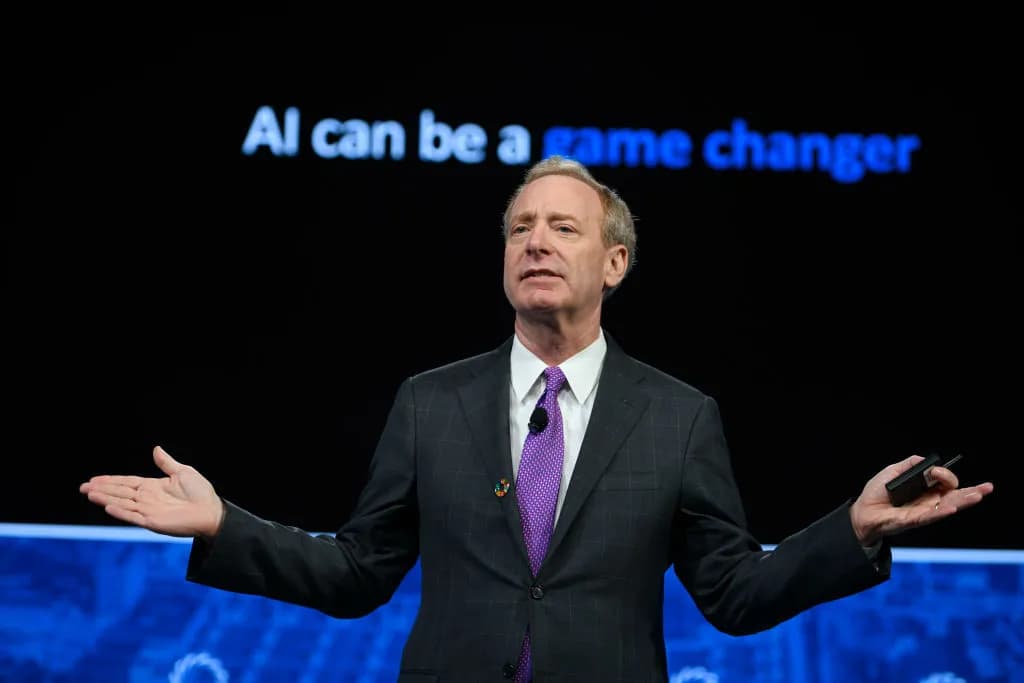
Microsoft President Brad Smith says UK is best placed to drive global AI regulation
Microsoft President Brad Smith told a BBC podcast that AI is both “a weapon and a tool” and that the moment has arrived for global safety rules. He said voluntary accords are not enough and backed legal breach-notification duties, outside evaluator approval before release and kill switches.

NVIDIA opens Vera Rubin rack and compute tray designs through OCP, expands AI factory networking with Meta, Google and Cisco
At the OCP Global Summit, NVIDIA contributed Vera Rubin rack and compute tray designs to the Open Compute Project via its MGX architecture. MGX 1.2 supports racks up to 250kW and a 5,000A liquid-cooled busbar, while Meta adopts Spectrum-6 Ethernet and new networking work with Google and Cisco targets AI factory bottlenecks.