
NASA’s Perseverance breaks 28-mile Mars driving record using autonomous navigation
NASA’s Perseverance rover has set a new record for the longest distance driven by any...
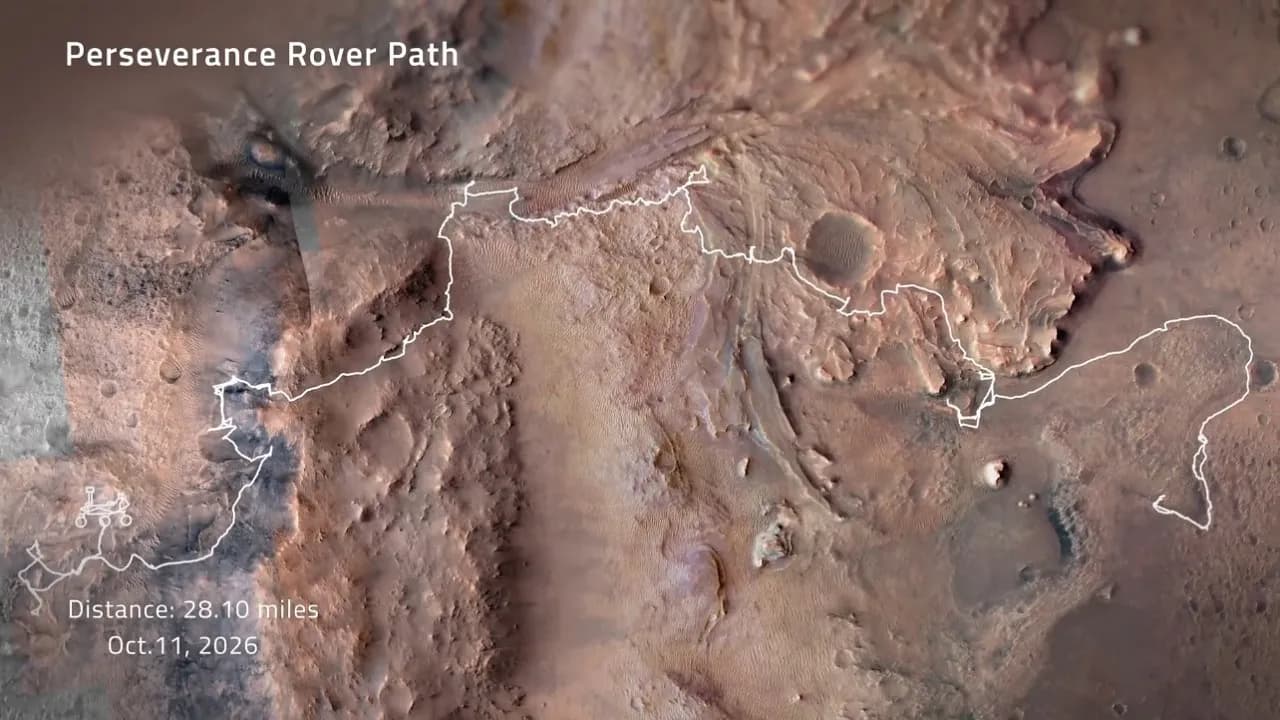
NASA’s Perseverance rover has set a new record for the longest distance driven by any vehicle on another world, reaching 28.10 miles (45.22 kilometers) on Mars and surpassing a record held by Opportunity for years.
The six-wheeled rover crossed the milestone on October 11, during the 2,006th Martian day of its mission. It overtook Opportunity’s 28.06-mile (45.16-kilometer) record, covering the distance in about five and a half years compared with Opportunity’s nearly 15 years.
Much of Perseverance’s progress comes from its autonomous navigation system, AutoNav, which allows the rover to identify obstacles and plan routes while moving. NASA says the system has guided more than 90% of its total driving distance, compared with about 5% for Opportunity’s early autonomous navigation system.
Perseverance can travel up to 1,351 feet (412 meters) in a single Martian day. Its navigation software processes about 600,000 measurement points with each look at the terrain, compared with just 20 used by Sojourner, NASA’s first Mars rover.
Autonomous driving extends exploration
AutoNav uses onboard cameras to capture images of the surrounding terrain, builds a three-dimensional map of potential hazards and selects a safe route between waypoints chosen by engineers on Earth.
The system allows Perseverance to make driving decisions without waiting for detailed instructions from mission controllers. NASA describes the process as “thinking while driving.”
The record-breaking drive covered 299.6 feet (91.31 meters), pushing the rover beyond Opportunity’s previous mark.
“The original mission called for no more than 12.4 miles of driving. We’ve blown well past that, and with all mobility systems fully operational and favorable extended-ground-life test results, we expect Perseverance to keep adding to this record for many years to come,” said Steven Lee, project manager for the Curiosity and Perseverance rovers at NASA’s Jet Propulsion Laboratory.
NASA recently approved Perseverance’s first mission extension, which began in October and will continue its exploration of Jezero Crater’s rim through approximately the end of 2028.
The rover is currently traveling through an area called Lac de Charmes toward Idubi, where scientists hope to identify evidence of ancient hydrothermal systems.
These systems involve heated water interacting with surrounding rock and could provide clues about environments that may once have supported microbial life.
Ancient rocks guide missions
Perseverance has collected 29 rock and soil samples while exploring Jezero Crater, including its former lakebed, ancient river delta and crater rim.
Some rocks in the region are approximately 4 billion years old. NASA says the terrain could preserve geological evidence largely lost on Earththrough erosion and plate tectonics.
The rover previously identified a potential biosignature in a rock called Cheyava Falls. That finding remains a possible indicator of ancient life, not proof that life existed on Mars.
Perseverance has also surpassed the distances traveled by Apollo 17’s lunar rover and the Soviet Union’s Lunokhod 2.
NASA’s earlier Mars rovers established successive milestones. Sojourner traveled about 330 feet (100 meters), Spirit covered 4.8 miles (7.7 kilometers), and Curiosity has driven more than 23.65 miles (38.07 kilometers).
After Lac de Charmes, Perseverance is expected to continue south toward Rainbow Falls, a 328-foot-wide (100-meter-wide) block of ancient crust exposed by the impact that formed Jezero Crater
NASAis also improving the rover’s navigation software to reduce unnecessary steering and help it determine its position using orbital maps while driving.
The agency hopes future improvements will allow rovers to operate longer each day, expanding the amount of Martian terrain they can investigate.
Related articles
US Genesis Mission backs digital twin to predict fusion plasma in under 20 minutes
A new US Department of Energy-backed project aims to predict the behavior of plasma inside...
NASA and DOE sign agreement to develop nuclear power and propulsion for space
Deep-space exploration is trading chemical rockets for nuclear fission. To expand human presence beyond Earth,...

Nuclear war, malicious AI pose extinction risk by 2100 among 17 health threats: Lancet
Nuclear war and the malicious use of artificial intelligence top a list of 17 major...
Meteorite, desert soil and AI: New electrical method takes aim at hunt for alien life
Researchers in Japan have developed an electrical method that tells mirror-image forms of amino acids...

NASA dumped over 800GB of Artemis II data online
If you thought you'd seen all there is to see from the Artemis II mission, you're wrong.

Scientists stop a quantum particle using a magnetic field it never crossed
Quantum particles can move between two locations through a process called tunneling. However, what if...