Mapped: Which Countries Pay the Most to the UN?
Who funds the United Nations? Explore the biggest UN contributors in 2025, how funding is calculated, and what donors gain.
This story was prepared automatically by software.
A Global Look at Who Funds the United Nations
Key Takeaways:
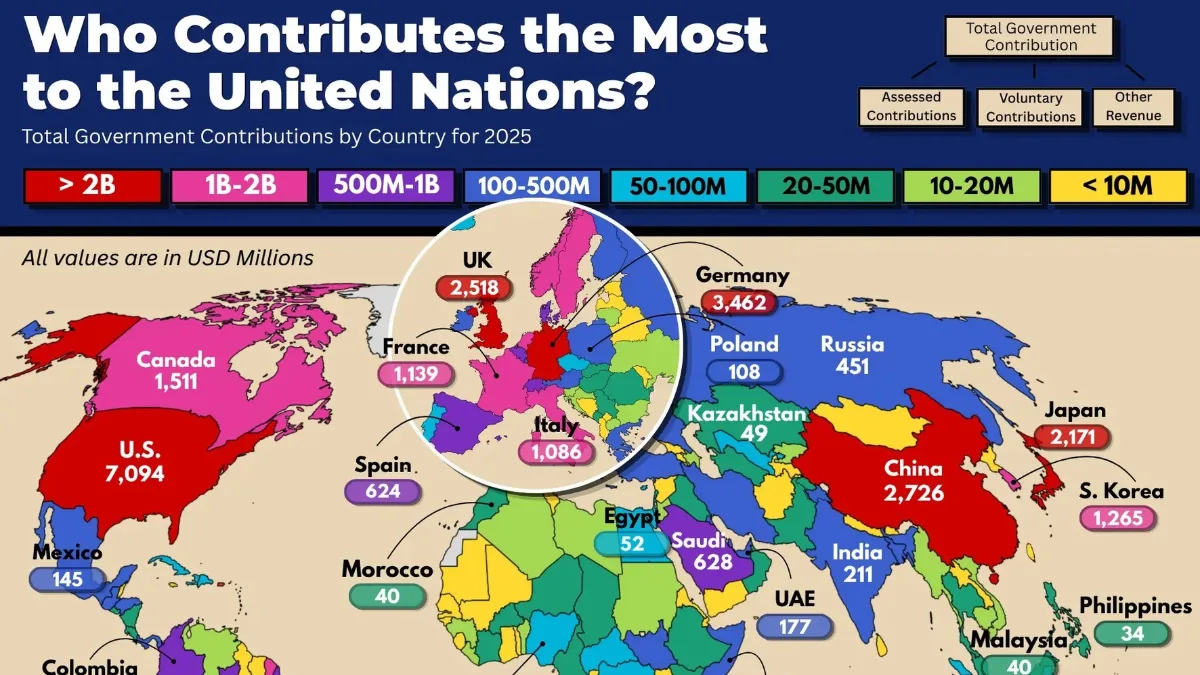
The United States leads UN government contributions at $7.1 billion, more than double Germany’s $3.5 billion.
China ranks third at $2.7 billion, ahead of the United Kingdom and Japan.
Smaller European economies, including Sweden and Norway, rank among the world’s top 10 contributors.
The United Nations relies on government funding for everything from peacekeeping to humanitarian assistance. Contributions include mandatory assessments and voluntary funding, which allows governments to support specific agencies and programs.
This visualization, created by Iswardi Ishak, maps government contributions to the UN system using 2025 figures attributed to the UN System Chief Executives Board for Coordination (CEB).
Which Countries Contribute the Most?
The following table ranks government contributions to the UN system, combining assessed contributions, voluntary funding, and other revenue. All figures are in millions of U.S. dollars.
RankCountry/TerritoryTotal Contributions (in USD Millions)
1 United States of America7,094
2 Germany3,462
3 China2,726
4 United Kingdom2,518
5 Japan2,171
6 Sweden1,720
7 Canada1,511
8 Norway1,414
9 Netherlands1,297
10 South Korea1,265
11 France1,139
12 Italy1,086
13 Switzerland764
14 Denmark753
15 Australia676
16 Brazil631
17 Saudi Arabia628
18 Spain624
19 Colombia621
20 Belgium508
21 Argentina492
22 Russia451
23 Ireland387
24 Finland338
25 Austria233
26 Guatemala224
27 Luxembourg215
28 India211
29 Qatar209
30 New Zealand181
31 Iran180
32 Honduras178
33 United Arab Emirates177
34 Peru170
35 South Sudan163
36 Somalia163
37 Panama157
38 Bangladesh154
39 Ecuador148
40 Mexico145
41 Türkiye133
42 Kuwait132
43 Gabon130
44 Greece112
45 Poland108
46 Indonesia96
47 Haiti84
48 Chile84
49 Singapore84
50 Dominican Republic81
51 Central African Republic79
52 Israel78
53 Portugal68
54 Nigeria66
55 Uzbekistan66
56 Uruguay61
57 Democratic Republic of the Congo57
58 Czechia56
59 Cyprus53
60 Iceland52
61 Cuba52
62 Egypt52
63 Mozambique51
64 Pakistan49
65 Kazakhstan49
66 Nicaragua47
67 Paraguay45
68 Dominica44
69 Angola44
70 Costa Rica44
71 Thailand43
72 Ethiopia42
73 Hungary42
74 South Africa41
75 Romania41
76 Morocco40
77 Malaysia40
78 Chad39
79 Philippines34
80 Bolivia34
81 Turkmenistan33
82 El Salvador31
83 Lebanon31
84 Iraq31
85 Niger30
86 Serbia27
87 Kenya27
88 Slovakia26
89 Madagascar25
90 Montenegro23
91 Cameroon23
92 Zambia22
93 Malawi22
94 Burkina Faso22
95 Côte d'Ivoire21
96 Oman21
97 Burundi20
98 Jordan20
99 Azerbaijan19
100 Croatia18
101 Slovenia18
102 Venezuela18
103 Viet Nam17
104 Trinidad and Tobago17
105 Ukraine14
106 Sudan13
107 Benin13
108 Libya13
109 Myanmar13
110 Monaco13
111 Bulgaria12
112 Guinea12
113 Liberia11
114 North Macedonia11
115 Lithuania10
116 Kyrgyzstan10
117 Cambodia10
118 Algeria10
119 Bosnia and Herzegovina9.4
120 China, Hong Kong Special Administrative Region9.2
121 Sierra Leone9.2
122 Mauritania8.3
123 Estonia8.3
124 Mongolia7.7
125 Malta7.7
126 Guinea-Bissau7.5
127 Democratic People's Republic of Korea7.0
128 Barbados7.0
129 Bahrain6.9
130 Latvia6.8
131 United Republic of Tanzania6.7
132 Marshall Islands6.6
133 Equatorial Guinea6.5
134 State of Palestine6.4
135 Senegal6.3
136 Belarus5.9
137 Sri Lanka5.7
138 Nepal5.6
139 Timor-Leste5.5
140 Botswana5.5
141 Bahamas5.3
142 Mali5.0
143 Syria4.9
144 Liechtenstein4.9
145 Namibia4.5
146 Sao Tome and Principe4.5
147 Uganda4.5
148 Ghana4.4
149 Papua New Guinea4.2
150 Tunisia4.0
151 Guyana3.9
152 Gambia3.9
153 Taiwan3.8
154 Kosovo3.7
155 Moldova3.7
156 Afghanistan3.7
157 Jamaica3.5
158 Fiji3.5
159 Albania3.4
160 Rwanda3.4
161 Brunei Darussalam3.2
162 Armenia3.1
163 Mauritius3.0
164 Georgia3.0
165 Laos2.9
166 Congo2.9
167 Tajikistan2.5
168 Solomon Islands2.4
169 Lesotho2.4
170 Eswatini2.4
171 Vanuatu2.2
172 Seychelles2.2
173 Djibouti2.0
174 Belize1.9
175 Jersey1.8
176 Samoa1.7
177 Suriname1.4
178 Maldives1.3
179 Sint Maarten (Dutch part)1.3
180 Andorra1.3
181 Bhutan1.1
182 China, Macao Special Administrative Region1.0
183 Cabo Verde0.9
184 Antigua and Barbuda0.8
185 Togo0.8
186 Zimbabwe0.8
187 Yemen0.8
188 Comoros0.8
189 San Marino0.7
190 Tuvalu0.6
191 Saint Lucia0.6
192 Saint Vincent and the Grenadines0.6
193 Saint Kitts and Nevis0.5
194 Grenada0.5
195 Eritrea0.5
196 Aruba0.4
197 Palau0.4
198 New Caledonia0.4
199 Cook Islands0.3
200 Bermuda0.3
201 Curaçao0.3
202 Holy See0.3
203 Tonga0.3
204 Guernsey0.3
205 Cayman Islands0.3
206 Kiribati0.2
207 Nauru0.2
208 Micronesia (Federated States of)0.2
209 Montserrat0.2
210 Turks and Caicos Islands0.2
211 Tokelau0.2
212 Puerto Rico0.1
213 British Virgin Islands0.1
214 Anguilla0.1
215 Niue0.1
216 Faroe Islands0.03
217 French Polynesia0.02
--Total40,751
European countries account for seven of the top 10 contributors, highlighting the region’s substantial role in financing the UN system. Germany leads Europe, while Sweden, Norway, and the Netherlands contribute more than several much larger economies.
India contributes $211 million, compared with China’s $2.7 billion, illustrating the significant differences in UN funding among the world’s most populous countries.
How Are UN Contributions Calculated?
UN funding combines mandatory assessments with voluntary contributions. Assessments reflect countries’ capacity to pay, factoring in gross national income, debt, and income per capita.
The UN’s regular budget caps individual assessments at 22%, a ceiling reached by the United States. Peacekeeping uses a separate formula, with higher rates for permanent Security Council members. U.S. law also generally limits American peacekeeping contributions to 25%.
These assessment caps do not apply to voluntary funding, which supports agencies such as UNICEF and the World Food Programme.
What Does America Gain From Funding the UN?
For Washington, UN funding supports diplomatic influence, humanitarian objectives, and international stability. Multilateral peacekeeping also helps distribute security costs among countries, complementing the role of mutual defense alliances.
However, financial contributions do not directly translate into voting power. Every General Assembly member receives one vote, regardless of how much it contributes.
The Security Council’s five permanent members hold veto powers, providing a separate source of institutional influence. Meanwhile, governments can earmark voluntary contributions for specific programs, helping shape which humanitarian and development priorities receive funding.
Learn More on the Voronoi App
For another perspective on the UN’s global standing, explore Which Countries Trust (and Distrust) the UN? to see how public confidence varies around the world.
Related articles