Neglected ghost particle could be reason for universe shaping up like this, says study
Physicists at the University of Southampton in the UK and the Indian Institute of Technology...
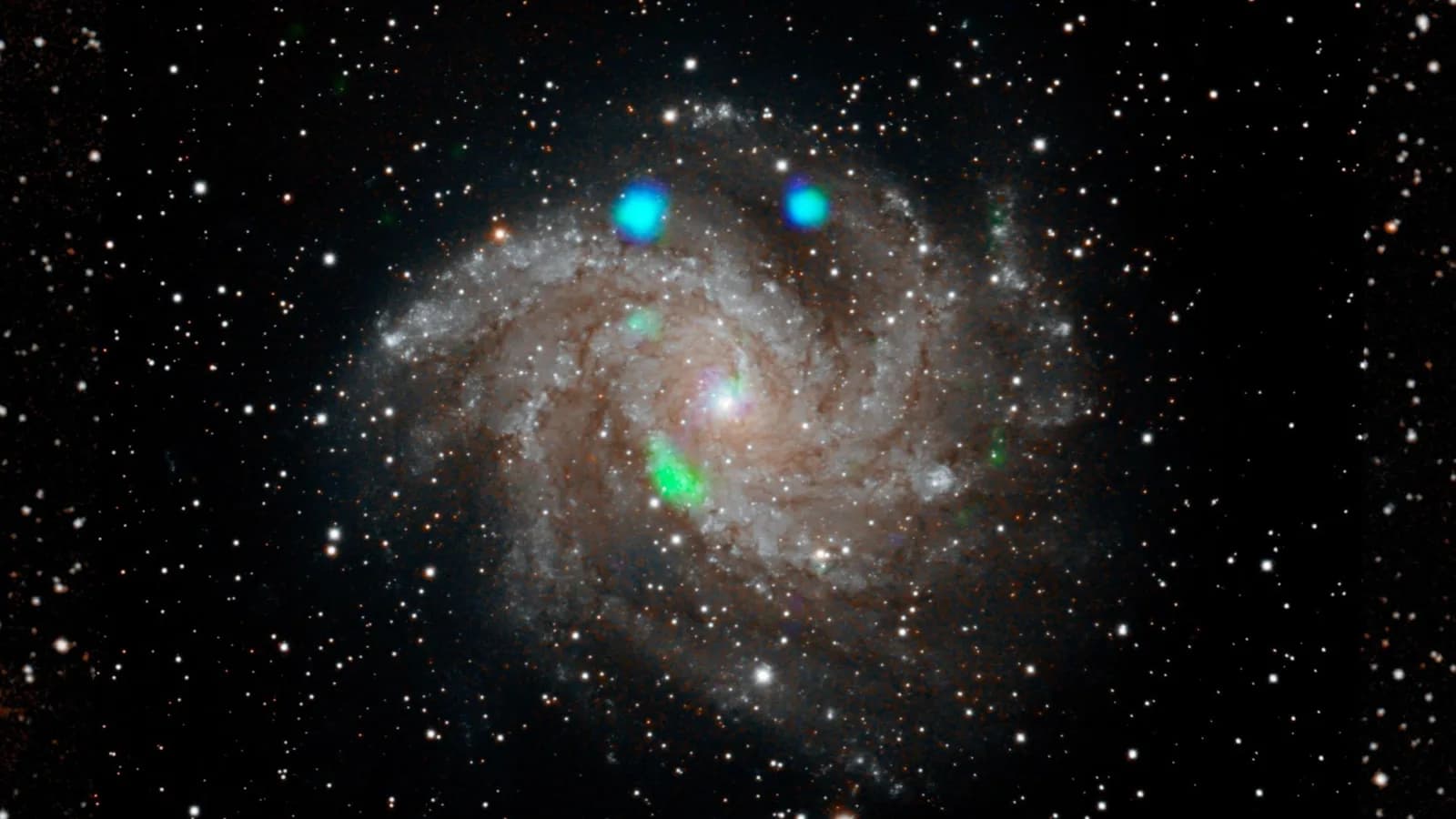
Physicists at the University of Southampton in the UK and the Indian Institute of Technology Kanpur have proposed that the largely neglected ‘ghost’ particle called a right-handed neutrino could have been a dominant force in the universe right after the Big Bang and may have played an important role in how the universe shaped up to the way it is today.
Neutrinos by themselves are known as ghostly particles since they do not typically interact with anything. A neutrino released from our Sun could travel for an entire light year (5.9 trillion miles or 9.5 trillion kilometers) through matter before striking any atom.
The Standard Model of Particle Physics suggests that neutrinos should be massless. Yet, they exist in three different types – electron, muon, and tau- each differentiated only by differences in their mass. Like other particles, neutrinos have their own spins, which scientists use to define them as either left-handed or right-handed. But every neutrino scientists have detected so far has been a left-handed one.
What are right-handed neutrinos?
Right-handed neutrinos are hypothetical particles with no electric charge and are thought to be heavier than their left-handed counterparts. While they do not feel the weak nuclear force, right-handed neutrinos likely interact with the left-handed neutrinos, which might explain why the latter have differences in their mass.
Quantum physicists use a theoretical framework called the seesaw mechanism to explain this. According to this framework, ordinary neutrinos carry traces of the right-handed neutrinos, which give them mass.
The mass of the right-handed neutrino and the trace are inversely related. So a heavier right-handed neutrino leaves a fainter trace and makes the ordinary neutrino lighter. This is much like a playground seesaw, where the ends move in opposite directions.
The role after the Big Bang
When the Big Bang occurred, matter and antimatter were generated in equal amounts. Their interactions should have annihilated everything and the universe would not be what we see it as today.
However, according to Rishav Roshan, a theoretical physicist at the University of Southampton, UK, right-handed neutrinos played a crucial role in preventing this from happening.
Working with Sudipta Show, a physicist at IIT Kanpur, Roshan suggests that the heaviest neutrino was 100 trillion times heavier than a proton and would have zipped at nearly light speed after the Big Bang. After losing some energy, it would have spread out and moved to weaker wavelengths as the universe expanded.
The cooling cosmos would have slowed the neutrino and locked its energy into mass, increasing its share of cosmic energy. The particle would have remained dominant until it decayed into other particles. Such a universe dominated by a heavy neutrino would have expanded faster, but its interaction would have only begun only after it outpaced the expansion of space.
In this scenario, the decay neutrinos would leave behind an excess of leptons that formed the matter that we see in the universe today. The researchers suggest that a lighter right-handed neutrino about 100 billion times as heavy as a proton could have been involved in the process.
However, since it is not possible to generate something this big in a particle accelerator, the researchers plan to look for the signs of its existence in gravitational waves.
The research findings were published in the journal Physical Review Letters.
Source: https://interestingengineering.com/science/right-handed-neutrinos-universe-big-bang
Related articles