NEURA’s 20% lighter humanoid robot with touch and force sensing moves toward production
NEURA Robotics has unveiled 4NE1 Gen 4, a humanoid robot designed for serial production that...
This story was prepared automatically by software.
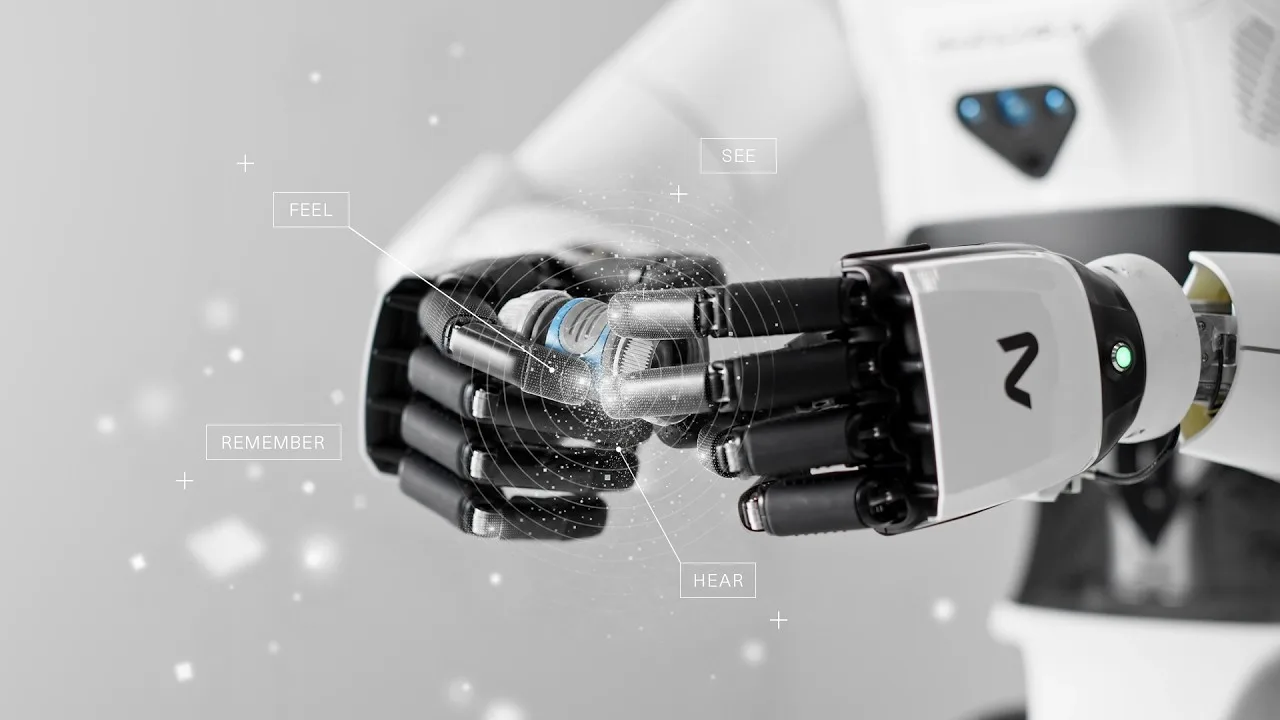
NEURA Robotics has unveiled 4NE1 Gen 4, a humanoid robot designed for serial production that is 20 percent lighter than its predecessor.
The robot features a slimmer design, a black textile outer skin, advanced motion control, and Neuron AI, the company’s foundation model for Physical AI.
The launch coincides with the opening of the TUM RoboGym, a joint research and training center NEURA and the Technical University of Munich (TUM) established near Munich Airport.
The 2,300-square-meter facility will train robots for practical tasks using real-world data, human demonstrations, and simulation.
4NE1 gains intelligence
4NE1 Gen 4 is a humanoid robot designed for serial production that is 20 percent lighter than its predecessor. The robot features a slimmer body, a black textile outer skin, advanced motion control, and Neuron AI, the company’s foundation model for Physical AI.
The 4NE1 Gen 4 represents the latest generation of NEURA’s humanoid robot platform. Its redesigned body is slimmer and lighter, while its black textile outer skin provides a different exterior finish from the previous generation.
The robot incorporates advanced hands for more precise gripping and Smart Limbs, which allow individual limbs to respond independently to their surroundings. According to NEURA, these features are intended to help the robot react quickly and move more fluidly.
At the core of the system is Neuron AI, NEURA’s Perception-Language-Action model for Physical AI. The model translates the robot’s perceptions into movements, using inputs that include vision, touch, force, sound, and the robot’s internal state.
These capabilities are intended to help robots handle tasks that require more than visual recognition. For example, a robot may need to determine whether a fastener has clicked into place while assembling a component.
Neuron AI is trained using real-world robot data, human demonstrations, and simulation. Through NEURA’s Neuraverse platform, skills learned by one connected robot can be shared with others in the network.
The company is preparing 4NE1 Gen 4 for serial production. The robot is already operating at NEURA Gyms, where companies can train and test practical applications.
4NE1 Gen 4 is already making its mark on the world stage.
Today, we unveiled the next generation of our humanoid robot on two major stages.
First, at the opening of the TUM RoboGym powered by NEURA in Munich, built in collaboration with the Technical University of Munich… pic.twitter.com/ljBlmHQTU7
— NEURA Robotics (@NEURARobotics) October 22, 2026
Training smarter robots
The TUM RoboGym provides a shared environment where researchers and companies can develop robotic capabilities for manufacturing, logistics, agriculture, healthcare, and other industries.
Companies provide specific tasks and process knowledge, while researchers investigate how robots can learn them faster and perform them more reliably. Training activities began in September, with participants from more than ten industries, including automotive, pharmaceuticals, medical technology, packaging, logistics, agriculture, and care.
Demonstrations involve tasks such as handling cardboard boxes, filling bottles, and loading and unloading wooden components. Companies can use the facility to evaluate robot systems, identify training requirements, and assess applications before expanding their deployment.
The training infrastructure combines three approaches. Real-world robot data captures movements, physical contact, and task outcomes through sensors. Human demonstrations use sensor-equipped suits, motion-capture systems, and teleoperation to record movements and interactions. Simulation expands this experience by exposing robots to additional situations and variations before testing their skills on physical machines.
According to NEURA, the center supports multiple robot types, including humanoids, mobile assistance robots, and cognitive robot arms.
NEURA and TUM have committed to an initial three-year partnership, with a combined investment of approximately €17 million. NEURA is contributing about €11 million, along with robotics infrastructure, computing resources, and operational support.
Munich is also the starting point for NEURA’s planned international network of training centers, with additional locations planned in Europe, the United States, and China. NEURA is also developing another German facility with RWTH Aachen.
Related articles