
NVIDIA Vera CPUs land at Los Alamos to power three new future supercomputers
Los Alamos National Laboratory has received its first NVIDIA Vera CPU systems, installing them inside...
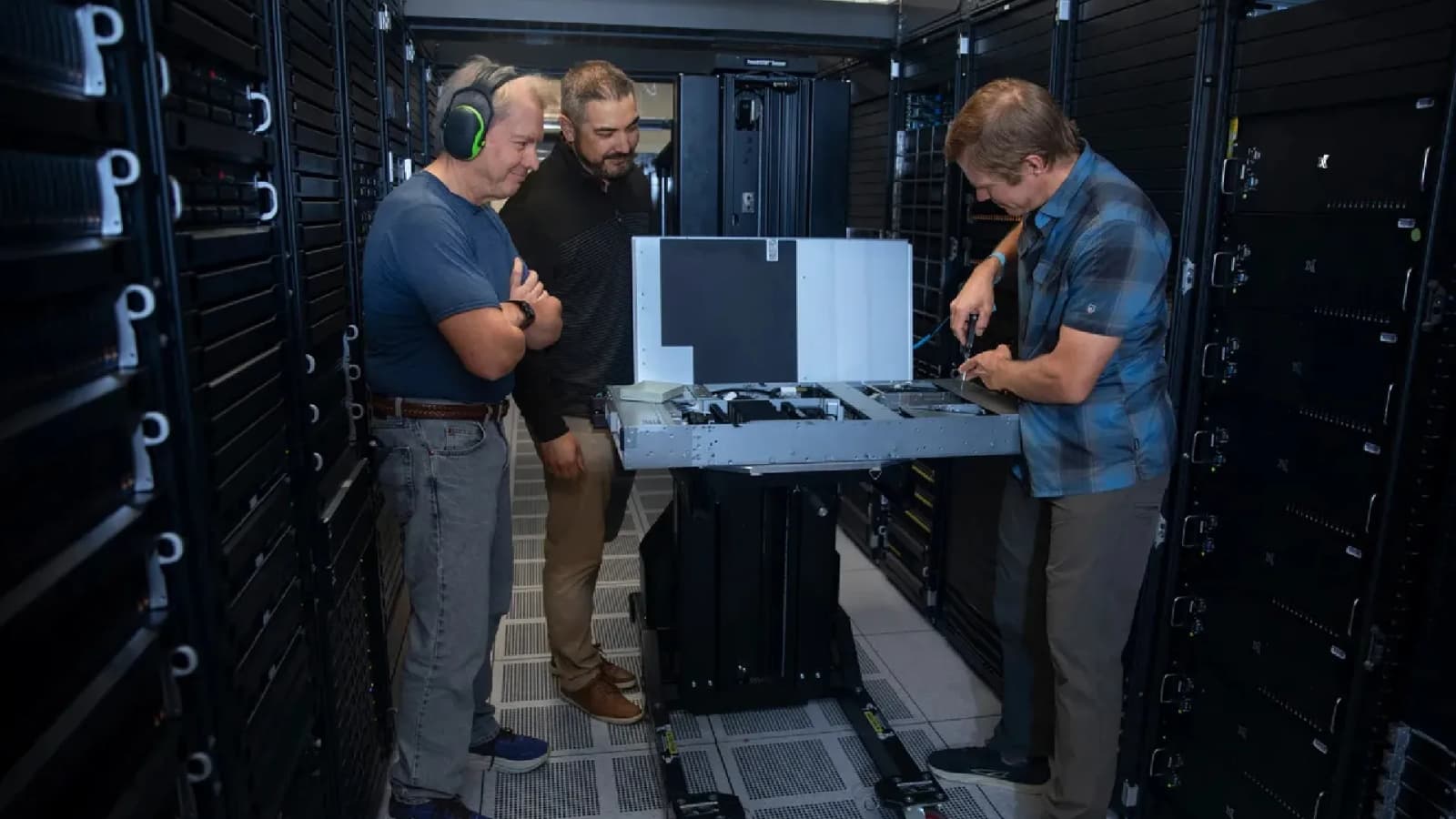
Los Alamos National Laboratory has received its first NVIDIA Vera CPU systems, installing them inside the lab’s Darwin testbed for early performance testing. The deployment marks a milestone in a long-running codesign partnership between the lab and NVIDIA on high-performance CPU technology.
Gary Grider, senior director for computing technology at Los Alamos, said the lab will be among the first institutions anywhere to receive Vera CPU technology through its ongoing collaboration with NVIDIA.
Inside the new hardware
The new system is an air-cooled MGX Vera CPU node, combining two Vera CPUs, each carrying 88 high-bandwidth Olympus cores, inside a two-socket server. The two CPUs connect through NVIDIA’s high-bandwidth NVLink Chip-to-Chip interface.
The deployment builds on more than a decade of hardware and software codesign work between the two organizations, following the earlier success of the Grace CPU, which currently powers the lab’s Venado supercomputer. That system was built jointly by NVIDIA and HPE.
Powering three new systems
The Vera CPU node now installed at Darwin is a precursor to three upcoming supercomputers at Los Alamos, named Mission, Vision and Veritas, all of which will run on a combination of Vera CPUs and NVIDIA Rubin GPUs. Mission and Veritas will specifically combine Vera CPU partitions with NVIDIA’s Vera Rubin NVL-4 and NVL-72 partitions to support complex modeling, simulation and agentic AI workloads.
The hardware arrived at Los Alamos in August, and the lab’s Darwin team, supported by the National Nuclear Security Administration’s Advanced Simulation and Computing Program, quickly installed and configured the system. Performance and stability testing followed shortly after the software stack was deployed, and the system is now actively supporting benchmarking and application readiness work.
Built for unique workloads
Mission stands out as the first NNSA Advanced Technology System built from several purpose-built technology partitions rather than one general-purpose architecture. The system will combine three distinct partitions, Ranger, which runs on Vera CPUs, Sandstone, built on Vera Rubin NVL-4 hardware, and Starlight, built on Vera Rubin NVL-72 hardware, tied together through shared high-performance storage designed for AI-driven modeling and simulation work. Vera CPU nodes are also planned for the separate Veritas system.
Galen Shipman, chief architect of advanced technology systems at Los Alamos, said the Vera CPU will ultimately support the lab’s most complex 3D multi-physics simulations once deployed in Mission’s Ranger partition. NVIDIA vice president Ian Buck said the partnership positions Vera CPUs and Rubin GPUs to help combine agentic AI with the lab’s most demanding modeling and simulation workloads going forward.
The full Ranger partition is expected to arrive at Los Alamos in 2027 alongside the Sandstone partition, while the Mission-Starlight and Vision-Transformer partitions could be delivered as early as late 2026.
Related articles

New center bids to supercharge nuclear isotope production for deep-space missions
Canada is moving to expand its role in supplying nuclear isotopes that could power spacecraft...
Schneider tests quantum chip that improves home energy forecasting by up to 41%
Australian government-backed Silicon Quantum Computing (SQC), whose investors include telecom giant Telstra and Commonwealth Bank,...
Digital twin tech from US, Korea could predict toxic ammonia leaks on new ships
The US, South Korea and Germany have recently joined forces in order to develop a...

Mapped: The World’s Digital Leaders in 2026
Which economies are the most digitally connected? See how 159 economies rank in the ITU’s 2026 ICT Development Index.

Breaking up (with Elon Musk) is hard to do
In a throwback to MySpace-style internet drama, Shivon Zilis announced that she and the father of four of her children, Elon Musk, had broken up on X.

OpenAI’s Dot agent is enterprise software that can also order your dinner
It's a tale as old as last week: OpenAI's new agent platform, called Dots, is full of cute little guys who can do your bidding.