
Old smartphone, new legs: UCLA’s open-source PhoneBot walks on a $400 robot body
Old Android phones gathering dust in drawers could soon have a second career as the...
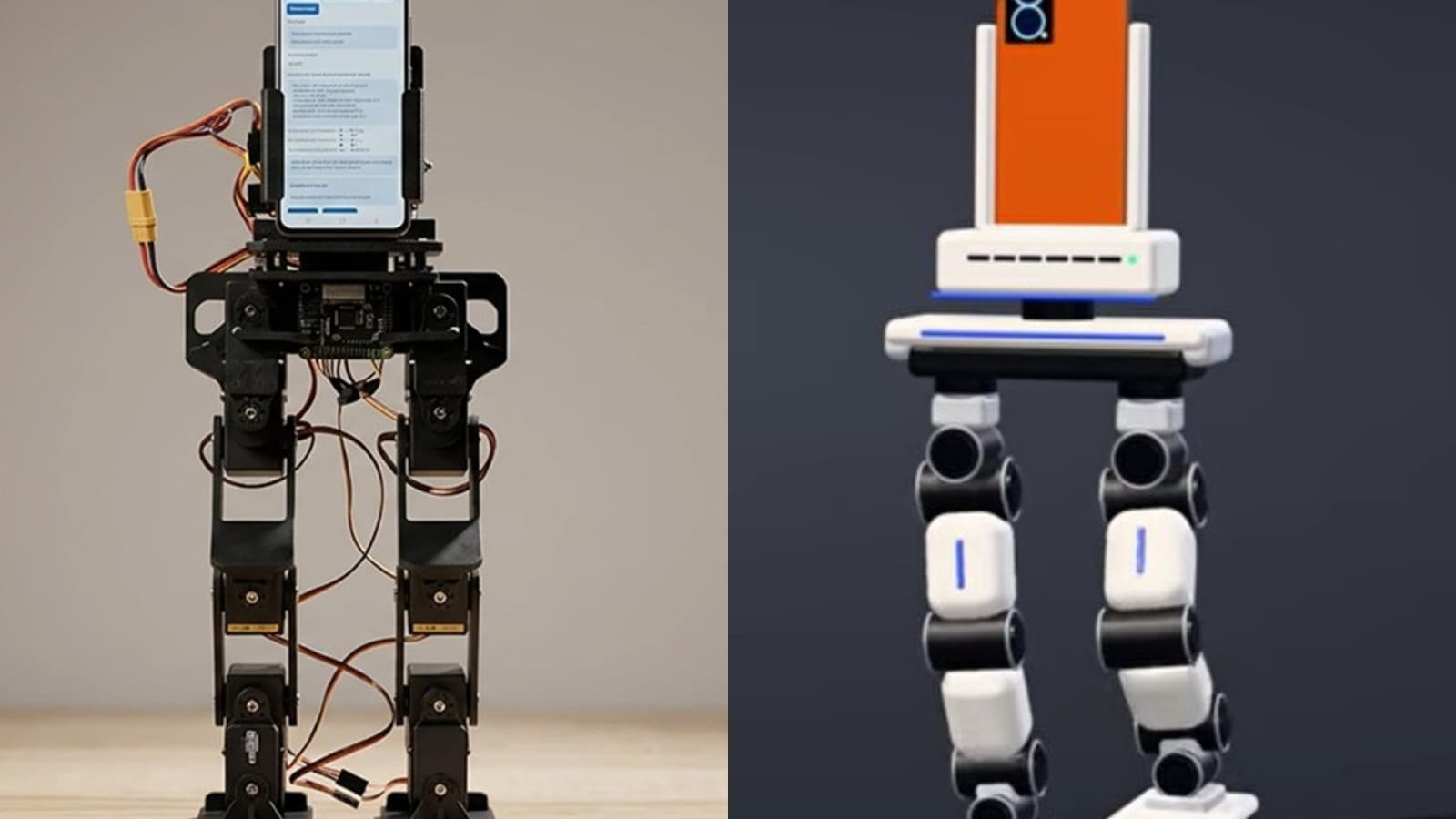
Old Android phones gathering dust in drawers could soon have a second career as the brains of a walking robot, thanks to an open-source project from UCLA.
The robot, called PhoneBot, stands about 19 inches tall and weighs less than 4 pounds. Researchers at UCLA’s Robotics and Mechanisms Laboratory mounted a commodity smartphone as its torso and used the phone’s camera, motion sensors, processor and wireless connection for vision, balance sensing and movement calculations.
$400 body for any phone
The body, motors and supporting electronics cost around $400, leaving the phone as the main variable. The electronics are kept simple on purpose, so swapping one phone for another requires no rewiring.
PhoneBot uses 13 low-cost DYNAMIXEL servo motors: six in each leg, with joints at the hip, knee and ankle, plus one that spins the upper body. That torso joint lets the phone’s camera sweep from side to side while the feet stay planted, which helps when tracking a person. A small computer in the lower body receives commands from the phone over Wi-Fi and converts them into motor positions, so the phone never has to be wired to the hardware.
Four phones, four passes
The team tested four Android devices, including a 2017 Honor 9 and two inexpensive off-the-shelf models priced between $50 and $80. All four handled the core jobs of walking control, motion detection and basic vision. The older Honor lacked the Google services needed for onboard mapping.
Taught to walk in simulation
The walking controller is a neural network trained entirely in simulation with reinforcement learning. The virtual robot earned rewards for staying upright, alternating feet and holding speed, and lost points for high torque, harsh braking and loading one foot. Real motors have limited strength and speed, so those constraints were built into the simulation.
Early results were uneven, with one foot doing most of the work. Adding mirrored samples that swapped left and right produced a more even stride, less variation between runs and better load sharing. The physical robot can walk in any direction on level floors at up to half a meter per second (about 1.6 feet per second) and push itself upright after a fall.
Everything runs on the phone
An Android app makes decisions in real time. TensorFlow Lite runs the walking and recovery routines about 50 times a second using the phone’s built-in sensors. The camera tracks people and their positions, and on supported phones it can also perform visual mapping for telepresence and photography.
Speech recognition and language processing still run on a nearby laptop, though the team could move them onto the phone as models improve.
What it cannot do yet
PhoneBot has no arms, so it cannot pick up or carry objects. It has been tested only on flat ground, and stairs, slopes and uneven surfaces remain works in progress. Limited motor power also caps the weight it can carry and how fast it can move.
The hardware and software are fully open, available to students, research labs and hobbyists who want to work with bipedal robots without paying for pricey specialized gear or sensors.
Related articles

Epic shifts to ‘AI-accelerated development’ for upcoming Disney game
Epic Games plans to use AI to generate code and art for an unannounced Disney game, which is now delayed from its original March release window, according to a report from Bloomberg.

Here are all the new HomePod Mini 2 colors
Apple's HomePod Mini 2 is here, and we've gotten a close-up look at the second-gen smart speaker.

DLSS 5 gets toned down for its Hogwarts Legacy debut next month
When Nvidia originally showed off DLSS 5 earlier this year, the technology immediately got branded as gen AI for video games. To gamers, Nvidia had lost the plot.

Apple’s HomePod Mini 2 is available to preorder
After nearly six years, Apple debuted a new, improved HomePod Mini. The $149 HomePod Mini 2 will launch on Friday, October 30th, and you can place a preorder now through Apple.
New two-phase system for chip cooling could reduce short-circuit risks
Researchers at Peking University in China have developed an embedded cooling system that uses an...
Paper mill waste could become key material for cheaper sodium-ion batteries
Researchers may have found an unexpected battery material solution within the discarded wood industry byproduct....