
Robot learns complex 12-step tasks in 5 minutes, replans when things go wrong
A robot learned to complete complex tasks involving up to 12 steps after receiving just...
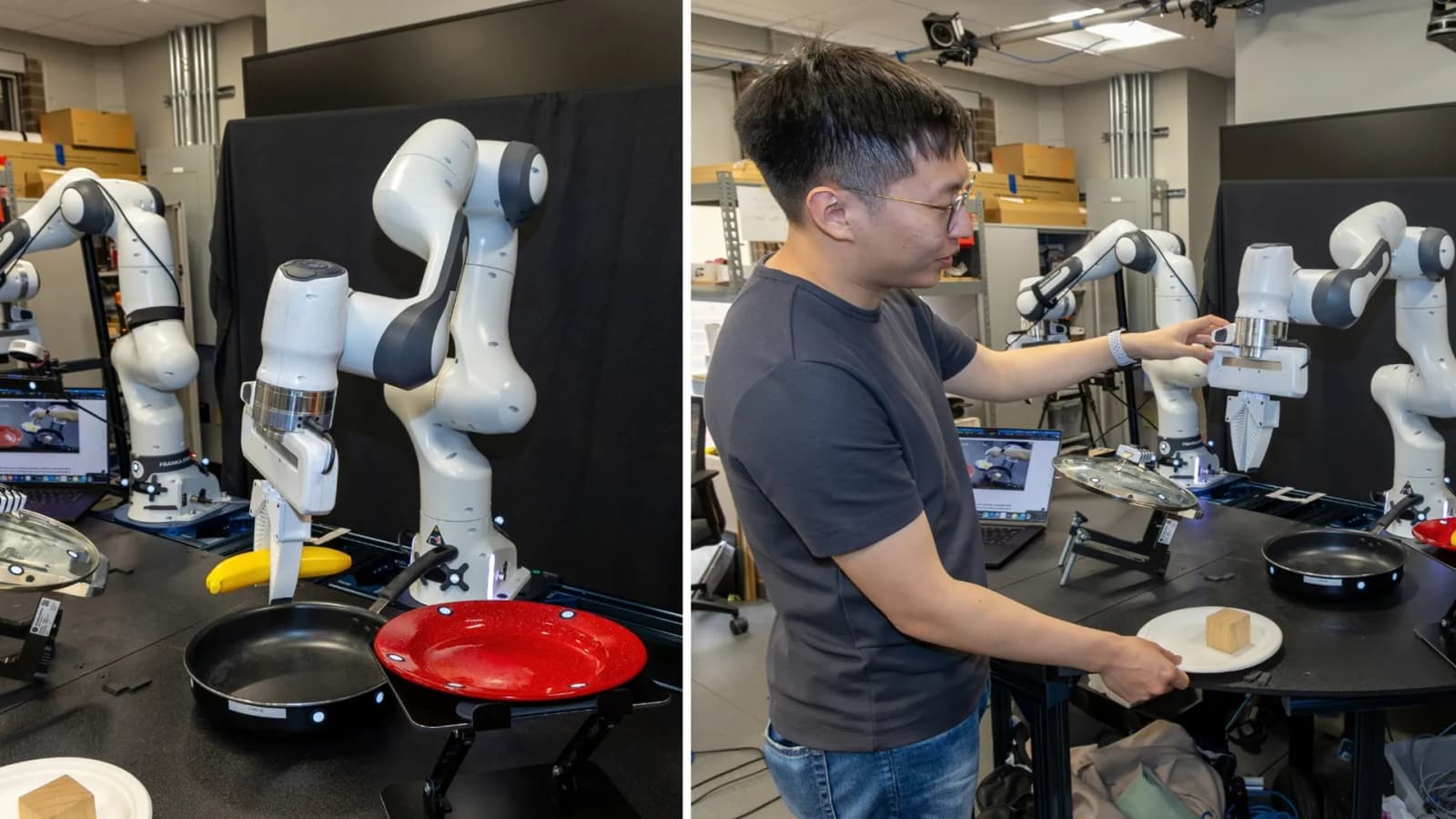
A robot learned to complete complex tasks involving up to 12 steps after receiving just five minutes of video demonstrations, while also adapting when people interrupted its actions or individual attempts failed.
Researchers at the University of Pennsylvania developed the system, called SymSkill, to help robots combine simple skills into longer tasks without requiring demonstrations of every possible sequence. The approach was tested both in simulation and on a physical robotic arm.
Instead of relying on increasingly large training datasets, SymSkill combines symbolic planning with a physics-based approach called dynamical systems. Together, they allow the robot to decide what actions are needed and determine how to physically carry them out.
The researchers demonstrated the system on tasks such as moving a banana from a covered pan onto a plate. The robot had to remove the lid, pick up the banana and place it on the plate, while adjusting its actions if a person interfered or an attempt failed.
Five minutes teaches sequences
SymSkill separates robot learning into two connected levels. At the higher level, symbolic planning represents objects, actions and their relationships, allowing the robot to determine the sequence needed to reach a goal.
The second level controls movement. A dynamical systems approach determines how the robotic arm should execute individual actions and allows it to react when its environment changes, such as when a person gets in its way.
Crucially, the system learned its basic capabilities from only five minutes of demonstrations. Once individual skills had been learned, SymSkill could recombine them into longer sequences rather than requiring researchers to demonstrate each complete task separately.
“What makes this exciting is that the robot doesn’t have to experience every possible version of a task before it can perform it,” said lead author Yifei Simon Shao, a doctoral student in Nadia Figueroa’s lab at Penn Engineering.
“Once it has learned all basic skills and understands how they relate to the world around it, it can start putting those skills together in ways it hasn’t seen before. That’s an important step toward robots that can actually operate in the unpredictable and highly variable environments of everyday life.”
Robots recover from failures
The ability to respond when a task goes wrong is important for robots operating around people. A machine following only a fixed sequence could fail if an object is moved or someone blocks its path.
SymSkill instead allows the robot to re-plan and continue. If a person interferes or one step fails, the system can adjust its plan and retry rather than requiring the entire task to be restarted.
The researchers demonstrated tasks containing as many as 12 steps without providing additional demonstrations for those longer sequences.
“We can make robots more capable without simply throwing more data at the problem,” said Figueroa, an assistant professor in mechanical engineering and applied mechanics at Penn Engineering.
Her lab is also investigating how previously learned robot movements can be reused to reach new destinations. A separate approach called Gaussian Graph turns demonstrated movements into a map of possible paths through a workspace, allowing a robot to create routes it was never explicitly shown.
Researchers now plan to combine these approaches with language models so robots can better interpret human instructions. They are also exploring their use with dual-arm and humanoid robots and machines that can move through an environment while manipulating objects.
Related articles
Neuralink trains on 50,000 hours of brain data, hits 11.32-bit/s cursor record
Neuralink says its brain-computer interface has achieved a cursor-control record of 11.32 bits per second...

Meta open sources code to let you make Muse AI gadgets
Meta now lets you make your own Muse gadgets that feature the company's new AI agent with code that the company open sourced.

Apple will limit Mac disk access as AI agents ‘substantially’ increase risk
Apple will add new limits for "full disk access" on Mac in response to risks posed by AI agents, as reported earlier by TechCrunch.
New rice-sized GaN chip packs 3x more power, 20x better signals and dual functions
Northrop Grumman has unveiled a new gallium nitride chip aimed at handling demanding radio-frequency workloads...
Why safety will decide the future of humanoid robots
In this episode of Lexicon, we spoke with Rick Balzano, Vice President of Go-to-Market for...

New center bids to supercharge nuclear isotope production for deep-space missions
Canada is moving to expand its role in supplying nuclear isotopes that could power spacecraft...