
Robotic legs get muscle-like flexibility with a single 3D-printed plastic
University of Tokyo researchers have developed a life-size robotic leg system featuring 3D-printed structures inspired...
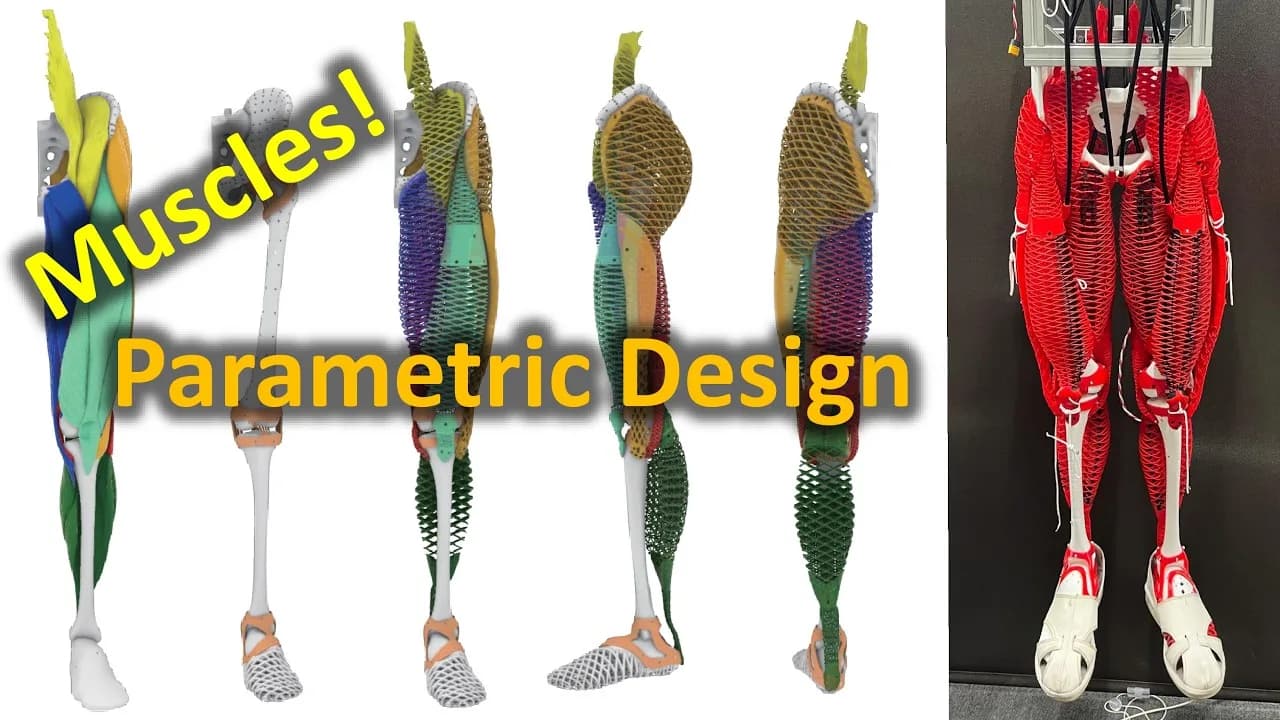
University of Tokyo researchers have developed a life-size robotic leg system featuring 3D-printed structures inspired by human muscles, tendons, and ligaments.
The design uses a single flexible plastic material, with different printed geometries giving each component distinct mechanical properties.
These structures provide muscle-like elasticity, tendon stiffness, ligament support, and cushioning in the feet, while electric motors and wires power the leg movements.
Although the prototype can demonstrate stepping with external support, achieving independent walking remains a challenge for future development.
Flexible robotic anatomy
The life-size robotic leg system uses 3D-printed flexible structures to replicate some of the mechanical properties of human muscles, tendons, and ligaments. The system uses a single thermoplastic polyurethane (TPU) material, with variations in printed geometry giving different structures distinct levels of flexibility, stiffness, and mechanical support.
Rather than manufacturing each component from a different material, the researchers use adjustable printing patterns to create muscle-like elastic structures, stiffer tendons, joint-constraining ligaments, and cushioned foot soles. The approach could simplify the design and fabrication of musculoskeletal robots by integrating different mechanical properties into a single material system.
According to the team, the project explored how the mechanical behavior of robotic body components can be controlled through their geometry. The researchers vary parameters such as lattice density and strut thickness to control how individual TPU structures respond to mechanical forces. These adjustments allow the same material to produce components with different mechanical characteristics. Softer printed regions behave like elastic muscles, while denser or thicker structures provide the greater stiffness associated with tendons.
The team also uses patterned structures to create ligament-like components that constrain movement around the hip, knee, and ankle joints. These structures provide mechanical limits without relying on conventional bearings. The foot soles incorporate cushioning properties, adding another function to the same material-based manufacturing approach.
By adjusting the geometry, the researchers can transition between softer and stiffer regions within a printed structure. This reduces the need to develop and manufacture separate material systems for every component of a robotic musculoskeletal structure. However, the TPU structures do not actively contract like biological muscles. Instead, they deform when external forces are applied, providing passive elasticity and mechanical compliance.
Cable-driven robotic legs
The robotic legs use an electric actuation system comprising motors and pulleys mounted on the pelvic frame. These motors pull wires routed through Bowden cables to the printed muscle structures, producing the movements required to operate the legs.
Placing the motors higher on the body helps reduce the weight carried by the lower limbs. This is relevant to legged robot design, where additional mass in the legs can increase the mechanical demands of movement.
The combination of motor-driven cables and flexible printed structures separates the active and passive functions of the system. Motors generate the forces needed for movement, while the TPU components provide elasticity, stiffness, and structural constraints. The arrangement allows the researchers to investigate how different compliant structures interact during coordinated leg movements.
In the demonstrated stepping experiments, the robotic system uses an external suspension that supports part of its body weight and limits rotation of the torso. The legs follow preset wire-length commands, allowing the researchers to examine coordinated stepping movements without first having to solve the more complex problem of maintaining balance.
Consequently, the demonstrations do not establish that the robot can walk independently or maintain its balance without external assistance.
Manufacturing and control also present challenges. Individual printed muscle structures require approximately 20–40 hours to produce. Cable friction and changes in the material’s mechanical response under repeated loading further complicate the control process. The researchers’ approach offers a shared fabrication method for producing different compliant components, but integrating them into a reliable, independently walking robotic system remains a substantial engineering challenge.
The immediate contribution is a parametric design and manufacturing approach that allows multiple musculoskeletal structures to be produced from one flexible material. It provides a way to build different mechanical properties into a robot’s body rather than relying entirely on conventional rigid components and separate materials.
Get the latest news delivered to your inbox.
Related articles