
Scientists crack hidden solar cell leak that could boost efficiency to near 43%
Solar cells could potentially generate more electricity by controlling not only how they absorb sunlight,...
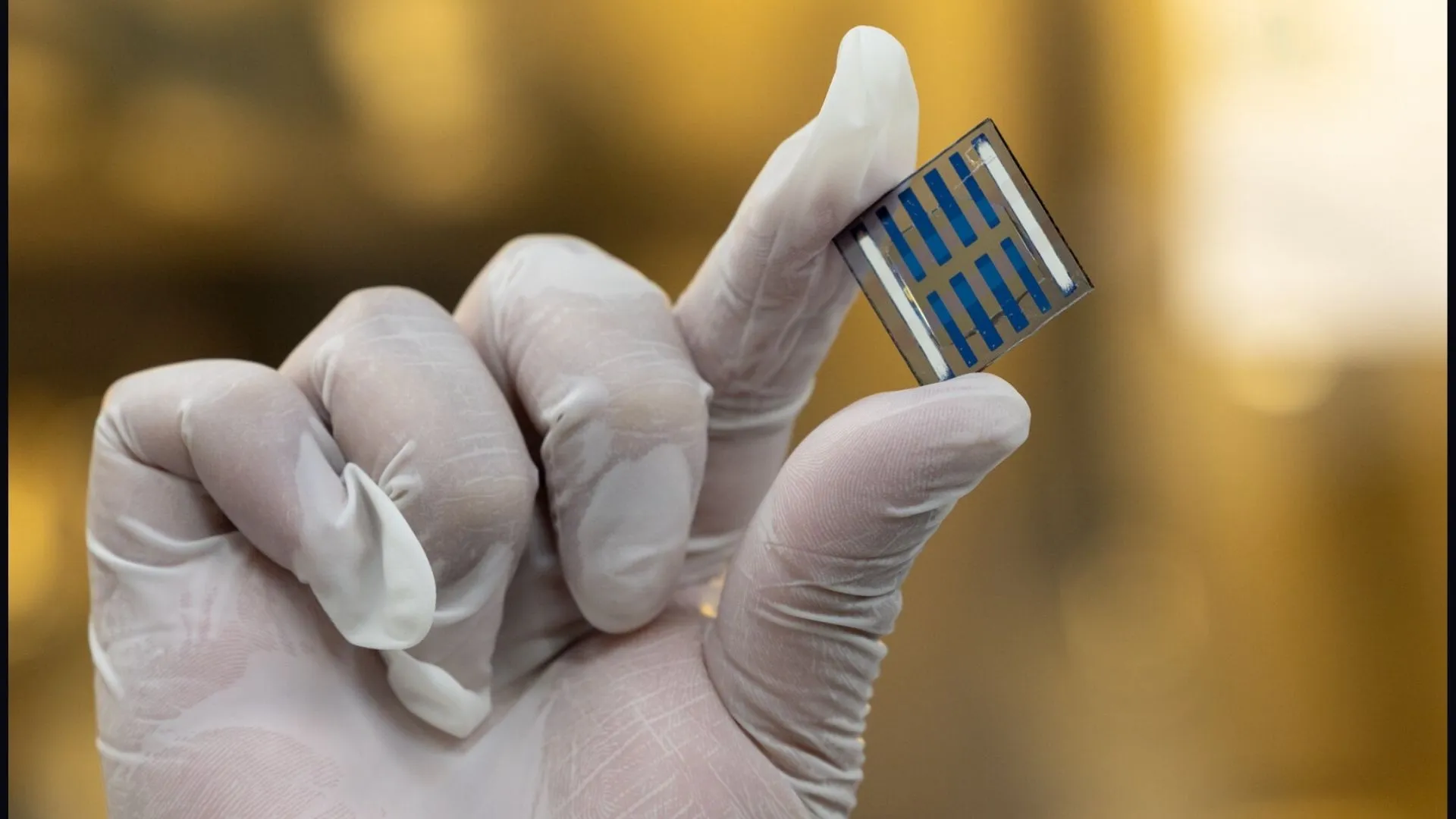
Solar cells could potentially generate more electricity by controlling not only how they absorb sunlight, but also the directions in which they emit light. Researchers at the Institute of Photonic Sciences (ICFO) in Barcelona have experimentally demonstrated a method for reducing one source of energy loss in solar cells by narrowing the angular range over which they emit photons.
The approach, published in Energy & Environmental Science, could offer a route to surpass the conventional theoretical efficiency limit for single-junction solar cells. The work focuses on a loss mechanism known as Boltzmann loss, which occurs because a material that absorbs light can also emit it.
Why the direction of emitted light matters
A solar cell receives sunlight from a relatively narrow range of directions. The Sun occupies only a small area of the sky, meaning incoming sunlight reaches a solar cell within a narrow angular cone.
Photons generated inside the solar cell, however, can normally be emitted over a much wider range of directions. According to the ICFO researchers, this mismatch between the narrow incoming cone and broad emission cone reduces the amount of useful work that can ultimately be extracted from the device.
The researchers sought to reduce that loss by making the solar cell more selective about the directions in which it can emit light.
The team, led by ICFO and UPC Professor Jordi Martorell, included Dr. Francisco Bernal Texca, Chiara Cortese, Dr. Mariia Kramarenko and Dr. Quan Liu. They used an inverted organic solar cell based on the PM6:Y6 material blend and transformed it into an optical cavity.
The resulting structure inhibited photon emission at large angles, effectively narrowing the cell’s emission cone.
An optical cavity changes how photons escape
The researchers achieved the effect using a silver-based front electrode combined with a layered structure and a second silver electrode at the back of the cell.
The metal front electrode provides high reflectivity across a broad range of angles for emitted light. Together with the rear electrode and surrounding layers, it forms an optical cavity.
The cavity performs two functions at once: it suppresses light emission at wider angles while allowing incoming sunlight to enter efficiently from the direction it arrives. That allows the angular distribution of emitted light to more closely resemble the angular distribution of incoming sunlight.
Importantly, the researchers say the approach does not require additional fabrication complexity compared with many other strategies being explored to push photovoltaic efficiency beyond conventional limits.
Could this surpass the Shockley–Queisser limit?
The work addresses the well-known Shockley–Queisser limit, which describes the theoretical efficiency ceiling for a conventional single-junction solar cell under the assumptions of the model.
ICFO puts that limit at 33.16 percent. The researchers say that if the emission cone could be narrowed sufficiently to better match the absorption cone of sunlight, efficiencies approaching 43 percent could theoretically become possible.
That does not mean the researchers have produced a 43-percent-efficient solar cell. The study demonstrates the optical strategy for reducing the relevant loss mechanism in an organic photovoltaic device.
“Our study is a significant step forward in the solar energy conversion field as it opens a completely unexplored route to surpass the Shockley–Queisser limit,” said Dr. Francisco Bernal Texca, first author of the study.
The researchers also emphasize that the underlying principle is not restricted to organic photovoltaics. While the experiment was conducted using an organic solar cell, Martorell said the concept could, in principle, be applied across different photovoltaic technologies.
If the approach can be translated into higher-performing practical devices, controlling the direction of photon emission could become another tool for squeezing more electricity from the same amount of incoming sunlight.
Higher photovoltaic efficiency could also reduce the land and materials needed for a given amount of solar generation while lowering the cost per watt of electricity produced, according to the researchers.
Source: https://interestingengineering.com/energy/solar-cells-efficiency-light-emission
Related articles

Nobel Prize in Chemistry awarded to two scientists for providing solution to a century-old mystery
The Nobel Prize in Chemistry 2026 awarded to two scientists for providing a solution to...
Smart US tool could cut quantum device tuning time in hunt for elusive dark matter
Scientists in the US have been developing a smart agent that could automatically tune sensitive...
‘Camera’ captures atomic shockwaves before quantum bit forms inside a crystal
Scientists have recorded what happens inside a crystal in the split second before a quantum...
Microscopic nuclear fuel particles from Chernobyl still intact after 40 years
Forty years after explosions scattered radioactive debris from Chernobyl’s reactor across the surrounding landscape, some...
Wave-shaped building walls and roofs can cut hurricane wind pressure by up to 60%: study
Buildings with wave-shaped exterior walls and roofs can withstand hurricane-force winds far better than conventional...

Heat first, compress later: New fusion strategy flips the script to reach ignition
A tiny amount of tungsten inside fusion plasma could roughly double the pressure needed to...