
Microscopic nuclear fuel particles from Chernobyl still intact after 40 years
Forty years after explosions scattered radioactive debris from Chernobyl’s reactor across the surrounding landscape, some...
Forty years after explosions scattered radioactive debris from Chernobyl’s reactor across the surrounding landscape, some microscopic fragments still preserve the crystal structure of their original nuclear fuel.
A study of six particles from Ukraine found that the material remained more chemically stable than researchers had expected.
Scientists at Germany’s Leibniz University Hannover and Helmholtz-Zentrum Dresden-Rossendorf (HZDR) examined the fragments using synchrotron X-ray diffraction in Grenoble, France.
Their findings help explain how these remnants retain radioactive substances, although the small sample cannot establish conditions across the contaminated region.
Microscopic remnants of the disaster
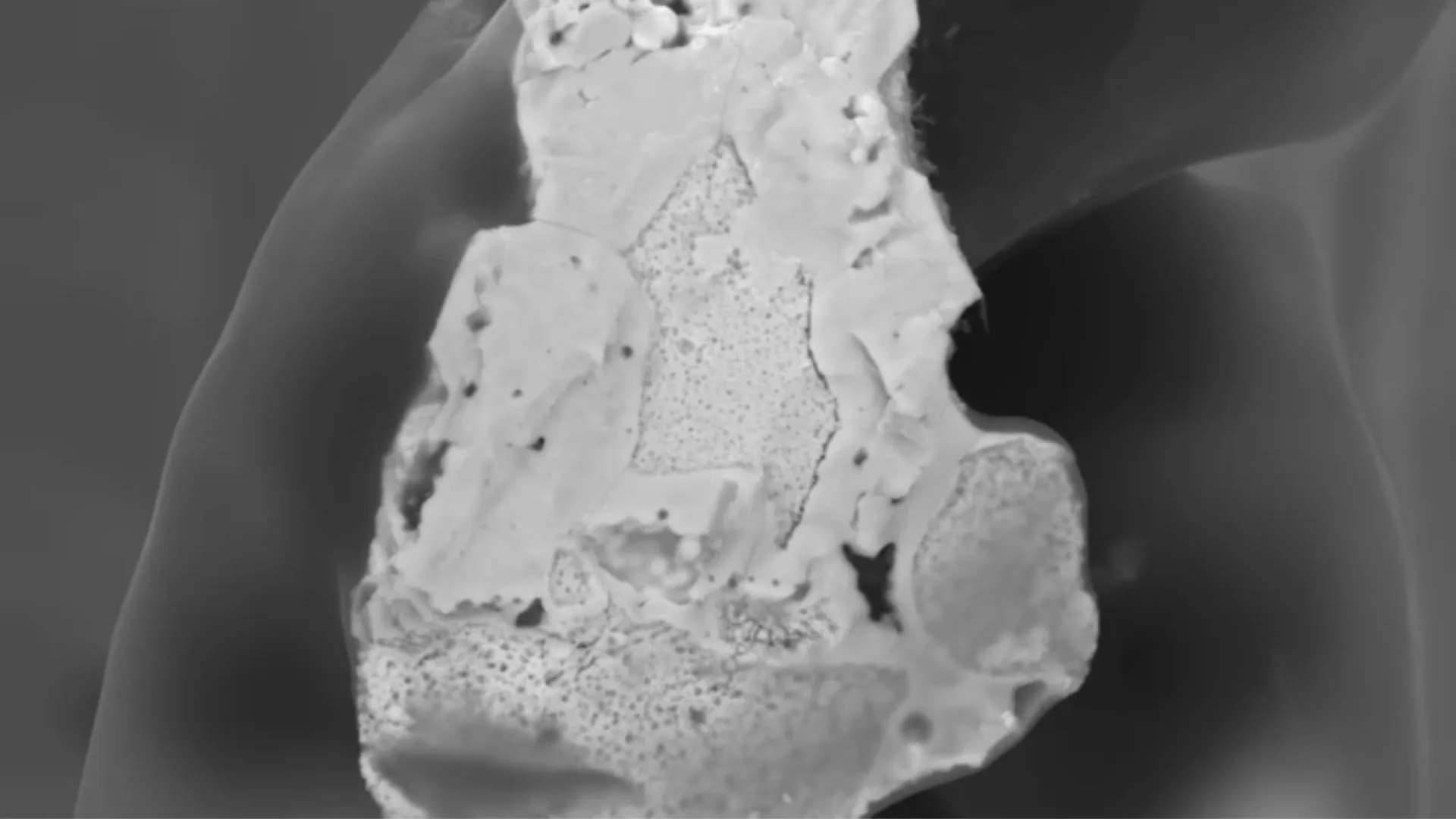
The radioactive “hot particles” described in the research measure just 8 to 50 micrometers. Despite their size, they remain highly radioactive four decades after the 1986 accident.
Researchers distinguished three broad classes. Some particles remain chemically and physically similar to uranium dioxide, the reactor’s nuclear fuel. Others are partly or fully enclosed in zirconium, or fused with the metal that originally surrounded the fuel.
Those combined particles formed when intense reactor temperatures melted the fuel and bonded it to its protective zirconium layer.
A third class emerged as the reactor’s graphite moderator burned. The moderator normally slowed neutrons to sustain the chain reaction, but during the disaster, its fire lasted ten days.
The fuel oxidized into uranium compounds, including triuranium octoxide. This mechanically unstable material readily forms microscopic particles that wind can carry away, creating an inhalation hazard.
Hot particle from the 1986 reactor accident: the nuclear fuel particle is partially fused with zirconium oxide. (Image credit: Leibniz University Hannover)
X-rays reveal enduring fuel structures
Understanding why these fragments weather at different rates requires examining their internal structures.
The Hannover researchers isolated particles from Ukrainian soil samples and attached them to tungsten electrodes. Multiple confinement layers secured the radioactive samples for transport to Grenoble.
At the Rossendorf Beamline, HZDR crystallographer Dr. Christoph Hennig and colleagues rotated the particles inside a focused X-ray beam.
“Ultimately, we fully rotated the particles in an X-ray beam focused down to 100 micrometers, or roughly the thickness of a human hair. We measured each particle from 2,000 different angles to seamlessly capture all the reflections,” Hennig said.
The measurements identified different oxide phases within the samples. Crucially, the nuclear fuel’s crystal structure remained largely intact in the particles examined.
That stability helps keep fission products inside the fragments, potentially limiting their release into surrounding soil and water. The phase analysis also enabled researchers to estimate how quickly the particles release radioactive substances.
Six particles cannot define regional risks
The findings come with a significant limitation: the researchers examined only six particles collected from two locations.
“However, every single particle has a different structure, and our experiment only studied six such particles from two different locations,” warned Tobias Weissenborn, a physicist and doctoral candidate at Leibniz University Hannover.
Establishing broader patterns requires many more particles from additional locations. Even then, averages cannot capture every fragment’s behavior or establish universal health risks across the region.
Some more persistent particles can retain radionuclides longer and release them later, complicating assessments of contamination over time.
The results therefore provide no basis for lifting restrictions across the Chernobyl Exclusion Zone. Weissenborn and Hennig are already conducting follow-up experiments on highly radioactive transuranic phases within the disaster’s remnants.
Source: https://interestingengineering.com/science/chernobyl-nuclear-fuel-particles-remain-stable
Related articles

Wave-shaped building walls and roofs can cut hurricane wind pressure by up to 60%: study
Buildings with wave-shaped exterior walls and roofs can withstand hurricane-force winds far better than conventional...

Heat first, compress later: New fusion strategy flips the script to reach ignition
A tiny amount of tungsten inside fusion plasma could roughly double the pressure needed to...

Google’s power-hungry data centers crave nuclear energy
Google announced a new agreement to update six nuclear power plant sites across the US as the tech giant seeks to generate more electricity for its power-hungry data centers.
World’s largest neutrino telescope wins its creator the 2026 Nobel Prize in Physics
A Belgian-American particle physicist has won the 2026 Nobel Prize in Physics for his work...

7 of history’s deadliest plagues and the science behind their spread
Long before scientists could identify bacteria or sequence viruses, infectious diseases traveled with soldiers, merchants,...
Could Nazi Germany’s nuclear reactor work in 1945? The material gap explained
When the American forces in 1945 reached Nazi Germany’s final experimental nuclear reactor, the B8...