
World’s largest neutrino telescope wins its creator the 2026 Nobel Prize in Physics
A Belgian-American particle physicist has won the 2026 Nobel Prize in Physics for his work...
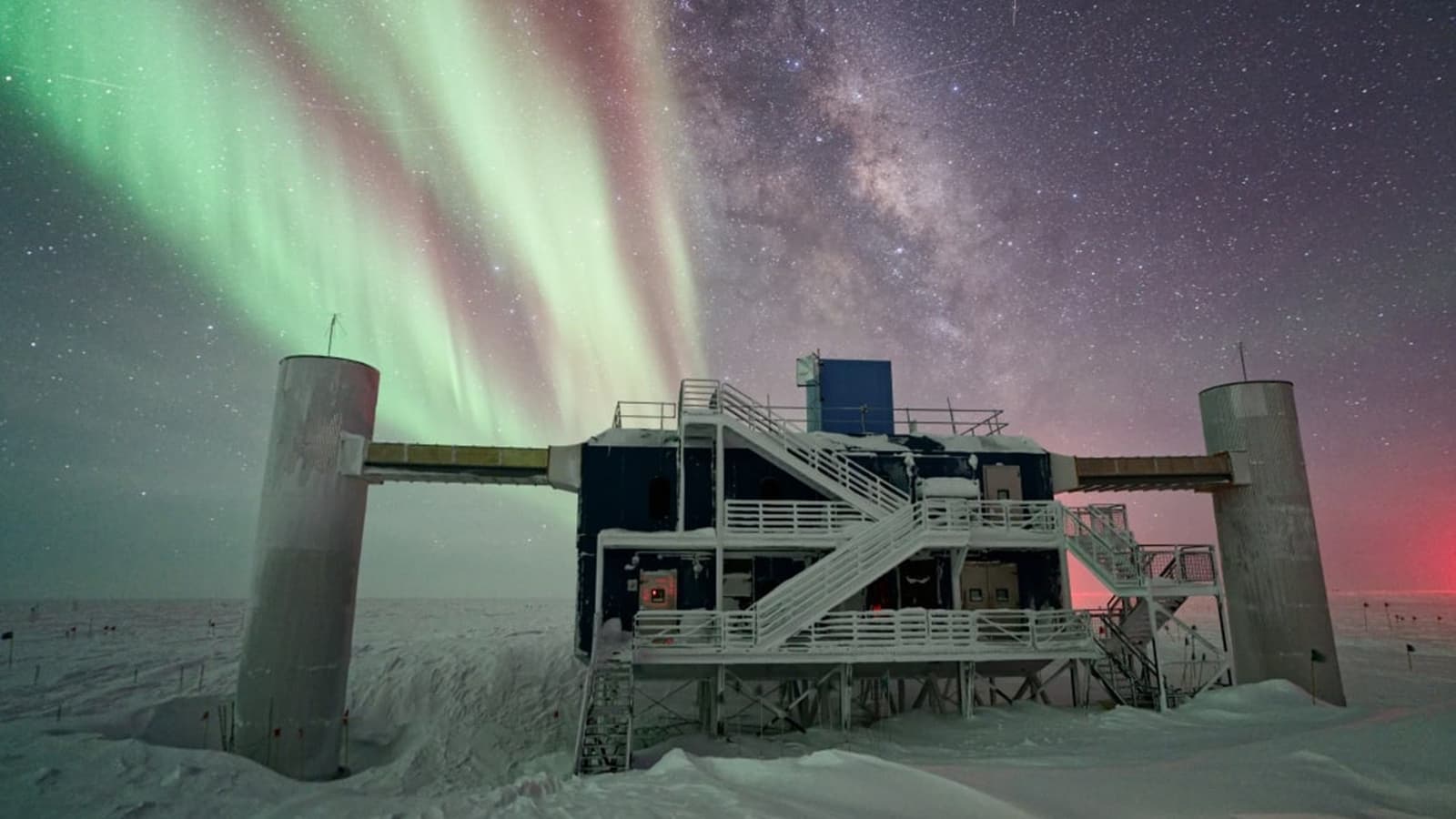
A Belgian-American particle physicist has won the 2026 Nobel Prize in Physics for his work on the world’s largest neutrino telescope that can detect ghost particles beneath the Antarctic ice.
The Royal Swedish Academy of Sciences awarded the 2026 Nobel Prize in Physics to Francis Halzen on Tuesday, October 6. Halzen is the Hilldale and Gregory Breit Distinguished Professor at the University of Wisconsin-Madison, and director of its Institute for Elementary Particle Physics.
The laureate is the principal investigator of IceCube, the world’s largest neutrino telescope. The unique observatory uses thousands of light sensors embedded in Antarctic ice to detect elusive particles known as neutrinos, often called “ghost particles.”
“Francis Halzen has led an international team of researchers and engineers who have provided us with a fantastic instrument,” Mark Pearce, chair of the Nobel Committee for Physics, pointed out. “His tenacity and scientific vision has paved the way for a new kind of astronomy.”
A giant telescope beneath Antarctic ice
Neutrinos are tiny elementary particles with no electrical charge. They’re referred to as ghost particles, since they rarely interact with matter. They can travel across enormous cosmic distances almost completely undisturbed. This allows scientists to investigate some of the universe’s most energetic and mysterious events.
However, neutrinos occasionally collide with atoms and produce charged particles that generate faint flashes of light. These signals can be picked up by sensitive instruments embedded deep in the clear Antarctic ice. Halzen first proposed using South Pole ice to detect neutrinos in 1988.
The NSF IceCube Lab in Antarctica. Credit: Ilya Bodo, IceCube / NSF
The idea eventually led to IceCube (IceCube Neutrino Observatory), which surveys roughly 0.24 cubic miles (one cubic kilometer) of ice near the geographic South Pole. Supported by the US National Science Foundation (NSF), the detector was completed in 2011.
It reportedly contains 5,160 original digital optical modules (DOMs) embedded in the ice. Another 600 to 670 advanced sensors were added during an upgrade in early 2026.
“IceCube is like no other telescope in the world,” Eric Wilcots, PhD, UW-Madison Interim Chancellor, said in a statement. “And there is no other scientist quite like Francis Halzen, whose idea to create a neutrino detector under almost a mile of ice has led to a remarkable multinational and multi-institutional scientific collaboration and a fundamental shift in how we think about the universe.”
A new view of the universe
IceCube hit a milestone in 2013 when scientists announced the first detection of high-energy neutrinos originating outside the solar system. Then, in September 2017, it detected a high-energy neutrino that Halzen and his team traced to a distant active galaxy containing a supermassive black hole.
Together with observations from other telescopes, the finding helped scientists identify a source of high-energy cosmic rays for the first time. Their origins had puzzled researchers for more than a century.
IceCube also helped identify high-energy neutrino emission from an active galaxy about 47 million light-years away in 2022. In 2023, the researchers produced the first neutrino-based image of the Milky Way, demonstrating that our own galaxy also produces high-energy neutrinos.
The IceCube Lab with a sky showing the Milky Way and green auroras. Credit: Yuya Makino, IceCube / NSF
The discoveries helped establish “multi-messenger astronomy,” which studies the universe using light, neutrinos, gravitational waves, and other cosmic signals. The team hopes that IceCube will reveal more about the extreme environments that produce neutrinos and uncover previously unknown cosmic phenomena.
Meanwhile, the observatory recently underwent its first major expansion since its completion 15 years ago. Halzen, who was born in Belgium in 1944, joined the physics faculty at UW-Madison in 1972.
He is the sixth physicist associated with the university to win the honor and its 23rd Nobel laureate overall. The 2026 Nobel Prize in Physics carries an award of roughly USD 1.27 million (SEK 12 million).
Source: https://interestingengineering.com/science/francis-halzen-nobel-prize-icecube
Related articles

7 of history’s deadliest plagues and the science behind their spread
Long before scientists could identify bacteria or sequence viruses, infectious diseases traveled with soldiers, merchants,...

Could Nazi Germany’s nuclear reactor work in 1945? The material gap explained
When the American forces in 1945 reached Nazi Germany’s final experimental nuclear reactor, the B8...

World’s largest nuclear fusion reactor receives final piece of its giant plasma chamber
ITER, the world’s largest nuclear fusion reactor, reached a major milestone in its decades-long journey...

The planetary wave headed for California isn’t what you think it is
A rather strong "planetary wave" recently slammed into South America and is making its way toward California.
NASA tests new tools to detect 2,000-micron drops that bypass aircraft ice protections
Somewhere between an ordinary cloud and a rain shower lives a hazard that aviation engineers...
World’s first electron-ion collider receives 45,000-pound magnet storage stands
A US student has designed massive storage stands that are capable of supporting up to...