
World’s first electron-ion collider receives 45,000-pound magnet storage stands
A US student has designed massive storage stands that are capable of supporting up to...
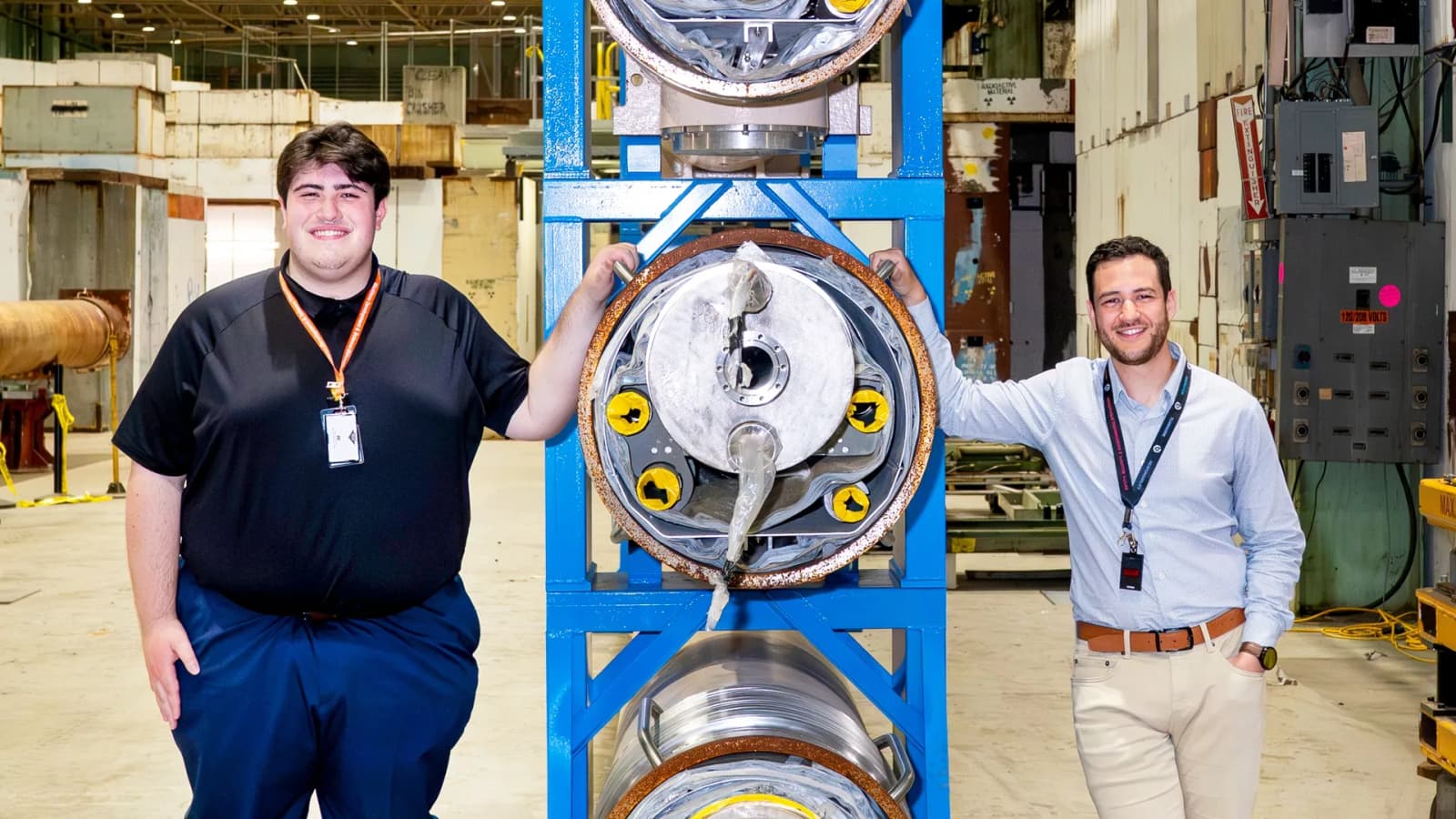
A US student has designed massive storage stands that are capable of supporting up to 45,000 pounds of superconducting magnets for the world’s first electron-ion collider (EIC).
The four-tier stands were created by Robert Desjardins, a mechanical engineering technology senior at Rochester Institute of Technology (RIT), and his mentor, EIC mechanical engineer Jonathon Greene. The structures will store superconducting magnets from Brookhaven National Laboratory’s (BNL) Relativistic Heavy Ion Collider (RHIC).
About 80 magnets are set to be removed from the RHIC. They will require storage during the transition to the EIC. Some of the equipment could later be reused as spares for the new machine.
According to the team, individual magnets can weigh as much as 12,000 pounds. With warehouse floor space limited, the engineers instead decided to go vertical. “Floor space is at a premium,” Greene said. “So, build up instead of build out.”
Stacking giant magnets
The team had been storing the magnets on three-tier stands where ceiling space was limited. The new design, in contrast, will increase that to four levels. It is also strong enough to safely support the enormous loads. “That’s what these stands are for,” Greene explained. “We have so many magnets that we need to store.”
Adding a fourth level, however, required updating a design dating back decades. Desjardins began redesigning the structure during his DOE summer internship at the facility. He worked from a design that was documented in hand-drawn plans dating back to the 1990s.
A prototype magnet storage stand based on Desjardins’ design. Credit: David Rahner / Brookhaven National Laboratory
“One of the challenges was just getting the cost down but also beefing the stands up to make them strong enough to hold four magnets,” Desjardins explained. The initial design came 10 weeks later. “It was a lot of analysis,” Greene unveiled. “But I don’t think I changed his design all that much.”
The student then made contact local manufacturers and discovered off-the-shelf components that were cheaper than the custom parts used in the 1990s design. The first stand based on his design arrived in June.
The stand also had to withstand potential earthquakes without compromising the safety of the stored magnets. To ensure it could handle those demands, engineers subjected the prototype to multiple safety and structural reviews. This included buckling, static load, modal, and seismic analyses.
Reusing magnets for the EIC
After completing the safety tests, Greene confirmed that the stand meets today’s structural engineering standards. He expects about 80 magnets from RHIC to be stored for the EIC with his mentee’s design. “Rob successfully designed the stands to withstand over 45,000 pounds,” Greene said.
The team plans to save one of every type of RHIC magnet. Desjardins’ redesign is expected to save the project about USD 420,000. Desjardins noted that watching his design become a real structure was a unique experience. “Seeing something that I designed over a summer of 10 weeks built in real life, it’s incredible,” the Long Island native, said in a press release.
RHIC operated for 26 years. It used superconducting magnets to focus and steer particle beams around its 2.4-mile rings. BNL crews began removing parts from the accelerator in April, as preparations for its successor moved forward.
The team aims to preserve viable magnets that are not immediately required. The EIC will reuse significant parts of RHIC’s existing infrastructure, including one of its ion storage rings. A new electron accelerator and storage ring will be constructed, as well.
Unlike RHIC, which collided heavy ions and protons, the EIC will smash electrons into protons and atomic nuclei. Researchers will use those collisions to probe the internal structure of matter and study how quarks and gluons, the fundamental particles responsible for building protons and neutrons, behave inside atomic nuclei.
Source: https://interestingengineering.com/energy/electron-ion-collider-magnet-storage-stands
Related articles

Astronomers find first second-generation planet formed from white dwarf’s own ashes
Astronomers have identified the first second-generation planet around a white dwarf, a world that appears...
Why plugged-in pickle glows: Engineer burns 100-plus pickles to find answer
A classic classroom demonstration has long puzzled scientists, and a Portland State University engineer now...
Scientists make progress in quantum communication, make 90% identical photons
Researchers from the universities of Basel, Ruhr, and Paderborn teamed up to make a major...

Oregon State’s new MOF turns light and water into hydrogen with no added metal catalyst
Researchers at Oregon State University have created a new class of light-activated materials that can...
A tiny change in crystal size can flip a material’s magnetic ground state
Japanese scientists may have found a surprisingly simple way to predict how some unusual materials...
How electrophoretic e-ink displays create images without a backlight
E-ink displays can look almost suspiciously like paper. They don’t glow like a phone screen,...