
Why plugged-in pickle glows: Engineer burns 100-plus pickles to find answer
A classic classroom demonstration has long puzzled scientists, and a Portland State University engineer now...
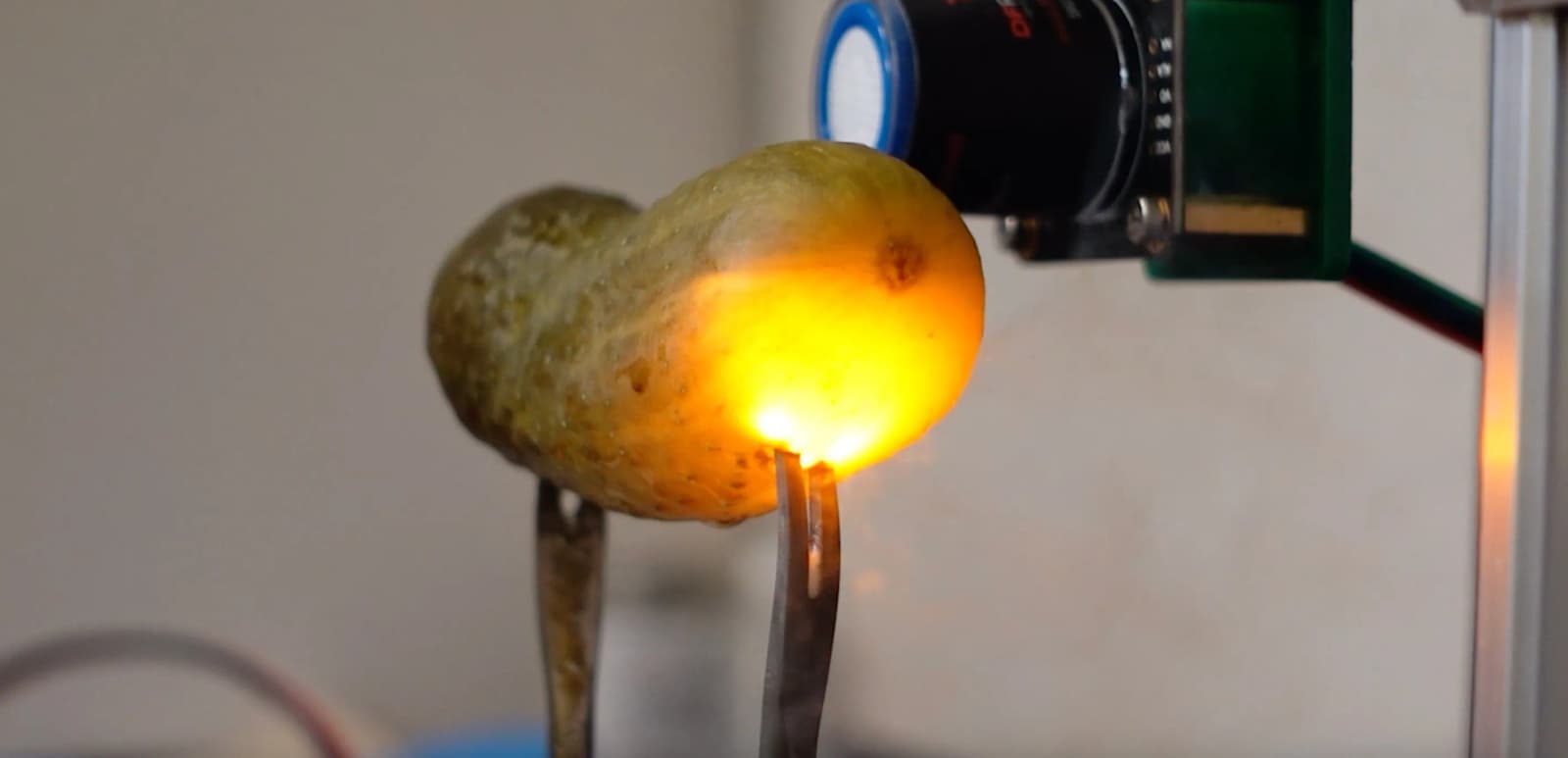
A classic classroom demonstration has long puzzled scientists, and a Portland State University engineer now says he is closing in on an explanation. Skewer a pickle on two metal forks and plug it into a wall socket, and one end glows a brilliant orange.
Josh Méndez, an assistant professor of electrical engineering at Portland State, was surprised to learn the glowing pickle remained an unsolved electrostatics problem. Drawn to obscure electrostatic puzzles, he took it on and has now burned through more than 100 pickles.
Two competing theories
Pickles are soaked in salty brine, so they conduct electricity, and two competing theories usually explain the resulting glow: a spark discharge or the ignition of hydrogen gas.
The first theory relies on vapor sparks. As current heats the pickle, liquid boils off and leaves gas pockets, along with a pungent smell of burnt pickle and hot metal. Those pockets block the current, so the pickle cools, the pockets shrink and conductive brine flows back toward the electrode. A small arc then jumps between the liquid and the electrode, much like the zap from a doorknob, Méndez said.
That explanation falls short, however, because it does not clarify why only one end of the pickle lights up.
The second theory points to electrolysis, in which electricity drives a chemical change, here splitting the brine’s water into oxygen and volatile hydrogen. Hydrogen forms only at the negative electrode, which could explain the one-sided glow. In this scenario, intense heat from the electrodes triggers tiny hydrogen explosions inside the pickle that produce the light.
A hybrid of both
Méndez’s research indicates the real cause blends the two ideas, with the electrical spark igniting the hydrogen, though heat is not what sets it off. It works on the same principle as the warning against lighting a cigarette at a gas station, where a spark ignites the gas.
The color comes down to chemistry: excited sodium ions in the brine produce the characteristic orange glow. Excited atoms release the extra energy as light of a specific color, which is why each element glows with its own signature hue. Pickle something in a different salt, Méndez said, and the glow would take on a color unique to those elements.
Testing the idea
Science News reported that the team monitored a pickle in the lab with a high-speed camera and a hydrogen sensor. The team also found that a pickle placed vertically always glows at its bottom end, where brine collects.
For a demonstration found in K-12 classrooms, the explanation turns out to involve spark, hydrogen and salt rather than anything exotic.
Related articles
Scientists make progress in quantum communication, make 90% identical photons
Researchers from the universities of Basel, Ruhr, and Paderborn teamed up to make a major...
Oregon State’s new MOF turns light and water into hydrogen with no added metal catalyst
Researchers at Oregon State University have created a new class of light-activated materials that can...
A tiny change in crystal size can flip a material’s magnetic ground state
Japanese scientists may have found a surprisingly simple way to predict how some unusual materials...
How electrophoretic e-ink displays create images without a backlight
E-ink displays can look almost suspiciously like paper. They don’t glow like a phone screen,...

SpaceX smashes US record as astronauts reach ISS in just 7 hours and 55 minutes
SpaceX’s latest crewed Dragon mission to the ISS is the fastest on record yet. Its...
Scientists find ‘ghost’ of superconductivity that survives even after the state vanishes
Superconductivity is supposed to be an all-or-nothing quantum state. Cool a material below a critical...