
A tiny change in crystal size can flip a material’s magnetic ground state
Japanese scientists may have found a surprisingly simple way to predict how some unusual materials...
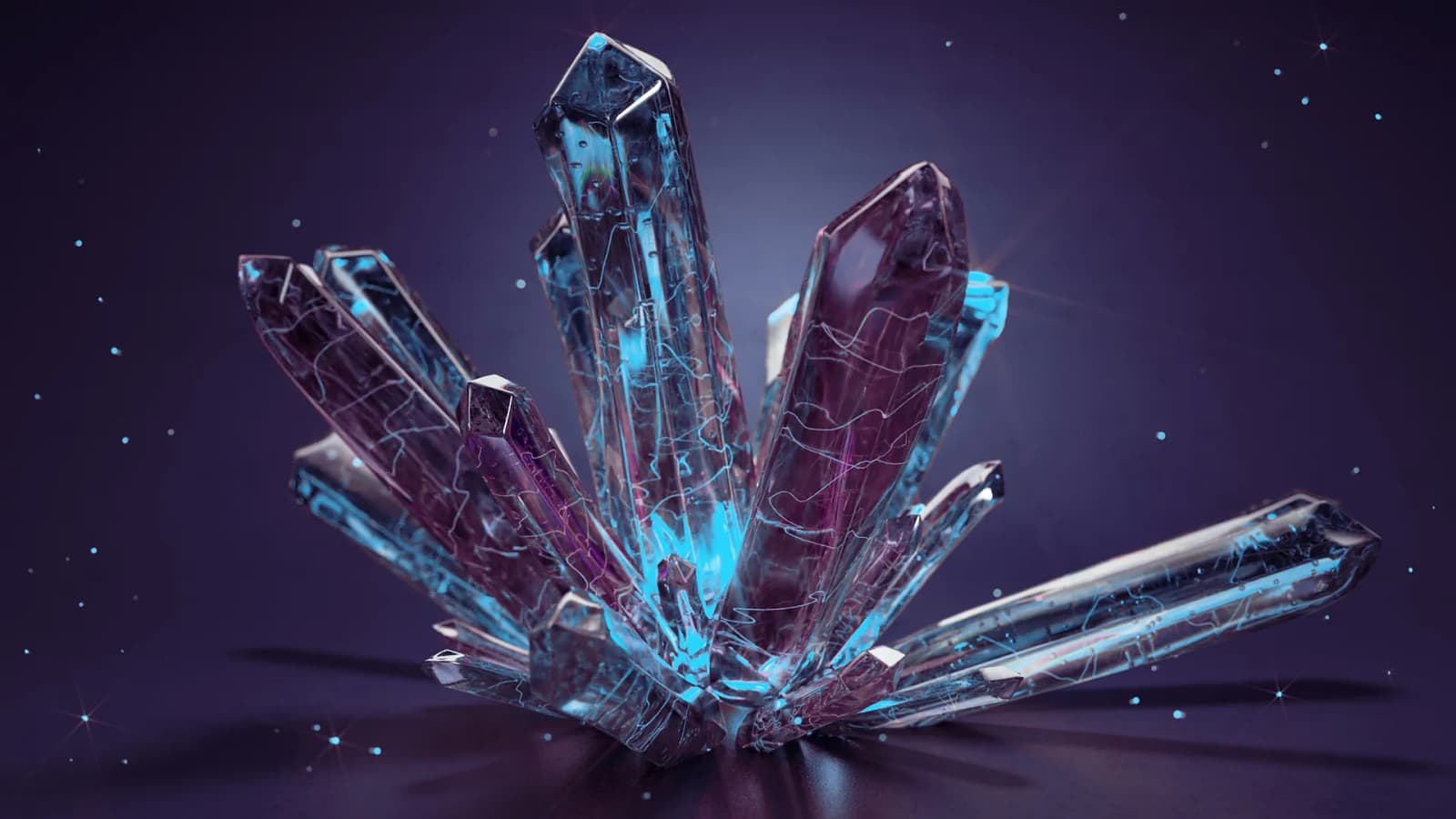
Japanese scientists may have found a surprisingly simple way to predict how some unusual materials behave by looking at the size of their crystal structure.
In their latest study, they claim that this structural measurement can predict magnetic ground states across a family of unusual materials more consistently than the electron-counting method scientists have traditionally relied on.
This could make the search for unusual magnetic materials less of a guessing game.
Until now, the challenge has been that quasicrystals and related materials have extremely complex atomic arrangements, making it difficult to find a single rule that works across different chemical compositions.
“Quasicrystals are among the most uniquely structured materials discovered to date and are expected to exhibit novel magnetic states and quantum phenomena not found in ordinary crystals. Until now, there has been no unified guideline for systematically exploring these novel phenomena in quasicrystals and their approximate crystals,” Farid Labib, first study author and assistant professor at Tokyo University of Science, said.
The new study suggests that a crystal’s size could provide that missing common measure when researchers search for unconventional magnetism.
Looking beyond the electron count
The researchers focused on Tsai-type approximant crystals. These materials mimic important structural features of quasicrystals while having a repeating crystal structure that can be studied experimentally.
Their atoms form nested clusters, with rare-earth elements such as terbium, dysprosium and holmium occupying positions that carry magnetic moments.
Researchers have often used the valence-electron concentration, or the number of valence electrons per atom, to classify magnetic behavior.
However, the magnetic boundaries associated with this measure shift with the rare-earth element and alloy composition, making it less reliable as a universal guide.
The researchers therefore synthesized Au–Al and Au–Ga-based 1/1 approximant crystals containing terbium, dysprosium and holmium, then compared their structures and magnetic properties. They also combined their measurements with data from previously reported Tsai-type compounds to see whether the pattern held across different compositions.
They found a nearly monotonic inverse relationship between electron concentration and the lattice parameter—the dimensions of the crystal’s repeating unit. This allowed them to reorganize the materials according to lattice size rather than chemical composition.
Three magnetic states separated by crystal size
The distinction turned out to be remarkably clear. Crystals with lattice parameters above about 14.72 Å (14.72 x 10⁻¹⁰ m) developed a whirling antiferromagnetic state, where magnetic moments form an ordered pattern with opposing contributions.
Between 14.62 and 14.72 Å, they showed a whirling ferromagnetic state with a net magnetization. Below about 14.62 Å, the materials enter a spin-glass state, where magnetic moments become frozen in a disordered arrangement.
The whirling magnetic states arise in these non-Heisenberg compounds partly because the local atomic environment creates a strong crystal electric field. This field favors particular orientations for the rare-earth magnetic moments, influencing how they ultimately arrange themselves.
The magnetic moments also interact indirectly through electrons moving through the material, linking the atomic structure to the way those moments arrange themselves.
A structural roadmap for new materials
The important point is not simply that lattice size correlates with magnetism. The study establishes specific structural thresholds that place different compounds on a common magnetic phase diagram.
This makes the lattice parameter an experimentally accessible starting point for deciding which materials may host a desired magnetic ground state.
“The unified magnetic phase diagram constructed in this study can serve as a practical roadmap for systematic exploration of new magnetic quasicrystals and approximant crystals exhibiting novel magnetic orders and quantum phenomena,” Kazuhiro Nawa, study co-author and a researcher at Tohoku University said.
“It can also provide a guideline for designing new magnetic materials with targeted magnetic ground states, opening new opportunities for discovering unconventional magnetism in quasiperiodic and complex intermetallic systems,” Nawa added.
The finding does not make electron concentration irrelevant. Rather, it suggests that lattice parameter may be a more consistent guide for Tsai-type compounds, while its usefulness in other magnetic materials remains untested.
What remains unclear is exactly why the lattice parameter works so well across these different compounds. The researchers also need to determine whether the same relationship holds in true quasicrystals.
Despite these limitations, the study indeed offers a more systematic route for exploring complex alloys and designing new quantum materials.
The study is published in the Journal of the American Chemical Society.
Related articles

How electrophoretic e-ink displays create images without a backlight
E-ink displays can look almost suspiciously like paper. They don’t glow like a phone screen,...

SpaceX smashes US record as astronauts reach ISS in just 7 hours and 55 minutes
SpaceX’s latest crewed Dragon mission to the ISS is the fastest on record yet. Its...
Scientists find ‘ghost’ of superconductivity that survives even after the state vanishes
Superconductivity is supposed to be an all-or-nothing quantum state. Cool a material below a critical...
Super-sticky ‘living cement’ could turn Martian dirt into 3D-printed shelters, study finds
Chinese scientists have developed a new kind of “living cement” that could, in theory, be...
Roads made with steel slag could last 15 years, cut pollution and prevent early deaths
Researchers at Southeast University in Nanjing and partners modeled what could happen if China replaced...
Magenta solar panels give broccoli 4.5-fold boost in sunlight efficiency, study finds
Broccoli grown under magenta solar panels used sunlight far more efficiently than plants grown in...