
World’s largest nuclear fusion reactor receives final piece of its giant plasma chamber
ITER, the world’s largest nuclear fusion reactor, reached a major milestone in its decades-long journey...
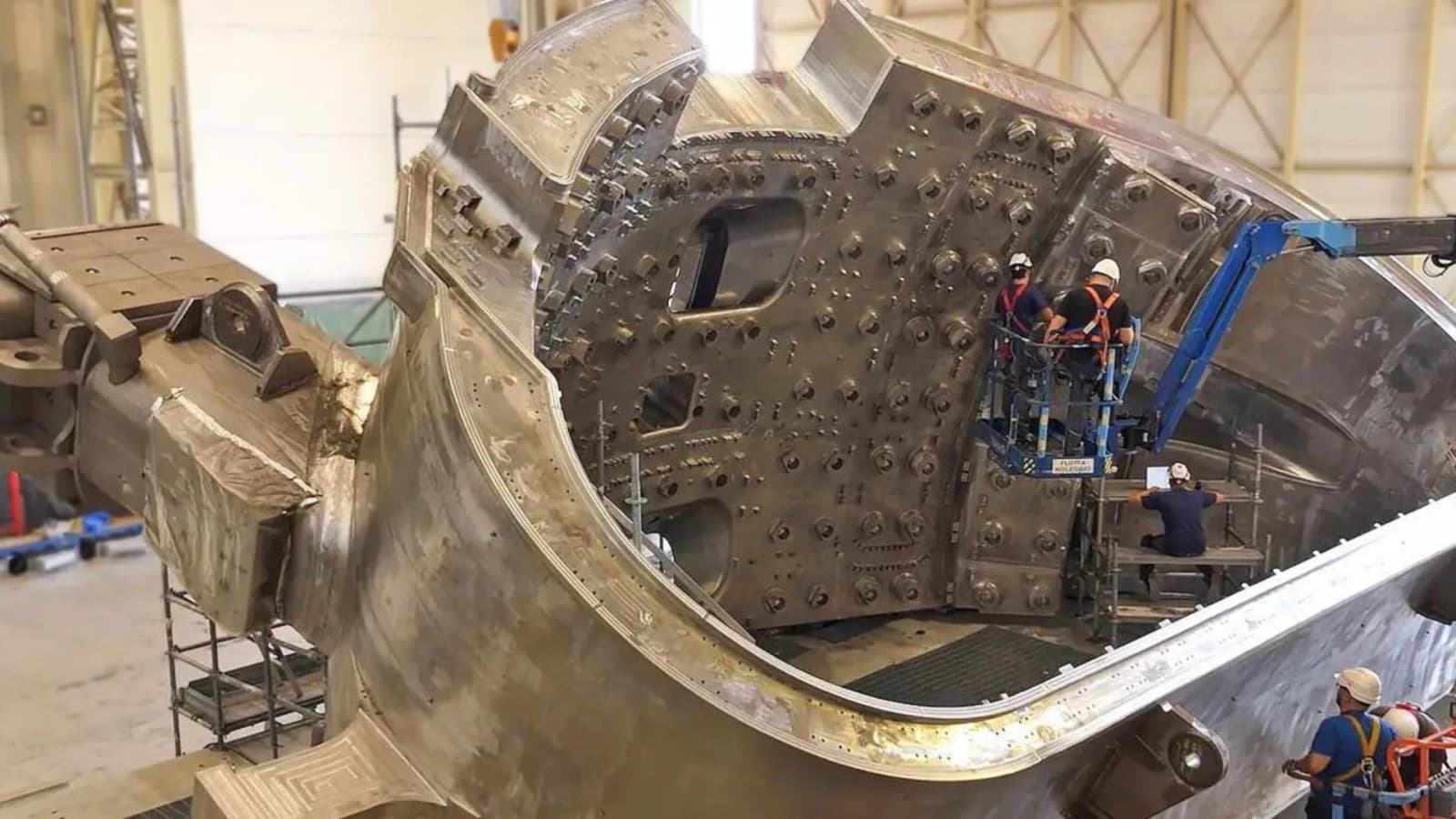
ITER, the world’s largest nuclear fusion reactor, reached a major milestone in its decades-long journey after a European consortium delivered the final vacuum vessel sector on site. The vacuum vessel is also known as the plasma chamber and will be home to fusion reactions while also acting as the first containment barrier for the reactor.
In our bid to move away from fossil fuels, scientists are working to replicate the reactions that occur in stars and release large amounts of carbon-free energy in the process. Called nuclear fusion, the process is considered advantageous over its fission counterpart, since it does not generate large amounts of radioactive waste.
However, nuclear fusion research is still in its infancy, and scientists are working to create reactions that can be sustained for long durations. ITER is the world’s largest nuclear fusion experiment that is working to sustain nuclear fusion reactions inside a tokamak, or donut-shaped, reactor vessel.
A collaborative effort between 35 nations, the facility is being built at Saint-Paul-lès-Durance in southern France and reached a major milestone with the delivery of the ninth and final sector of its vacuum vessel or plasma chamber.
ITER’s Vacuum Vessel
The vacuum vessel is a key component of a tokamak fusion reactor. Made of stainless steel, the vessel provides a clean environment for fusion reactions. It provides a scaffold for superconducting magnets to be placed and to control the plasma movements.
ITER’s design of the vacuum vessel consists of nine sectors which, when joined together, will boast an internal volume of 49,440 cubic feet (1,400 cubic meters). Each of these sectors are about 46 feet (14 m) tall. Each sector weighs about 485 U.S. tons (440 tonnes) and is built in four segments, requiring over 5,250 feet (1,600 m) of welding assembly.
When assembled, the vacuum vessel will have a diameter of 63 feet (19.4 m) and, along with other vessel components such as the blanket and the diverter, will weigh 9369 U.S. tons (8,500 tonnes).
The manufacturing of sectors for the vacuum vessel was shared between Europe and South Korea, with the latter producing four of these sectors. A European consortium was tasked with manufacturing five of these sectors, the last of which was delivered last week.
Who built ITER sectors in Europe?
The sectors were built by the AMW consortium, which consists of Ansaldo Nucleare, Westinghouse Electric Company and Walter Tosto, alongside 15 other companies in the supply chain.
Manufacturing the five sectors took more than two million hours of work and 466 miles (750 km) of welding beads. The production of the four segments of each sector was carried out at Westinghouse, Monfalcone, and in Walter Tosto, Chieti and then welded together. Once ready, the sector was shipped and then travelled by land before reaching ITER’s assembly site in southern France.
“Vacuum vessel sector #2 represents the last of our core tokamak components—now all toroidal field coils, poloidal field coils, correction coils, central solenoid magnets, vacuum vessel sectors and thermal shield sets are on site,” said Pietro Barabaschi, ITER Director General, after receiving delivery of the final sector in a press release.
Source: https://interestingengineering.com/energy/iter-fusion-reactor-vacuum-vessel-delivery
Related articles

The planetary wave headed for California isn’t what you think it is
A rather strong "planetary wave" recently slammed into South America and is making its way toward California.
NASA tests new tools to detect 2,000-micron drops that bypass aircraft ice protections
Somewhere between an ordinary cloud and a rain shower lives a hazard that aviation engineers...
World’s first electron-ion collider receives 45,000-pound magnet storage stands
A US student has designed massive storage stands that are capable of supporting up to...
Astronomers find first second-generation planet formed from white dwarf’s own ashes
Astronomers have identified the first second-generation planet around a white dwarf, a world that appears...
Why plugged-in pickle glows: Engineer burns 100-plus pickles to find answer
A classic classroom demonstration has long puzzled scientists, and a Portland State University engineer now...
Scientists make progress in quantum communication, make 90% identical photons
Researchers from the universities of Basel, Ruhr, and Paderborn teamed up to make a major...