
Soft sensor recreates 3D shapes through bending and twisting despite fiber damage
MIT researchers have developed a soft sensor that recreates its own three-dimensional shape as it...
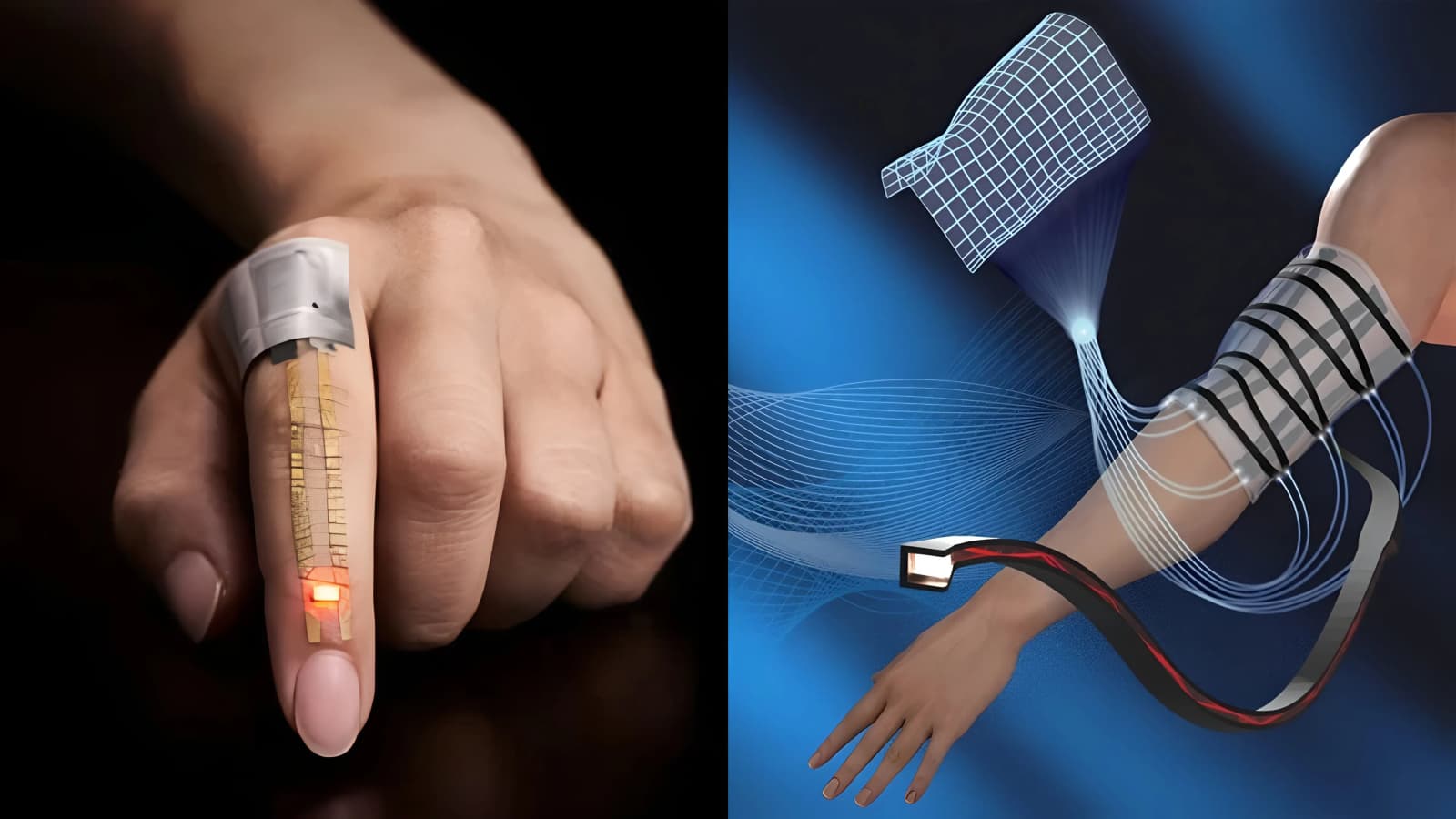
MIT researchers have developed a soft sensor that recreates its own three-dimensional shape as it bends, folds, and twists. The technology could help control robots remotely, create motion-tracking garments, and measure patients’ progress during physical rehabilitation.
The system embeds flexible optical fibers in silicone and uses changes in transmitted light to track surface deformations. Software then converts those measurements into a digital reconstruction that follows the material’s movements almost in real time.
Unlike motion-capture systems that rely on rigid sensors attached to clothing, the design uses soft components throughout its sensing surface. It can also tolerate damaged fibers without losing its ability to reconstruct its overall shape.
Soft fibers track movement
The researchers fabricated optical fibers using a flexible rubber core surrounded by black rubber cladding. They deliberately roughened one side of each core to make its response to bending more distinctive.
When a fiber bends, some light scatters away from its path. The roughened surface makes this effect sensitive to bending direction, allowing researchers to estimate how each fiber curves by measuring the light emerging from its opposite end.
Individual fibers can detect curvature along a line, but reconstructing an entire surface presents a greater challenge. MIT’s team addressed this problem by embedding multiple fibers into a stretchable silicone sheet.
Computer simulations helped the researchers compare different fiber arrangements, including checkerboard and zigzag patterns. A particular zigzag configuration proved most effective at capturing complex changes in the sheet’s shape.
Software reconstructs 3D shapes
The researchers fabricated a physical sheet using that arrangement. LEDs send light through the fibers, while sensors at their opposite ends measure the output. An external circuit board collects and amplifies the readings.
An algorithm translates those measurements into a three-dimensional representation of the sheet. During demonstrations, the researchers folded the material diagonally in opposite directions, and its digital counterpart followed the changing geometry.
They also placed the sheet over precisely shaped, 3D-printed molds to evaluate its accuracy. The reconstructed surface had an error of less than 0.4 centimeters, according to Qifan Yu, an MIT mechanical engineering graduate student.
Yu said comparable systems using rigid sensors typically produce errors of around 1 to 2 centimeters. The team also demonstrated that the sheet could reconstruct its overall shape even after some fibers were cut or disconnected.
Wearable sensors could aid therapy
The researchers envision garments that let users control video game characters or operate robots remotely. The technology could also help physical therapists measure patients’ mobility during rehabilitation.
A therapist could wrap the material around a patient’s arm or leg to record movement and range of motion. Repeated measurements could help clinicians compare mobility across sessions and evaluate recovery. Co-author Kaitlyn Becker, an MIT mechanical engineering assistant professor, said the technology could help therapists compare patient evaluations over time.
The team now plans to make the fibers thinner. Their current fibers measure about 1 millimeter across, but improved fabrication methods could reduce that thickness to tens of micrometers. Thinner fibers would allow researchers to embed more sensing elements into garments, potentially capturing finer details of body movement.
The study is published in the journal Advanced Intelligent Systems.
Related articles

Green hydrogen process reaches 98% efficiency while producing valuable chemicals
A new electrochemical process developed by researchers at the Technion, Israel Institute of Technology, could...

Biohub, DOE, NIH and Meta/DeepMind back $1.8B virtual-biology data push for predictive AI models of disease
On October 7, Biohub said it, the U.S. Department of Energy, the NIH and new partners are committing $1.8 billion in funding, data, compute and measurement technology to build open, AI-ready biological datasets for predictive models of cells and disease.
AWS launches open-source Physical AI Toolchain with NVIDIA stack for robotics development
Amazon Web Services on October 8 released an open-source Physical AI Toolchain that ties together synthetic data, training, simulation, validation and edge deployment with NVIDIA’s Isaac and Cosmos software for industrial automation, mobility and humanoid robotics.

OpenAI rolls out GPT-6 and Intelligent UI in ChatGPT, adding interactive charts, forms and in-chat tools
OpenAI began rolling out GPT-6 with Intelligent UI on October 7 to Plus, Pro, Business and Enterprise users, expanding to Free and Go on October 8, so ChatGPT can answer with interactive graphics, buttons, forms and tools inside the conversation.

Google Cloud launches a unified Gemini agent for enterprise work that plans tasks and connects to business systems
At Gemini at Work 2026 on October 8, Google unveiled a universal Gemini agent that can take objectives, plan work, connect to enterprise systems and return finished results from a single prompt—initially in private preview for businesses.

White House: 11 firms including NVIDIA, OpenAI and Anthropic pledge $2.4B in AI tools and compute for Genesis Mission
At a science summit on October 8, the Trump administration said eleven industry partners will provide $2.4 billion in super-intelligence tools and compute credits for the Genesis Mission Consortium, led by NVIDIA’s $1 billion commitment.