
Tiny light-measuring chip helps stabilize 10× more combs, could shrink atomic clocks
Researchers have demonstrated a chip-based optical frequency comb that matched bulky tabletop systems in key...
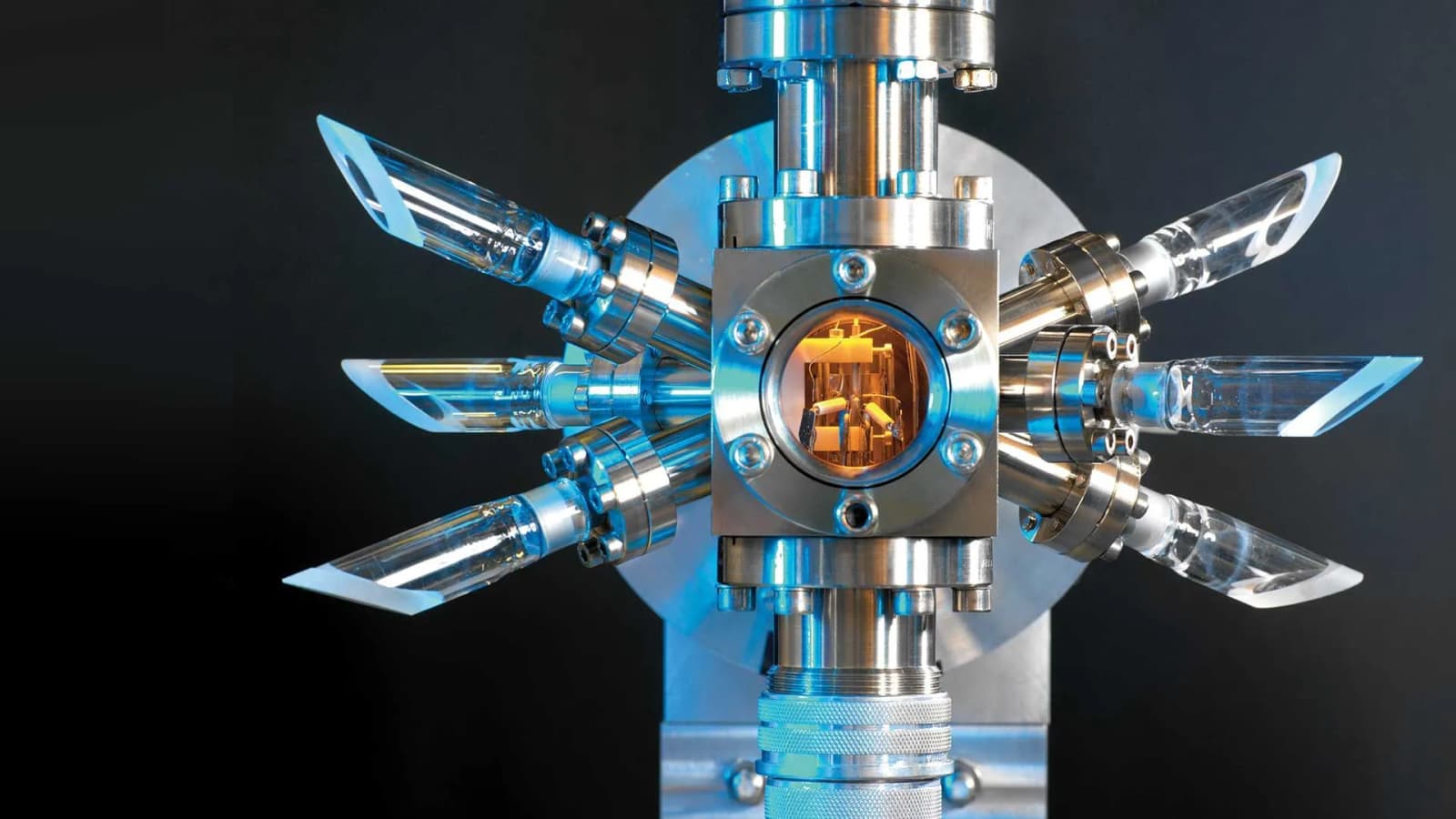
Researchers have demonstrated a chip-based optical frequency comb that matched bulky tabletop systems in key tests while allowing one device to perform several measurement tasks, a step toward portable atomic clocks and navigation systems that can operate without GPS.
The device uses a new approach called self-aligned parametrically-driven cavity solitons, or SParCS. Optical frequency combs produce a series of precisely spaced frequencies of light, creating a ruler that scientists can use to measure optical frequencies and connect them to electronic signals.
Researchers from the Joint Quantum Institute (JQI), the National Institute of Standards and Technology (NIST), and international partners tested the chip by linking microwave signals, which oscillate billions of times per second, with optical light operating at hundreds of trillions of cycles per second.
In an atomic-clock test, the chip converted an extremely stable optical reference into microwaves that conventional electronics could read. It measured the original optical frequency, which oscillated several hundred trillion times per second, to within about 100,000 oscillations per second of the expected atomic value.
Two lasers align frequencies
Conventional chip-scale frequency combs typically inject one laser into a tiny ring-shaped resonator. The resulting comb extends to frequencies on either side, but the outer “teeth” can become weak and less well defined, requiring additional equipment to amplify and stabilize them.
SParCS instead uses two lasers at different frequencies as the edges, or bookends, of the comb. Additional frequencies form between them. The researchers combined this approach with a synchronization technique that aligns the frequency lines into a single usable comb.
That addresses a problem with the team’s first demonstration of parametrically driven cavity solitons in 2024. Those experiments produced multiple overlapping sets of frequency lines, making the device difficult to use for practical measurements.
The two-laser design also allowed researchers to create a comb spanning an octave, meaning its highest frequency is roughly twice its lowest. That range is important for determining the comb’s zero-frequency offset, a calibration required for precise frequency measurements.
The researchers compared the chip directly with a conventional tabletop frequency comb using the same microwave and optical sources. Within the limits of their tests, the chip generated the same frequencies and generally matched the larger system’s stability and noise performance.
One chip handles more
The team also reversed the conversion, transferring the stability of optical light into microwave signals. Using a low-noise laser reference, the chip produced low-noise microwaves, a capability that could also benefit radar and other precision measurement systems.
Importantly, the researchers used the same chip for the different demonstrations, changing the connected light sources instead of fabricating a specialized microcomb for each application.
“As experimentalists, this new optical frequency comb has simplified much of our work,” said JQI research scientist Grégory Moille, who is also associated with NIST. “The system made it so easy that you actually have only one operator at a time doing each application.”
The researchers said previous chip-based comb experiments could require several people working for weeks or months to obtain practical results. Their lab has now shifted most of its microcomb experiments to SParCS and stabilized more than 10 times as many microcombs over the past year as it had across all previous years combined.
The team still plans to expand the frequency range and investigate whether the approach can eventually operate using a single laser.
The study was published in Nature.
Related articles

OpenAI drops another batch of mathematical breakthroughs
OpenAI has revealed solutions to a number of long-standing mathematics problems produced by an unreleased frontier model in a batch of 722 manuscripts, covering 372 result families that group related…

OpenAI’s largest mathematics release tackles 4,000 problems with Lean-checked proofs
OpenAI has released a large collection of mathematical research produced by an internal frontier model,...

85-kW MARVEL microreactor gets liquid-metal coolant ahead of criticality test
A small nuclear reactor at Idaho National Laboratory is approaching its first criticality test after...


Google DeepMind releases EmbeddingGemma 2, an open on-device model for multimodal search
The 740-million-parameter EmbeddingGemma 2 maps text, code, images, video and audio into a single embedding space, enabling private, offline search and retrieval on devices such as smartphones.

Nvidia-backed Lambda seeks up to $4 billion in final private round before planned 2027 IPO
AI cloud provider Lambda is raising up to $4 billion at a $14.5 billion pre-money valuation, led by Blackstone and Coatue, as its backlog jumped to $50 billion in September from $15 billion in June, The Wall Street Journal reported.