
US’ 8,800-mile-range B-52 bombers could get armed with ship-killing missiles
Plans are afoot to integrate the Long-Range Anti-Ship Missile (LRASM) into the payload of the...
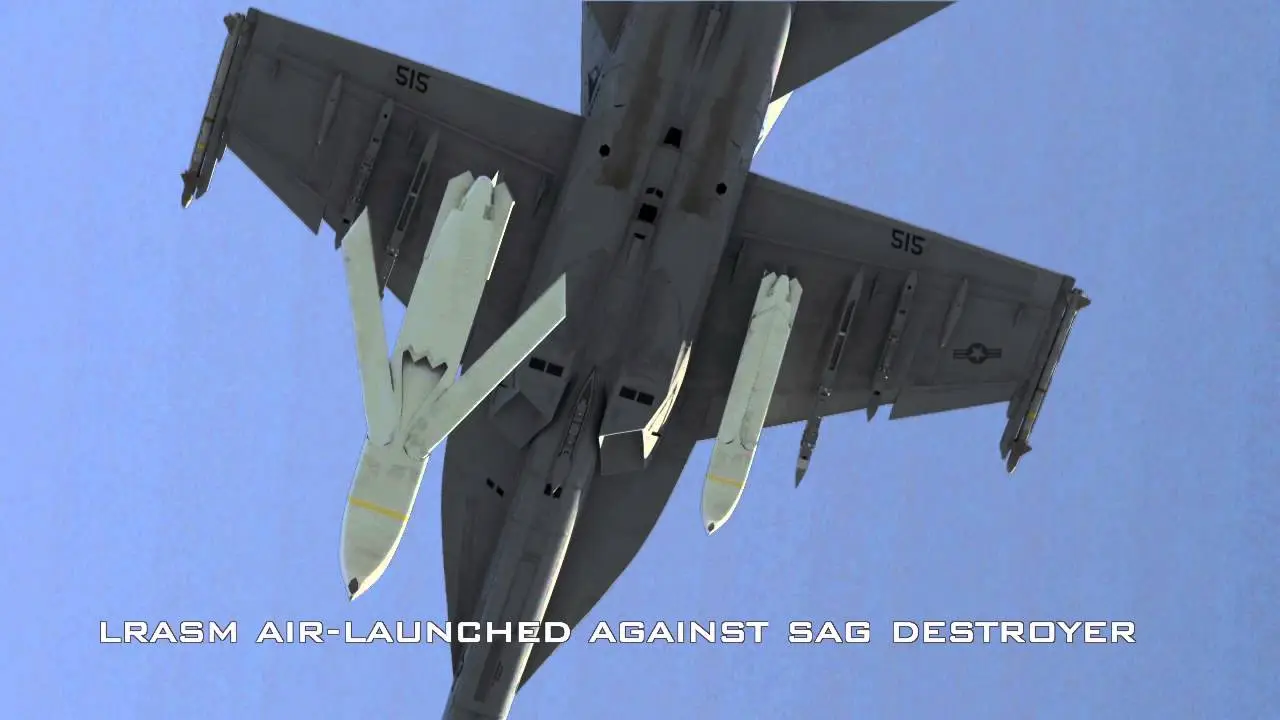
Plans are afoot to integrate the Long-Range Anti-Ship Missile (LRASM) into the payload of the United States Navy’s fleet of B-52 “Stratofortresses.” According to reports, the Navy will contract Lockheed Martin to make this a reality.
The plan, it seems, is to effectively turn B-52s into long-range, flying anti-ship missile silos. This would provide some interesting tactical options for the Navy, especially for conflicts with rivals, like China.
It will also blend cutting-edge technology with one of its oldest, the now 70 year+ old B-52. First developed in the 1950s, this aircraft has an enormous weapon payload capacity and intercontinental range.
The AGM-158C LRASM, in case you are unaware, is a stealthy, air-launched cruise missile. It is designed specifically to hunt and kill warships, including moving ships in contested environments.
Old dog, new tricks
Crucially, these missiles feature autonomous guidance, meaning they can independently hunt and destroy targets in a given “kill box.” This means they can be launched into a rough area to find potential targets without the need for specific coordinates.
As it stands, the B-52 already carries the AGM-158 Joint Air-to-Surface Standoff Missile (JASSM), which is essentially the land-attack cousin of LRASM. In theory, this should make integration of the latter more straightforward than starting from scratch.
That said, the targeting software and operational testing still require substantial work. Crucially, this is a planned integration contract, not an announcement that B-52s are already operationally equipped with LRASM.
If successful, each B-52 should be capable of carrying similar payloads of LRASM as JASSM, which currently stands at around 20 per airframe. So, just a few LRASM-capable B-52s could provide a lot of potential firepower for the Navy to call upon if needed.
“A handful of B-52s will be able to deliver more weapons on maritime targets and do so over much longer ranges than the Navy’s carrier-based aircraft per day,” retired Air Force Colonel Mark Gunzinger told Air & Space Forces Magazine.
But why the need? Well, currently the Navy must rely on submarines, surface warships, and strike aircraft like its F/A-18 “Super Hornet” to deliver these missiles. Each has its advantages, but also its limitations.
Carrier-based aircraft, for example, have relatively short unrefueled range, and ships have a finite missile capacity. Moving ships, like carriers, close enough to contested areas to fire such weapons is also inherently risky.
Not without risk
But even integration into the B-52 won’t be foolproof. Each LRASM has a range of about 200 miles (320 km). That would mean that even if a B-52 took off from a base thousands of miles away, it still needs to get relatively close to launch its missiles.
And the B-52 is not exactly the stealthiest of aircraft. For capable enemy forces like China, this would mean the B-52 would need supporting assets to either deflect attention away from them or directly protect them.
“As a precise, stealthy and survivable cruise missile, LRASM provides multiservice, multiplatform, and multimission capabilities for offensive anti-surface warfare,” Lockheed Martin spokesperson Scott Swofford said.
“By leveraging Lockheed Martin’s expertise in successful cruise missile productions, LRASM brings low-risk and long-term, flexible capabilities to the warfighters’ anti-surface warfare environment that no other inventory weapon provides,” he added.
Related articles

Anthropic adds live dashboards and animated explainers to Claude with Dashboards and Motion
Anthropic launched Claude Dashboards, which builds auto-updating dashboards from data platforms and CRMs, and Claude Motion, which turns reports and charts into editable animations, in beta, while making Docs, Slides and Design available on every plan.

Microsoft launches Microsoft-Decision-1, a fast decision-scoring model, on Foundry and OpenRouter
Microsoft released Microsoft-Decision-1, a model that returns calibrated probabilities over fixed options instead of generating text. Microsoft says it topped a 36-benchmark comparison and ran 35 times faster than GPT-6 Sol.

Microsoft’s Satya Nadella says advanced AI needs a human-controlled ‘emergency brake’
Microsoft CEO Satya Nadella urged the industry to treat frontier AI models like insider risks, wrapping them in containment, independent controls and an “emergency brake” that lets an authorized person pause or shut down a model mid-task.

Amazon in talks to buy AI startup Decart for around $7 billion, WSJ reports
Amazon is negotiating to acquire Decart, maker of real-time video-editing and robotics-simulation AI models, in a deal that could be valued at about $7 billion, The Wall Street Journal reported. Decart was valued at nearly $4 billion in May.

A college in Illinois tried to cancel its Flock contact and it refused
In April of 2025, Elgin Community College had six Flock safety cameras installed to "enhance the safety and security of students.

Silicon Valley is falling in line with Trump’s attempt to rename AI
When President Donald Trump announced his plans to rebrand artificial intelligence as "super intelligence," you'd be forgiven for being skeptical that it would catch on.