
Video: Uncut footage shows humanoid robot doing factory work with claimed 60% autonomy
Humanoid robots have become increasingly good at performing impressive demonstrations, but the harder test is...
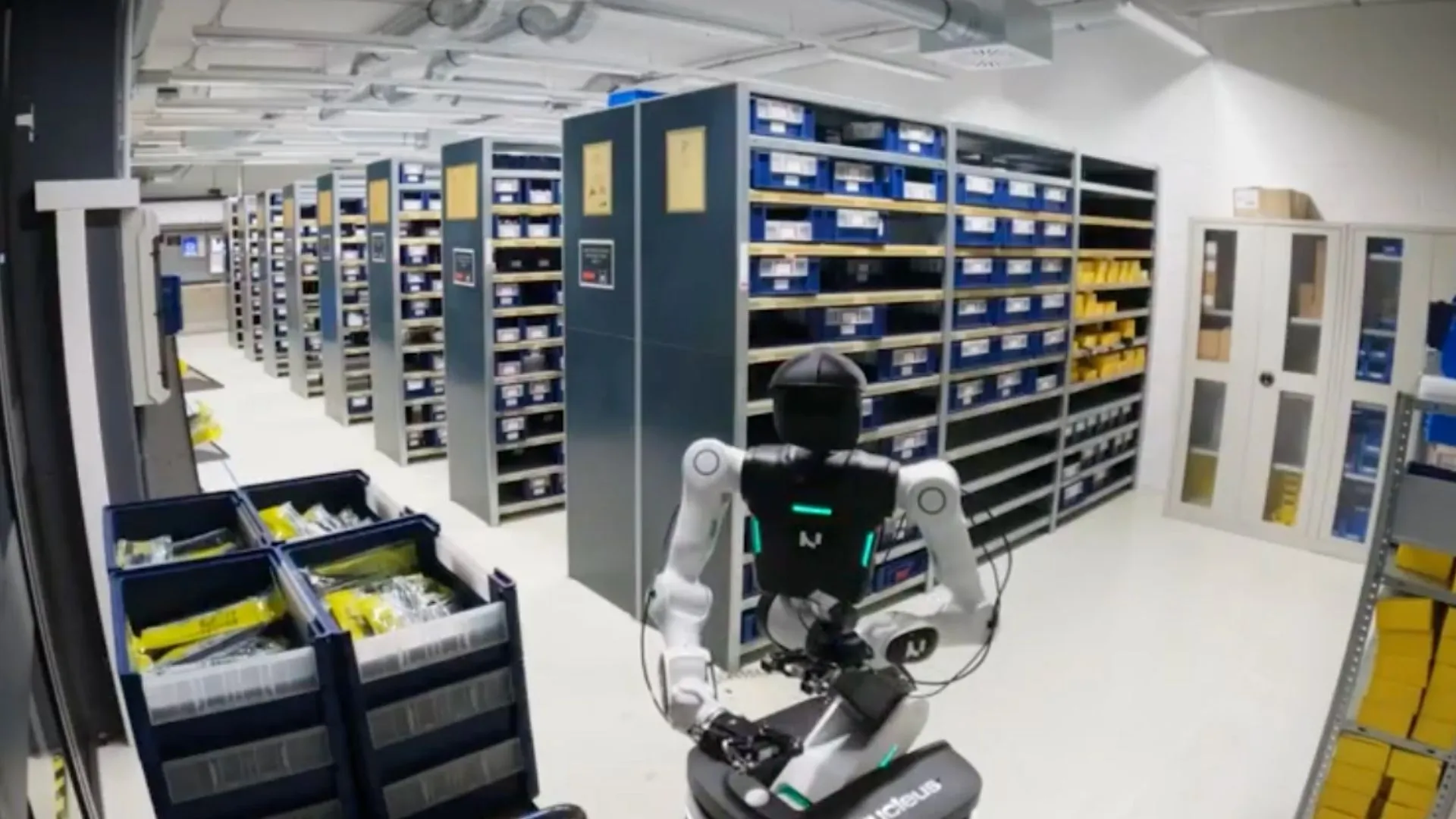
Humanoid robots have become increasingly good at performing impressive demonstrations, but the harder test is whether they can keep doing useful work for hours at a time. Nucleus is now offering a less glamorous demonstration of that challenge, sharing nearly two hours of uncut factory work while acknowledging that the robot still relies significantly on human assistance.
In an October 1 update, Nucleus founder and CEO Melvin Schwarz shared footage of the company’s humanoid worker performing routine factory tasks without cuts. The recording includes hesitations and human interventions rather than presenting only the successful portions of the operation.
According to the company, the demonstration was approximately 60 percent autonomous and 40 percent teleoperated. The company did not specify how it calculated those percentages, so they should be treated as a description of this particular demonstration rather than a general measure of Nucleus’ autonomy.
The goal is sustained work, not a perfect demo
Nucleus is pursuing a different measure of robotic progress. Instead of demonstrating a short sequence under controlled conditions, the company is trying to show that a robot can remain useful through an extended industrial workflow.
Schwarz said in a post on X that Nucleus is now regularly running four-to-six-hour shifts, with the robot completing a job from start to finish. That does not mean the robot is operating autonomously for four to six hours without intervention. Rather, it describes the duration of the company’s reported work shifts and fits Nucleus’ broader model of combining autonomous operation with human assistance when necessary.
We just achieved a major breakthrough in humanoid labor and physical intelligence. Enjoy almost 2 hours of “boring work”. We worked very hard to make it this boring!
You can see how our humanoid worker is doing real factory work:
Uncut!
We’re now regularly running 4-6 hour… pic.twitter.com/kHGG6cDa86
— Melvin Schwarz (@melvschwarz) October 1, 2026
The company’s website describes Nucleus as providing humanoid labor to factories by the hour, with current applications including parts picking, shelf loading, product handling, and cart transport. Its system records visual observations, depth information, robot motion, contact signals, human corrections, and task outcomes, creating data that can be used to improve its AI models.
Human intervention is part of the strategy
Nucleus has not positioned teleoperation simply as a temporary workaround until its robots become fully autonomous. Human guidance is part of its approach to deploying robots in factories today.
The company says task prompts, expert instructions, and teleoperation corrections can provide learning signals when a robot needs help. Its AI architecture is designed to capture those interventions alongside what the robot saw and did, turning difficult moments into training data for later improvements.
That creates a feedback loop between deployment and autonomy. A robot performs a task, encounters an unfamiliar situation, receives assistance, and records the resulting trajectory. Those experiences can then be used to improve the system before the robot returns to the factory floor.
The boring work may be the harder test
The footage also highlights a broader challenge facing humanoid robotics. A robot that completes a difficult maneuver once is not necessarily ready for industrial work. Factories need machines that can repeat tasks, recover from mistakes, and operate through ordinary variations in lighting, object placement, and workflow.
Nucleus’ own description of its approach emphasizes exactly those factors, including whether a robot can recover from disturbances and whether learned skills transfer to different objects, layouts, and days of operation.
The nearly two-hour recording therefore represents a different kind of robot demonstration. It is not evidence of full autonomy, and the disclosed 60/40 split leaves important questions about how much human attention the system requires. But by leaving the interventions visible, Nucleus is showing the less polished side of deploying robots for actual work and making sustained, repeatable factory labor the benchmark it wants to improve toward.
Related articles

New center bids to supercharge nuclear isotope production for deep-space missions
Canada is moving to expand its role in supplying nuclear isotopes that could power spacecraft...
Schneider tests quantum chip that improves home energy forecasting by up to 41%
Australian government-backed Silicon Quantum Computing (SQC), whose investors include telecom giant Telstra and Commonwealth Bank,...
Digital twin tech from US, Korea could predict toxic ammonia leaks on new ships
The US, South Korea and Germany have recently joined forces in order to develop a...

Mapped: The World’s Digital Leaders in 2026
Which economies are the most digitally connected? See how 159 economies rank in the ITU’s 2026 ICT Development Index.

Breaking up (with Elon Musk) is hard to do
In a throwback to MySpace-style internet drama, Shivon Zilis announced that she and the father of four of her children, Elon Musk, had broken up on X.

OpenAI’s Dot agent is enterprise software that can also order your dinner
It's a tale as old as last week: OpenAI's new agent platform, called Dots, is full of cute little guys who can do your bidding.