
What’s changing the length of our days, scientists find reason deep beneath Earth
Earth’s rotation changes by tiny amounts all the time. A new study suggests that forces...
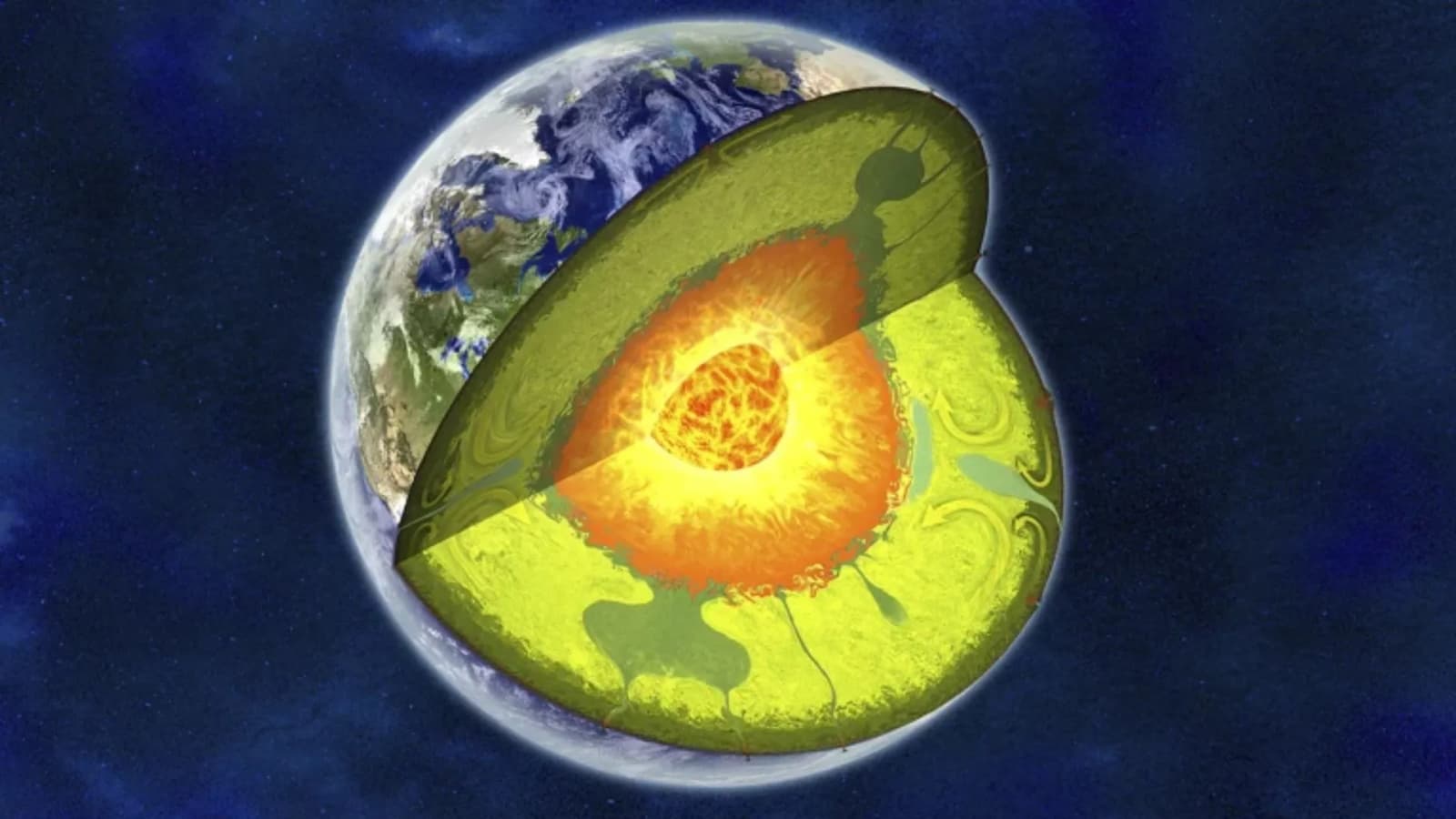
Earth’s rotation changes by tiny amounts all the time. A new study suggests that forces deep inside the planet, between the core and mantle, may be behind these small changes over several decades.
These changes are measured in milliseconds and are far too small to notice in daily life. However, they give scientists clues about conditions thousands of kilometers beneath Earth’s surface. The findings could help researchers better understand the planet’s deep interior.
A mystery measured in milliseconds
Earth’s day is commonly defined as 24 hours, based on the time needed for the planet to complete one rotation. Its actual rotation rate changes over different timescales.
Atmospheric and oceanic processes can influence shorter-term variations, while interactions with the Moon affect Earth over much longer periods. Changes over several decades have been harder to explain.
Huifeng Zhang, a PhD student at the University of Alberta in Canada, and her supervisor, geophysicist Mathieu Dumberry, examined how angular momentum exchanges between Earth’s core and mantle could affect the length of the day.
“Our main motivation was therefore to investigate the relative contributions of different core-mantle coupling mechanisms to the observed variations,” Zhang said.
Forces beneath Earth’s surface
Earth’s core is a roughly Mars-sized region dominated by iron. Its solid inner core sits inside a molten outer core and can rotate somewhat independently from the mantle.
The researchers examined three ways rotational momentum could transfer between these deep layers. Gravitational coupling is the pull between dense parts of the inner core and mantle. Electromagnetic coupling is related to electrical conductivity and magnetic fields near the bottom of the mantle.
Topographic coupling involves physical irregularities along the boundary between the core and mantle. These interactions can produce torques that influence how quickly Earth rotates.
Dumberry said scientists already knew the core was responsible for the decadal changes, but the exact mechanism remained uncertain. “This is the part that’s unclear.”
Gravity takes the lead
Zhang and Dumberry used statistical models to test different combinations of the mechanisms against observations covering roughly six decades. Their model matched the observed changes most closely when gravitational torque had the strongest influence.
The electromagnetic and mechanical effects acted in the opposite direction, creating a balance that limited the overall change in Earth’s rotation.
“Before we obtained the result, we didn’t know they are competing with each other,” Zhang noted.
Observations indicate that core-related processes changed the length of Earth’s day by several milliseconds between the early 1970s and 2021. Overall, Earth’s days have been getting shorter over time, although the rate is not constant.
Rotation reveals Earth’s hidden layers
The study adds another piece to the effort to understand Earth’s deep interior. The physical properties controlling these mechanisms are still uncertain, meaning measurements of rotation can provide useful constraints.
“What I find particularly exciting is that these different pieces of information can come together to provide a more coherent picture of Earth’s deep interior, a region that is extremely difficult to observe directly,” Zhang stated, as reported by Gizmodo.
Zhang is also examining whether similar mechanisms could explain an observed six-year cycle in the length of Earth’s day.
“Even tiny changes in Earth’s rotation can provide valuable information about processes occurring thousands of kilometers beneath our feet,” she added. “By combining these improved observations with measurements of Earth’s rotation and inner core motion, we hope to develop a more detailed picture of how Earth’s deep layers interact and how motions thousands of kilometers beneath the surface subtly change the length of our day.”
The study was published in the journal Nature.
Related articles
US tech drives European nuclear reactor to ditch weapons-grade uranium fuel
One of Europe’s most critical nuclear research reactors has moved closer to running on low-enriched...
World-first: Scientists use lutetium to build world’s most accurate atomic clock
Researchers at the Centre for Quantum Technologies (CQT) in Singapore have built the world’s most...

China launches first trio of satellites to start 60-spacecraft radio tracker network
China has put three satellites into orbit that can locate radio signals from space, marking...

Claude scans 200,000 enzymes to uncover new CRISPR-like system hidden in phages
Anthropic’s Claude has identified a previously uncharacterized enzyme system in bacteriophages after searching more than...
World’s first heavy-ion collider crushes gold ions in Mini Big Bang, finds 5-sigma dip
Researchers in the US have turned to the world’s first heavy-ion collider to smash gold...

70cm axon, 35,000 neurons, 400,000 cells: Researchers map brain’s ‘blue place’
Deep in the brainstem sits a cluster of neurons so small it makes up only...