
Wireless bipolar electrodes increase zinc-air battery power density by 80%
Scientists have invented a trick to make batteries up to 80 percent more powerful without...
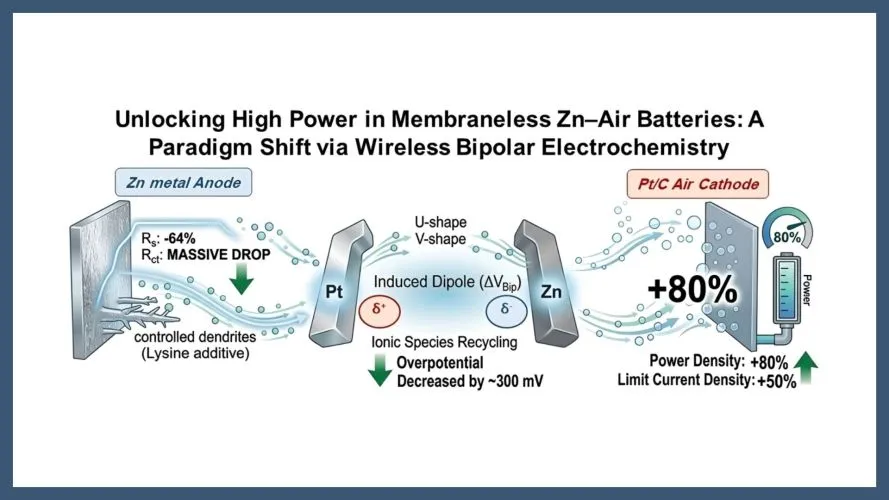
Scientists have invented a trick to make batteries up to 80 percent more powerful without changing their basic chemistry.
The Barcelona Institute of Materials Science (ICMAB-CSIC), in collaboration with ICN2 and the National University of La Plata, has developed a new architecture for zinc-air batteries that boosts power output without changing the core chemistry.
Decades of battery design boiled down to one non-negotiable rule: keep the electrolyte electrically non-conductive. Free-floating electrons inside the liquid mean a short-circuited cell. Game over.
The team, led by Nieves Casañ-Pastor and Marc Mosqueda, showed that adding unconnected, conductive metal elements to the electrolyte can safely improve performance. In particular, it was found that introducing electrically conductive pieces into a membraneless zinc-air battery’s liquid middle creates wireless bipolar electrodes.
This design strategy opens new pathways for boost the power and charging capabilities of other battery technologies beyond zinc-air systems.
Graphical representation by the study team.
Breaking the non-conductive barrier
Batteries store energy using two distinct electrode materials separated by an electrolyte, a liquid that exclusively transports ions rather than electrons.
When the battery turns on, its internal electric field instantly polarizes the metal islands, charging one side positively and the opposite side negatively. This wireless reaction creates new pathways within the electrolyte that speed up charge movement and slash internal resistance. The result is a dramatically faster, more efficient flow of electrical energy without any physical wiring.
“Normally, if a material could transport electrons within the electrolyte, you would have a short circuit, and you would no longer have a battery,” said Casañ-Pastor. “What is surprising is that wires do not connect these conductors to anything: they are simply placed inside the system and, even so, they produce beneficial effects and enormous changes in power or charging capacity.”
Zinc-air systems are cheap, non-explosive, and rely on earth-abundant materials. Safety is their strong suit, but speed never was. Zinc-air batteries have always been held back by sluggish oxygen reactions that choke their power output.
The research team slashed internal electrical resistance to a fraction of its normal level by inserting these wireless bipolar electrodes. As a result, energy moved through the system much faster. The entire battery operated with dramatically improved efficiency and speed.
In the study, platinum (Pt) and zinc (Zn) were tested as small metal pieces placed directly in the battery’s liquid electrolyte to act as wireless bipolar electrodes.
Cuts internal resistance
The induced dipole moments cut ohmic internal resistance by up to 64 percent and further reduced charge-transfer resistance, easing energy flow inside the cell.
Varying the material and geometric configuration yields significant performance boosts across key battery metrics. Volumetric power density surges by up to 80 percent, while limit current density increases by more than 50 percent. The system also achieves up to a 300 mV drop in overpotential, making energy delivery considerably faster and more efficient.
Higher-power zinc-air batteries offer an eco-friendly alternative to lithium-ion for renewable energy grid storage (solar and wind integration), relying entirely on non-toxic, non-flammable chemistry.
The researchers said this development reflects a broader strategy for batteryoptimization rather than a single fixed solution. And have already observed similar benefits in other energy-storage technologies beyond zinc-air systems. Researchers will now continue exploring new applications of this wireless bipolar electrode architecture to enhance diverse battery parameters.
The study was published in the journalEnergy Storage Materials.
Related articles

New leaks provide our first look at Apple and LG’s smart home devices
Following a report from Bloomberg yesterday that Apple is collaborating with LG for a new collection of smart home devices and accessories, a reliable leaker known as "pdfu" on X has revealed more…

Google invests millions in Mark Zuckerberg’s efforts to create a ‘virtual cell’
Google DeepMind, Meta, and AI drug discovery startup Isomorphic Labs are jointly investing $300 million into Biohub, the nonprofit biomedical research organization founded by Mark Zuckerberg and his…

US firm’s microreactors to power Canada’s first 50 MW-class transportable nuclear plant
A coastal community in eastern Canada could soon host one of the world’s first transportable...

Windows and Surface event: how to watch and what to expect
Microsoft is heading to San Francisco this morning to reveal what's coming next for Windows and Surface and a "conversation on how local AI will shape the next chapter of the PC.

Amazon uses its tracking data to guess whether shoppers have a flat butt and no friends
Most people know that Amazon collects data about your shopping history to serve up personalized product recommendations.

My cats hate to see this great upright carpet cleaner coming
For a while, I swore by Bissell’s Little Green carpet cleaner.