10 US inventions that changed everything from travel to medicine
From the airplane to the transistor, inventions developed in the United States have radically changed...
This story was prepared automatically by software.
From the airplane to the transistor, inventions developed in the United States have radically changed how people travel, communicate, manufacture goods, and understand the world. Some emerged from individual inventors’ workshops, while others required teams of scientists, engineers, and industrial researchers.
Not all were invented entirely from scratch. Many built on earlier discoveries or emerged from competing efforts. But their development and adoption in America helped shape modern life across the globe. Here are 10 American inventions and innovations whose influence extends far beyond their origins.
1. The telephone
Alexander Graham Bell received a U.S. patent for his telephone in 1876, starting a new era of real-time voice communication. His device converted sound into electrical signals that could travel over wires and be converted back into speech.
Earlier inventors explored similar ideas, but Bell’s work made the telephone a practical technology. Its descendants now underpin mobile communications, internet calling, and the global telecommunications networks connecting billions of people.
2. The airplane
On December 17, 1903, Orville and Wilbur Wright achieved the first successful powered, controlled, and sustained airplane flights at Kitty Hawk, North Carolina. Their achievement followed years of experimentation with gliders, propellers, and flight controls.
The Wright Flyer stayed airborne for only seconds during its first flight, but the underlying engineering principles helped make powered aviation practical. Aircraft subsequently transformed passenger travel, global trade, emergency response, and military operations, shrinking the practical distances between continents.
3. The modern assembly line
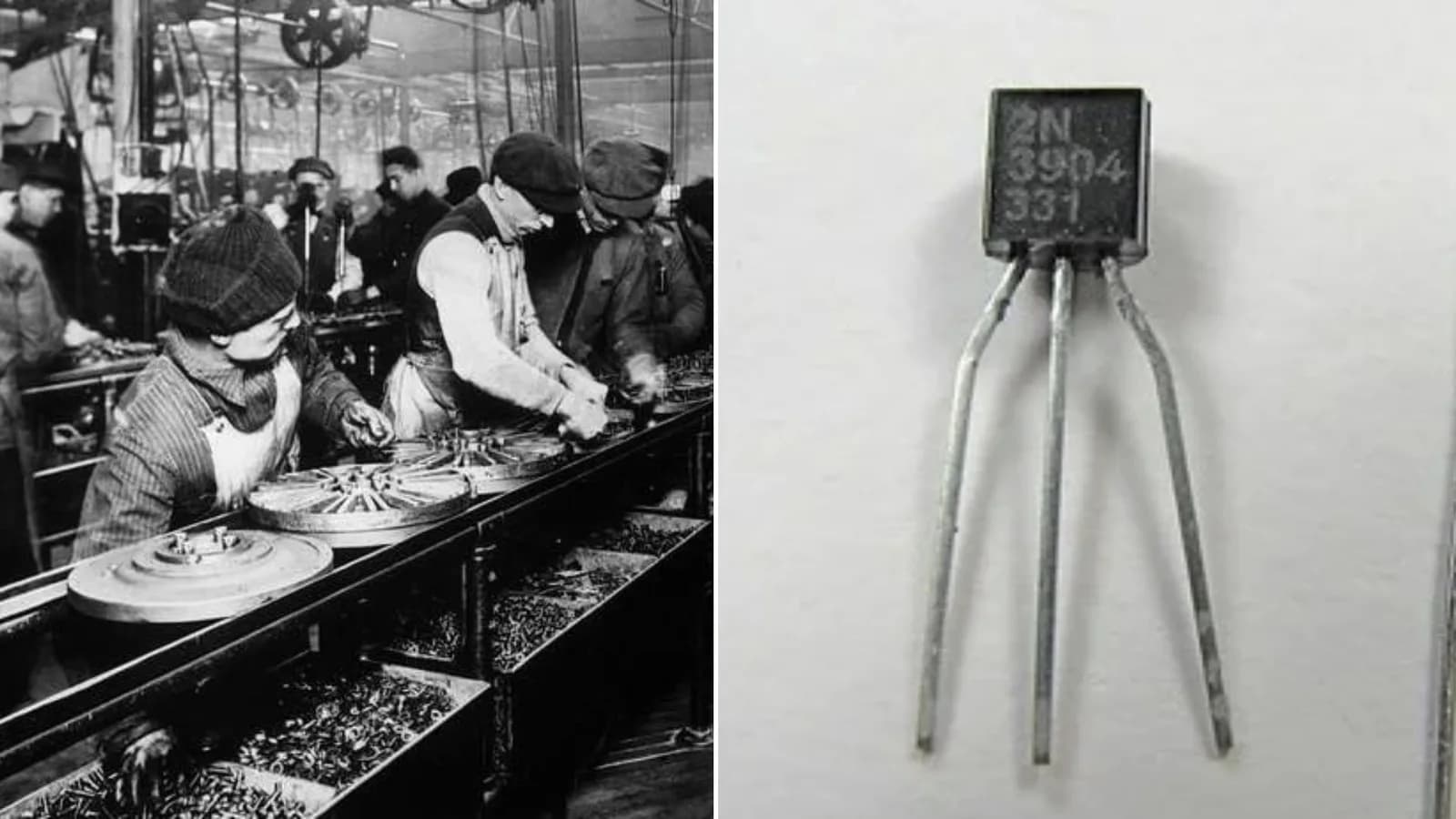
American industrialist Ransom Olds introduced an early automotive assembly-line production system around 1901, while Henry Ford later popularized moving assembly lines in automobile manufacturing. Ford’s Highland Park plant began using a moving assembly line for Model T production in 1913.
By breaking manufacturing into standardized, repeatable tasks, the approach dramatically increased production efficiency and helped lower vehicle costs. Assembly-line principles subsequently spread across industries, from electronics and appliances to food processing, changing how products are made worldwide.
4. Modern air conditioning
American engineer Willis Carrier developed a system for controlling temperature and humidity in 1902 to address printing problems caused by changing atmospheric conditions. His work helped establish modern air conditioning as a practical engineering discipline.
Beyond making buildings more comfortable, air conditioning has supported industrial processes, laboratories, hospitals, and data centers where temperature and humidity control matter. It has also reshaped architecture and urban life, enabling dense populations and businesses to function in hot climates, though its energy use creates significant environmental challenges.
5. The transistor
In 1947, researchers John Bardeen and Walter Brattain demonstrated the point-contact transistor at Bell Laboratories under the leadership of William Shockley. The device could amplify or switch electrical signals while avoiding the bulk and power demands of vacuum tubes.
Shockley later developed the junction transistor, further advancing the technology. Transistors became the foundation of modern electronics, enabling smaller radios, computers, mobile phones, and countless digital devices. Billions of these components now operate inside the processors and memory chips used throughout modern life.
6. The integrated circuit
In 1958, engineer Jack Kilby at Texas Instruments demonstrated an integrated circuit that placed multiple electronic components on a single piece of semiconductor material. Robert Noyce at Fairchild Semiconductor independently developed a practical integrated-circuit approach that helped enable scalable manufacturing.
By combining components into compact circuits, the technology reduced size and complexity while improving reliability. Integrated circuits eventually evolved into microprocessors and system-on-chip designs, enabling modern computers, smartphones, digital cameras, and advanced industrial control systems.
7. The internet’s core networking protocols
The modern internet emerged from decades of work across many institutions, but American computer scientists Vinton Cerf and Robert Kahn played a central role in developing TCP/IP, the protocols that allow separate computer networks to communicate.
Their work grew from research supported by the U.S. Defense Advanced Research Projects Agency during the 1970s. TCP/IP became the foundation for interconnected networks, allowing data to move between different systems. The resulting infrastructure supports everything from email and online publishing to cloud computing, video calls, and global commerce.
8. The Global Positioning System
The U.S. Department of Defense developed the Global Positioning System (GPS) as a satellite-based navigation technology. Development began in the 1970s, and the system became operational for military use before civilian access expanded. GPS receivers calculate their positions using precisely timed signals from multiple satellites.
Today, the technology guides aircraft, ships, vehicles, and smartphones while supporting agriculture, surveying, emergency services, and financial timing systems. GPS also inspired other satellite-navigation networks, making precise positioning a routine part of modern infrastructure.
9. The polio vaccine
American physician Jonas Salk developed an inactivated polio vaccine that was tested in a large-scale trial in 1954 and announced as effective in 1955. Albert Sabin later developed an oral vaccine using weakened poliovirus strains.
Together, these approaches transformed the fight against a disease that once caused widespread paralysis and outbreaks, particularly among children. Vaccination campaigns sharply reduced polio cases in many parts of the world. The disease has not been eradicated globally, but these vaccines remain central to international efforts to eliminate it.
10. The microwave oven
American engineer Percy Spencer helped develop the microwave oven after noticing that microwave radiation from radar equipment could heat nearby food. Working at Raytheon, he explored the effect and helped turn it into a cooking appliance.
Early microwave ovens were large and expensive, but later designs brought the technology into homes and commercial kitchens. By heating food using electromagnetic energy, microwave ovens made reheating and quick meal preparation easier, changing everyday cooking habits across much of the world.
Source: https://interestingengineering.com/culture/10-us-inventions-that-changed-everything
Related articles