
1,000 entanglements per second achieved in world-first quantum memory link
IonQ has demonstrated a quantum link that connects two different types of qubits at more...
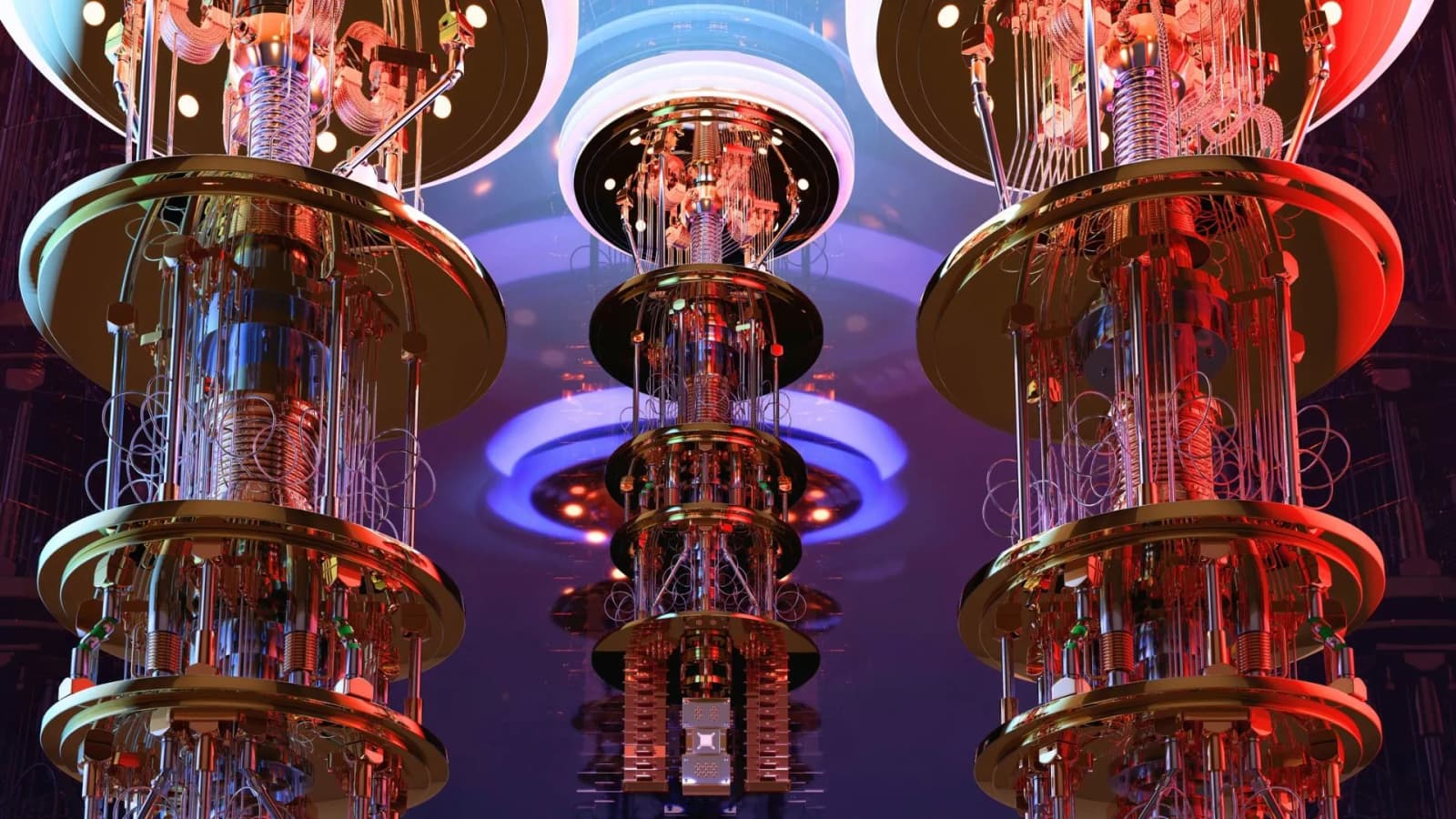
IonQ has demonstrated a quantum link that connects two different types of qubits at more than 1,000 entanglement events per second. The achievement could help engineers build larger quantum computers by allowing separate systems to exchange quantum information more efficiently.
The demonstration links a trapped-ion qubit with a silicon-vacancy (SiV) qubit inside a solid-state memory. A photonic interconnect carries the quantum connection between them using light. IonQ says the result exceeds the previous record for trapped-ion systems by more than four times.
The breakthrough tackles a major quantum computing challenge by connecting different hardware systems without creating communication bottlenecks.
Linking two quantum systems
Trapped ions offer excellent qubit coherence, allowing them to preserve quantum information for extended periods. Silicon-vacancy centers in diamond, meanwhile, interact efficiently with light, making them promising candidates for quantum memories.
IonQ’s approach combines these strengths through a photonic link. The trapped-ion system handles quantum information, while the solid-state memory provides an interface suited to optical communication.
Entanglement connects quantum systems through shared quantum states, enabling operations that classical communication cannot reproduce. Quantum networks rely on this property to coordinate separate processors and potentially distribute computational workloads across multiple machines.
IonQ’s demonstration uses real hardware to test the complete connection between the two qubit types. The results appear in a technical paper detailing the system’s performance.
Faster links could scale computing
The speed of an interconnect matters because larger quantum computers may need to coordinate many separate processing units. Slow connections could limit how quickly those units perform joint operations, even when individual qubits work well.
IonQ Chairman and CEO Niccolo de Masi compared the challenge with the evolution of conventional data centers. Specialized processors, memory and networking help classical computing infrastructure scale beyond individual machines.
Quantum systems could follow a similar path, with photonic links connecting separate computing modules. IonQ’s reported entanglement rate suggests that optical communication need not become a major bottleneck for distributed quantum computing.
The architecture could also support networked sensing, where connected quantum devices coordinate measurements across different locations. Its potential compatibility with several qubit technologies could broaden its applications beyond trapped-ion hardware.
DARPA program and commercial plans
IonQ is also pursuing quantum networking through the Defense Advanced Research Projects Agency’s HARQ program. The initiative aims to develop high-speed interconnects that work across different quantum computing architectures.
Although the reported demonstration uses trapped ions, IonQ expects the underlying design to accommodate other platforms. These could include neutral-atom systems and superconducting qubits paired with transducers that convert microwave signals into light.
The company has also started commercializing its quantum memory and interconnect technology. The University of Maryland purchased the first commercial system, announced in April 2026. IonQ announced another system sale to South Korean company SDT in September.
IonQ Chief Scientist Chris Monroe, who co-founded the company, said photonic links will play an essential role in large-scale quantum computing.
The next challenge will be translating faster entanglement into reliable operations across increasingly complex quantum networks. Connecting different qubit technologies could help researchers build modular systems without requiring every component to use the same hardware.
Source: https://interestingengineering.com/innovation/ionq-world-first-quantum-memory-link
Related articles

‘Pure insanity’: Mathematicians will need years to make sense of OpenAI’s latest drop
"Staggering." "Overwhelming." "Unprecedented." "Surreal." "Pure insanity.

Trump’s ‘Agreements on Reciprocal Trade’ (ARTs) threaten equitable access to the internet in Global South
The controversial reciprocal trade agreements (ARTs) gives the U.S.


Amazon’s new Kindles appear to have a light leak problem
Some users are reporting that the new Kindles have a light leak issue that is especially apparent when using dark mode.

The Samsung Galaxy S26 Ultra is down to $950 after Prime Day
Amazon has the Samsung Galaxy S26 Ultra in black with 256GB of storage discounted to $949.99, a healthy discount from its usual price of $1,399.99.

Google teases Fitbit Edge launch next week
It looks like Google is getting ready to take the wraps off its rumored Fitbit Edge next Monday.