27% efficient perovskite solar cells stay stable for over 1,400 hours with nano-links
Researchers at The Hong Kong University of Science and Technology (HKUST) have developed new nano-linked...
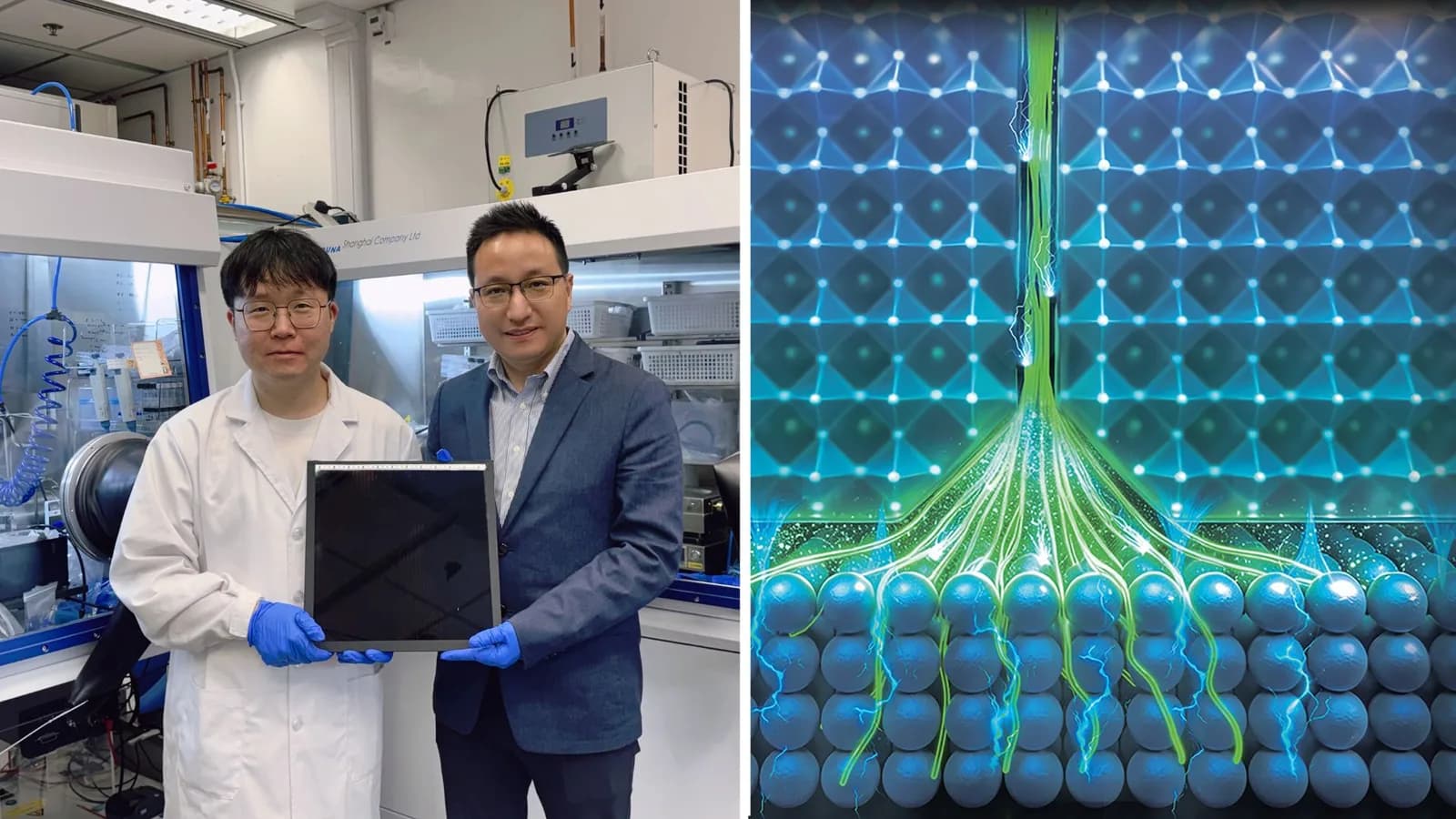
Researchers at The Hong Kong University of Science and Technology (HKUST) have developed new nano-linked perovskite solar cells that reach 27.04 percent efficiency while maintaining a stable performance for more than 1400 hours.
The new technology, described by the team as trans-interface engineering (TIE), was devised to boost the efficiency and lifetime of the device. These solar cells fail to work properly owing to the physical damage caused to thin layers that sit between their light-absorbing material and the charge-transport layers or electrodes.
“Our study reveals that mechanical failure is a key factor behind the poor stability of perovskite solar cells. TIE not only addresses this long-overlooked issue but also opens a new avenue for interface design in multilayer optoelectronic devices,” said Guo Pengfei, a researcher involved in the study.
Perovskite solar cells challenges
Perovskite solar cells are considered promising and offer an inexpensive alternative to traditional silicon-based photovoltaic technologies. They can be manufactured cheaply from liquid materials and printed onto flexible surfaces using scalable production methods.
Furthermore, these cells have reached a lab efficiency rate exceeding 27 percent. Despite these benefits, the wide-scale adoption remains limited as they often degrade faster than conventional silicon solar cells.
As perovskite solar cells operate over long periods, repeated heating and cooling can cause the thin interfaces between their layers to crack or peel apart. These defects speed up the cell’s deterioration, shortening the device’s lifespan.
Previous attempts have tried to reinforce these interfaces by introducing protective coatings that reduce defects and improve bonding. But such layers often sacrifice electrical performance for durability while doing little to prevent the underlying mechanical damage.
Nano-links aid stability
To solve the problem, researchers at HKUST abandoned the conventional strategy of adding another protective interface. Instead, they created vertically penetrating nano-links that act like molecular bridges, physically stitching the perovskite and electron-transport layers together.
The team achieved this by mixing polymerizable molecules into both layers before using heat to trigger a chemical reaction known as free-radical copolymerization. The reaction produced a network of vertically aligned covalent bonds that strengthened the interface while preserving the efficient flow of electrical charges.
By replacing the weak molecular interactions typically used to strengthen interfaces with a network of robust covalent nano-links, the new approach boosts the stability of these solar cells. According to the researchers, this stronger architecture enables the interface to withstand the mechanical stresses that accumulate during prolonged operation while maintaining efficient charge transport, resulting in improved overall device performance.
In laboratory tests, the perovskite solar cells incorporating the TIE interface achieved a power conversion efficiency of 27.04 percent, with a certified efficiency of 26.67 percent. The technology also made the interfacial layer nearly three times tougher, addressing one of the biggest durability challenges facing perovskite solar cells.
Beyond the durability gains, the technology also extended the lifespan of the cells. Of the 50 devices tested, 92 percent maintained stable performance for more than 1,400 hours. The cells also showed improved resilience in accelerated aging tests, continuing to operate reliably when exposed to 185°F (85°C) and 85% relative humidity, conditions commonly used to simulate years of real-world operation.
The findings were published in Nature Photonics.
Source: https://interestingengineering.com/energy/nanolinked-perovskite-solar-cells
Get the latest news delivered to your inbox.
Related articles