
3D-printed composite forms could cut nuclear construction time from months to weeks
Oak Ridge National Laboratory (ORNL) and its collaborators developed 3D-printed composite forms that could speed...
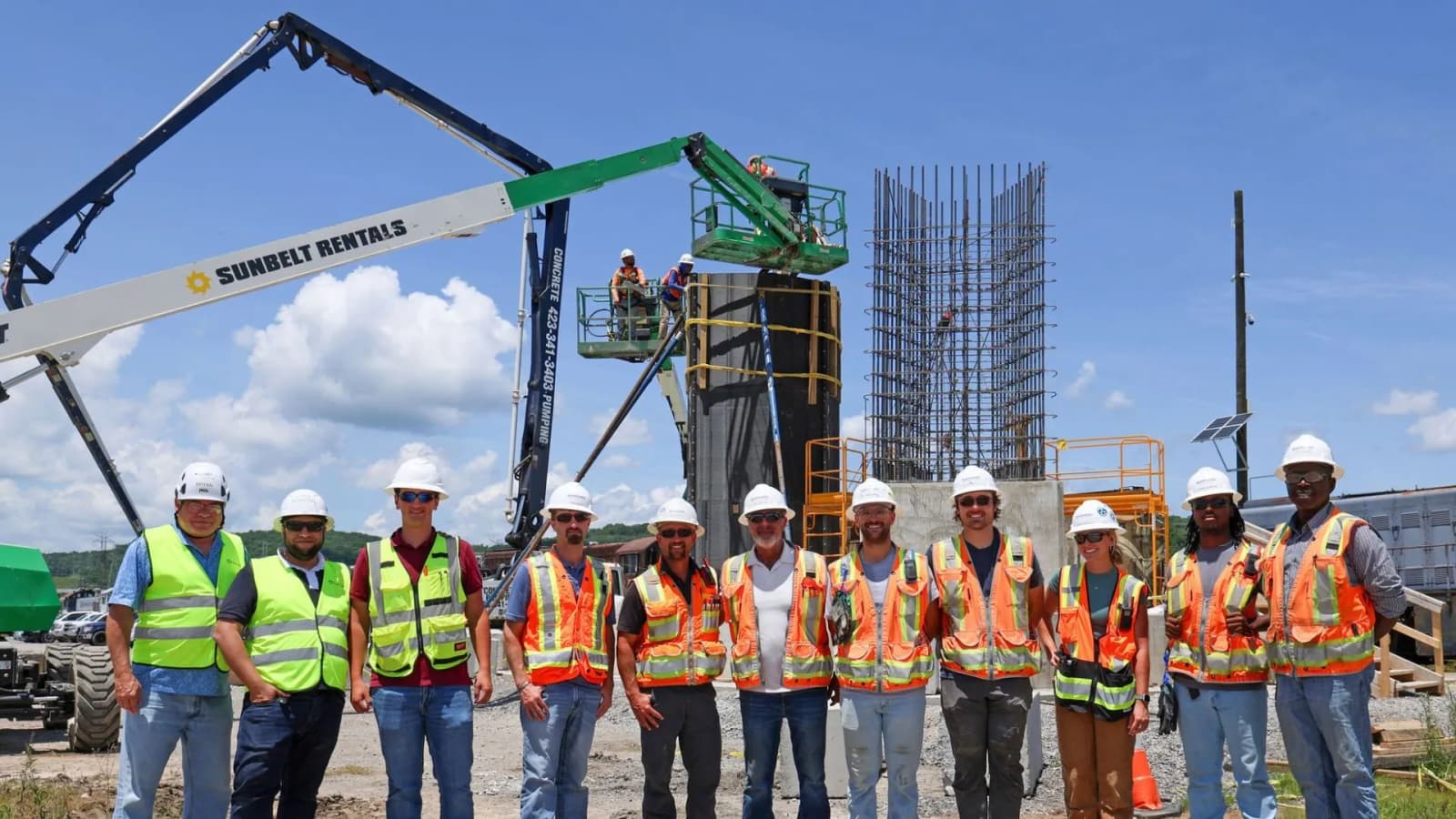
Oak Ridge National Laboratory (ORNL) and its collaborators developed 3D-printed composite forms that could speed up the construction of advanced nuclear facilities, cutting the time needed to produce specialized molds from about six months to about two weeks.
The project, titled “Advanced Composite Formwork for Accelerated High-Precision Nuclear Infrastructure,” received the 2026 CAMX Combined Strength Award. The team developed a digital manufacturing process that combines large-scale 3D printing and precision machining to produce reusable forms for shaping concrete in nuclear construction.
The technology has progressed to full-scale demonstrations at Kairos Power’s Oak Ridge campus in Tennessee, where the company’s Hermes Low-Power Demonstration Reactor is under construction.
3D printing complex forms for nuclear construction
Conventional formwork holds wet concrete in place until it hardens. Nuclear facilities can require specialized molds capable of producing complex geometries with tight dimensional tolerances while withstanding substantial pressure from the concrete.
The ORNL-led team developed fiber-reinforced composite forms that can be manufactured for geometries that are difficult to produce using conventional steel molds. These include interlocking joints designed to support grout-free assembly of radiation-shielding panels.
According to ORNL, the reusable forms can be designed, 3D printed, and delivered in about two weeks, compared with approximately six months for conventional steel molds. The forms achieved a reported precision of one-sixteenth of an inch on critical surfaces while withstanding the pressure exerted by the concrete they shape.
The approach could help construction teams produce specialized components more quickly and adapt designs without waiting months for new steel tooling.
Demonstrations at Kairos Power’s campus
The team demonstrated the technology through a cast-in-place concrete shielding structure known as the Janus demonstration at Kairos Power’s Oak Ridge campus.
Each section used in the demonstration measures 10 feet by 10 feet, with three sections stacked to create a column. The forms are precursors to those Kairos Power and construction partner Barnard Construction plan to use for portions of the Hermes reactor facility.
Barnard also provided feedback during implementation, allowing the team to make design changes based on construction requirements and improve how the forms could be deployed on site.
The demonstration shows the technology’s application to specific concrete structures. It does not mean that the entire Hermes facility is being built using 3D-printed formwork.
A collaboration across research and industry
The project brought together ORNL’s Manufacturing Demonstration Facility, the US Department of Energy’s Advanced Materials and Manufacturing Technologies Office, Kairos Power, the University of Maine’s Advanced Structures and Composites Center, Barnard Construction, Airtech Advanced Materials Group, JuggerBot 3D, Additive Engineering Solutions, Haddy, and Tru-Design.
“Accelerating advanced nuclear deployment requires rethinking how we build, not just how we design reactors,” said Ahmed Arabi Hassen, group leader of Composites Innovation at ORNL. The award recognizes the team’s combined expertise in materials, additive manufacturing, machining, and construction.
Supporting future nuclear projects
The immediate benefit is faster production of specialized concrete forms, rather than a guaranteed reduction in the overall time required to build a reactor. Nuclear projects still face engineering, safety, regulatory, and other construction requirements.
However, reducing formwork lead times could help remove one bottleneck in building complex nuclear infrastructure. ORNL says the project is also helping establish an additive manufacturing supply chain for nuclear construction, with the goal of improving manufacturing flexibility and supporting future advanced reactor projects.
Related articles

Sega pulls Total War: Shogun 2 remaster from sale following disastrous launch
Sega is removing Total War: Shogun 2 - Complete Edition from storefronts following a disastrous launch where users complained about issues like bugs and upscaling that appears to have been done by AI.

ChatGPT can peek at your Chrome tabs now
OpenAI's ChatGPT Atlas browser is gone, but now ChatGPT's Google Chrome extension is getting some upgrades that allow it to use the browser tabs you already have open.


Ultra-compact space radios aim to shield US military satellites from jamming threats
BAE Systems will develop and demonstrate compact radio-frequency (RF) terminals for a U.S. Space Force...

Withings now charges $100 per year to sync your data to other apps
If you're a new user of Withings' fitness-tracking smartwatches or smart scales and want to sync and access your health data through third party apps like Apple Health or Google Health it's now going…

Bluesky’s AI tool now lets you make games and apps to share on social
Bluesky's Attie AI tool, which initially launched earlier this year as a way to use AI to build your own feeds, now lets you make "small" social apps like games, polls, and dashboards that you can…