
Ranked: The World’s 30 Largest Banks in 2026
The world's largest banks by total assets are all headquartered in the same city. However, the city is Beijing, not New York.
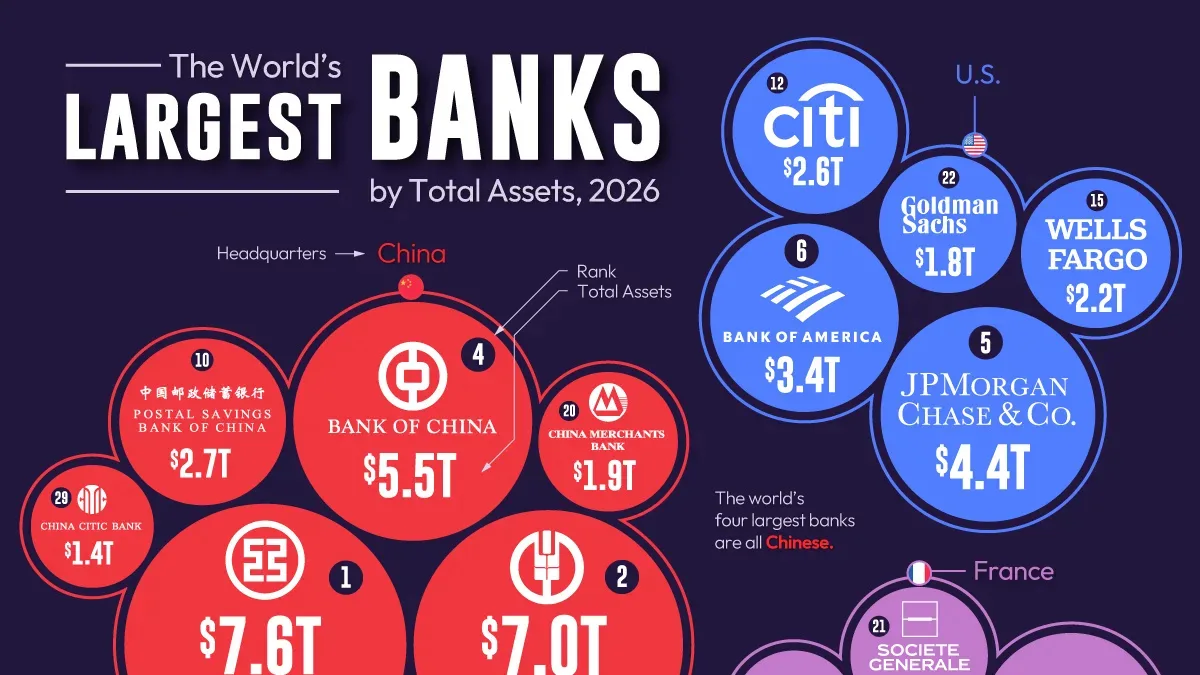
How the World’s 30 Largest Banks Rank in 2026
Key Takeaways
China is home to the world’s four largest banks by total assets.
JPMorgan Chase ($4.42 trillion) is the world’s largest bank outside China.
France’s BNP Paribas ($3.28 trillion) is Europe’s largest bank by total assets.
America’s biggest bank ranks only fifth globally, highlighting the enormous scale of China’s banking system.
This graphic ranks the world’s 30 largest banks using S&P Global Market Intelligence’s April 2026 ranking, based primarily on year-end 2025 financial statements. Total assets include loans, investments, and cash, with banks grouped by the country of their headquarters.
China’s Megabanks Outsize Wall Street
Industrial and Commercial Bank of China (ICBC) leads with $7.65 trillion in assets, roughly 73% more than JPMorgan Chase’s $4.42 trillion.
Together, China’s Big Four banks hold more than $26 trillion in assets, nearly twice the combined total of America’s five largest banks: JPMorgan Chase, Bank of America, Citigroup, Wells Fargo, and Goldman Sachs.
RankCompanyTotal assets (trillions $)
1 Industrial and Commercial Bank of China7.65
2 Agricultural Bank of China6.97
3 China Construction Bank Corp.6.52
4 Bank of China Ltd.5.48
5 JPMorgan Chase4.42
6 Bank of America3.41
7 BNP Paribas3.28
8 HSBC3.21
9 Crédit Agricole3.15
10 Postal Savings Bank of China2.67
11 Mitsubishi UFJ Financial Group2.67
12 Citigroup2.62
13 Banco Santander2.25
14 Bank of Communications2.22
15 Wells Fargo2.15
16 Barclays2.08
17 Sumitomo Mitsui Financial Group2.02
18 Groupe BPC1.99
19 Mizuho Financial Group1.90
20 China Merchants Bank1.87
21 Société Générale1.81
22 Goldman Sachs1.81
23 Royal Bank of Canada1.73
24 Deutsche Bank1.68
25 UBS1.62
26 Industrial Bank1.59
27 Toronto-Dominion Bank1.55
28 Japan Post Bank1.45
29 China Citic Bank1.45
30 Crédit Mutuel1.44
ICBC’s customer base illustrates the scale behind these totals. At the end of 2025, it served 782 million individual customers, more than twice the entire U.S. population, along with over 14.7 million corporate clients.
Europe’s banking hierarchy is also shifting. BNP Paribas ($3.28 trillion) overtook HSBC ($3.21 trillion) as the continent’s largest bank, following acquisitions including AXA Investment Managers. Meanwhile, HSBC has been selling businesses to focus on Asia and the Middle East.
How China Built Such Large Banks
China’s financial system channels an enormous pool of household savings and corporate cash into banks. Those deposits provide a broad funding base for lending, making banks central to financing the country’s economy.
Government priorities also influence where that money goes. With private-sector borrowing subdued, state-owned lenders have expanded financing for technology, green investment, and other strategic sectors. Their growth therefore reflects both everyday banking demand and Beijing’s efforts to support particular industries.
The government is also reinforcing their capacity to lend. In March 2026, Beijing announced plans to issue 300 billion yuan in special government bonds to recapitalize ICBC and Agricultural Bank of China ($6.97 trillion). The additional capital strengthens their financial cushions and supports further lending, even as low interest rates pressure profits.
The Capital Markets Strategy
The U.S. takes a different approach to financing businesses. In 2025, securities such as bonds represented 77.5% of outstanding debt at nonfinancial corporations. Companies can raise money directly from investors, giving them a major alternative to bank loans.
That creates substantial business for Wall Street. Banks earn fees helping companies sell stocks and bonds, arrange acquisitions, and connect with investors. JPMorgan led the global investment banking fee market in 2025, capturing an 8.4% share.
That business model can generate enormous profits without requiring the world’s largest balance sheet. JPMorgan earned $57 billion in net income in 2025, supported by $87 billion in noninterest revenue from activities including trading, investment management, and other services.
The distinction matters: total assets measure a bank’s financial scale, but not necessarily its profitability. China’s banks dominate the global asset rankings, while American banks have more diversified sources of earnings. This helps explain why the largest banks aren’t necessarily the most profitable.
Learn More on the Voronoi App
To explore how satisfied employees are at major banks, check out Banks Dominate the List of U.S. Best Companies to Work for in 2024 on Voronoi.
Source: https://www.visualcapitalist.com/the-worlds-30-largest-banks-in-2026/
Related articles
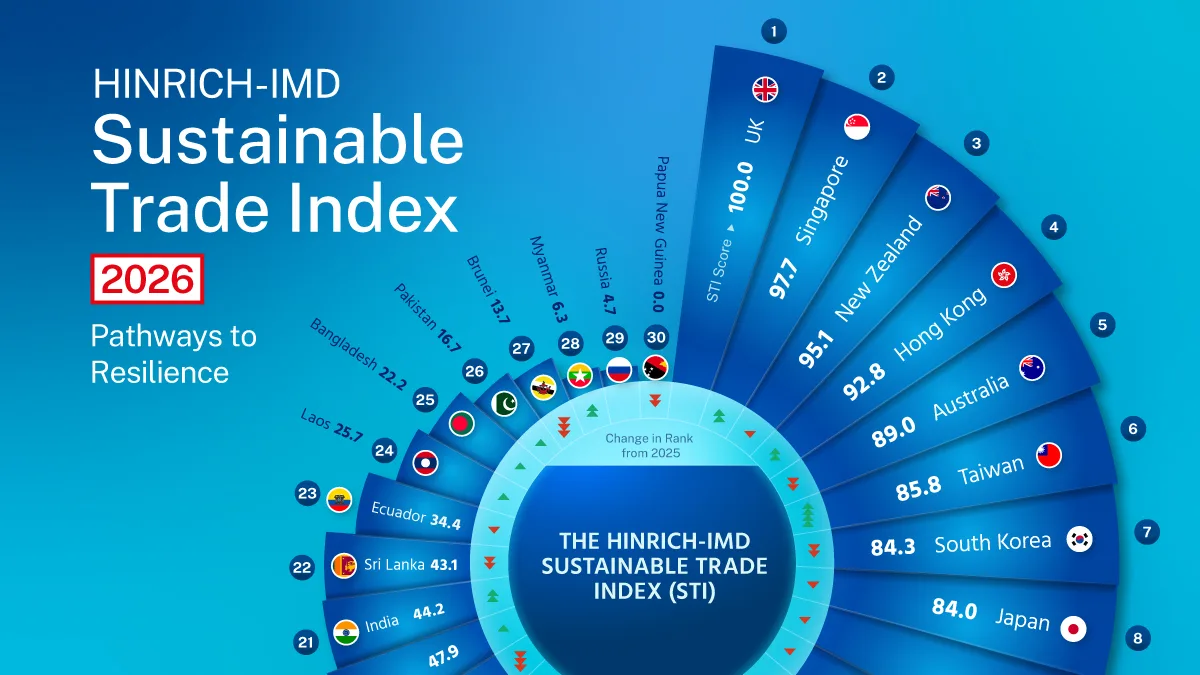
Ranked: The World’s Most Sustainable Trading Economies in 2026
Based on the Hinrich Foundation's 2026 Sustainable Trade Index, which economies are the most and least sustainable?
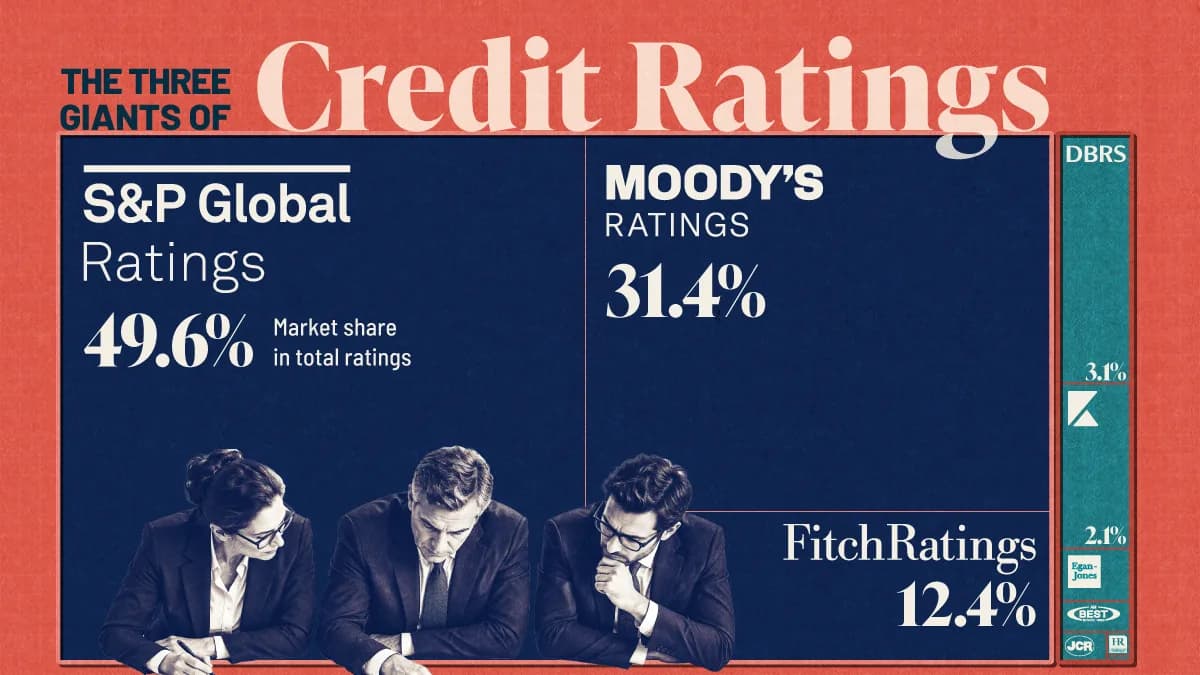
The Credit Rating Agencies Which Price the World
Companies and governments around the world tend to rely on just three big agencies to rate their debt and access capital markets.
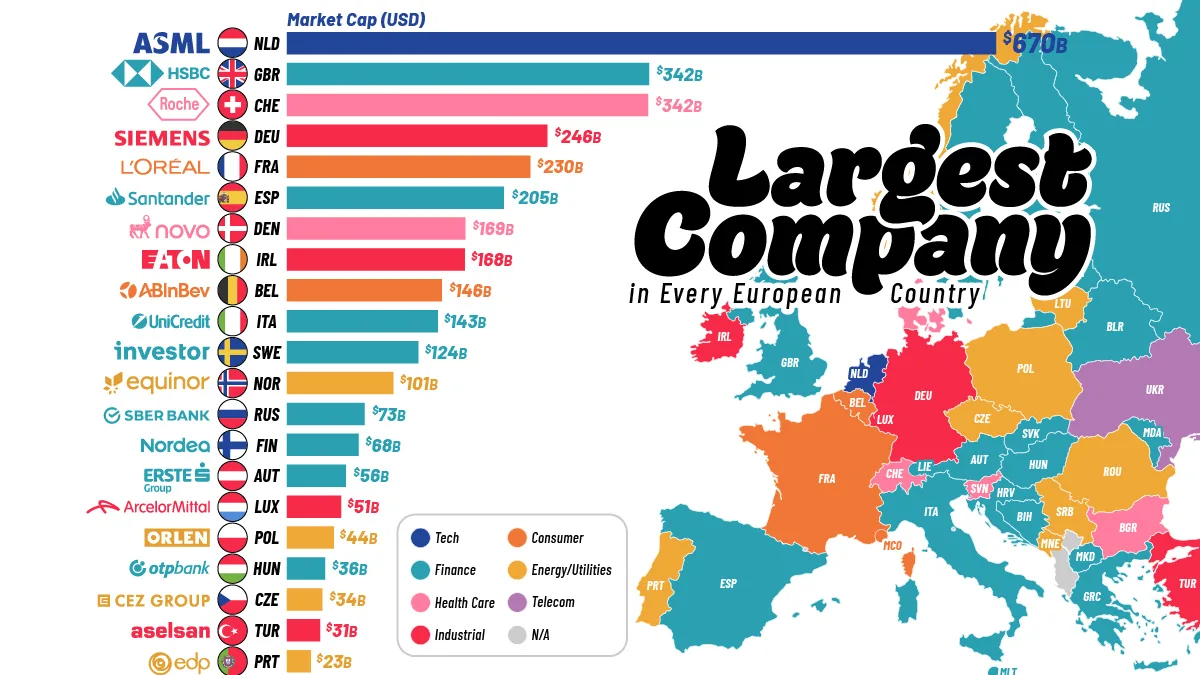
Ranked: The Most Valuable Company in Every European Country
ASML is Europe’s most valuable listed company at $670 billion, but banks lead in 15 of the 42 countries covered.
The Global Stock Market Boom, by Country (2011–2025)
Global equities more than tripled in total market capitalization between 2011 and 2025. One country's stocks powered most of this growth.
Ranked: Profit Margins of the World’s Largest Companies
Nvidia keeps nearly $56 of every $100 in revenue as profit. For some of the world’s largest companies, it’s less than $1.
Mapped: The Most Expensive ZIP Code in Every State
Which ZIP codes have America’s priciest homes? See the most expensive location in every state based on median list prices.