83% capacity after 1,000 cycles: Silicon-rich batteries show promise for EV use
Silicon can store far more charge than graphite, but keeping silicon-rich batteries working over repeated...
This story was prepared automatically by software.
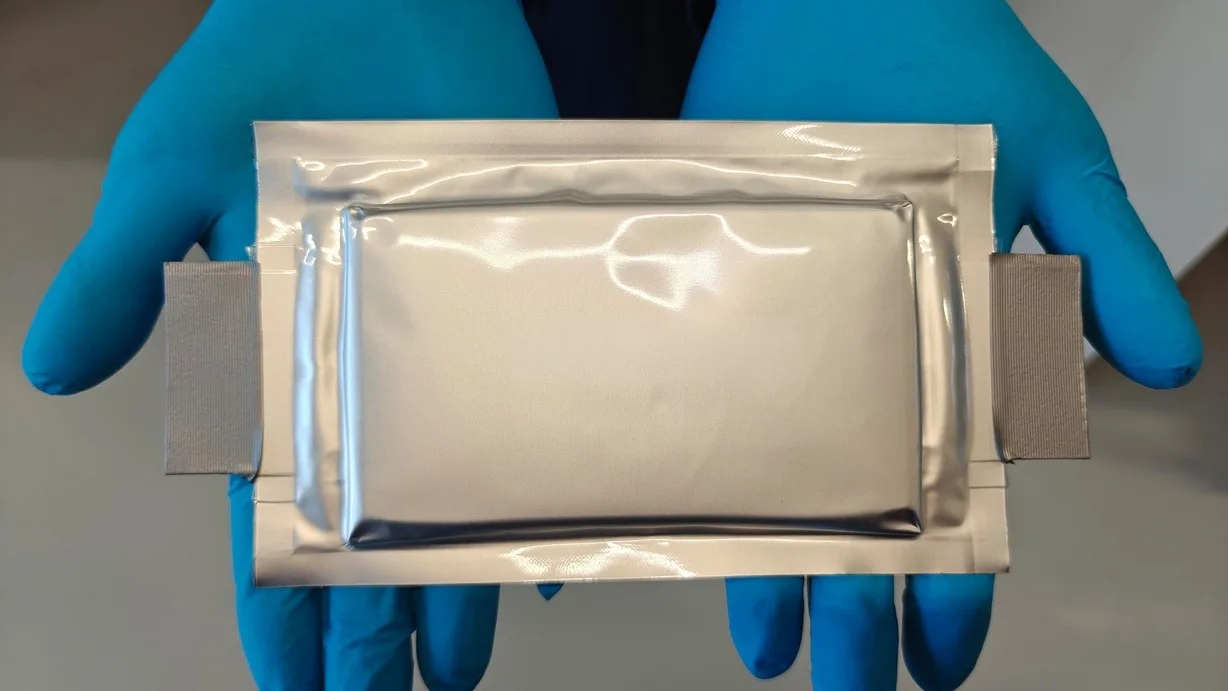
Silicon can store far more charge than graphite, but keeping silicon-rich batteries working over repeated charging cycles remains a hurdle to industrial use.
Researchers at Germany’s Fraunhofer Institute for Solar Energy Systems ISE have now tested pouch cells that retained over 83 percent of their original capacity after more than 1,000 full cycles.
Announced on October 20, the StrOboBatt project results came from in-house-manufactured, 25-Ah cells with silicon-rich anodes.
The research cells achieved an energy density of 280 Wh/kg, advancing high-energy batteries for electric mobility, aerospace, and stationary storage.
The results also highlighted an operating requirement: mechanical pressure significantly affected the cells’ ability to maintain performance.
Tackling silicon’s durability hurdle
“Cycle life is one of the key hurdles to the widespread industrial use of silicon-rich anodes. More than 1,000 cycles with a capacity retention of at least 80 percent is considered an important performance target here,” said Dr. Lukas Dold, team leader for battery materials technology and scaling at Fraunhofer ISE.
The team manufactured multilayer full cells containing 40 layers, using commercially available electrode foils. These paired a silicon-carbon/graphite anode with a nickel-rich nickel-manganese-cobalt oxide cathode.
Silicon has a theoretical specific capacity ten times that of graphite, the material currently used in battery anodes. In the test cells, a silicon-carbon composite accounted for 51 percent of the anode active material.
The anodes achieved a specific capacity above 1,000 mAh/g and an areal capacity exceeding 5 mAh/cm².
Fraunhofer ISE expects an industrially optimized pouch cell format to reach approximately 330 Wh/kg.
That figure is a projection; the demonstrated energy density was 280 Wh/kg in the institute’s non-optimized PrecISE research format.
A high-energy pouch cell with a silicon-dominant anode, manufactured at Fraunhofer ISE, in its aged state after 1,000 full cycles. Credit: Fraunhofer ISE
Pressure shapes battery performance
Researchers tested the cells at axial contact pressures of 300 and 1,000 kilopascals during 1C charging and discharging. Regular check-up cycles at lower current rates helped them evaluate how pressure influenced cycle stability.
External pressure can improve interfacial resistance and reduce the risk of electrode materials separating from one another or their substrate, an issue particularly relevant to silicon-containing anodes.
“Axial pressure has a significant impact on the long-term behavior of the cells. At a contact pressure of 1,000 kPa, our cells still retain over 83 percent of their original capacity even after more than 1,000 full cycles,” explained Marc Kissling, group leader for battery cell production and technology evaluation at Fraunhofer ISE.
Cells operating at 300 kilopascals showed a greater decline in usable capacity, particularly during 1C operation.
Moving toward industrial validation
The team also observed a growing gap between residual capacity measured at low discharge rates and capacity available during regular 1C operation. Capacity retention alone therefore does not fully describe these cells’ operating performance.
Manufactured on a semi-automatic cleanroom production line, the pouch cells serve as references for evaluating materials, designs, and operating conditions.
Fraunhofer ISE’s infrastructure covers electrode mixing, roll-to-roll coating, cell assembly, formation, and electrochemical characterization.
This lets researchers assess new battery concepts throughout the manufacturing process while examining the conditions needed to sustain performance.
Source: https://interestingengineering.com/innovation/1000-cycle-life-for-silicon-pouch-cells
Related articles