
Deep boreholes could slash disposal costs for nuclear fuel recycling waste, study finds
Deep boreholes could provide a safe and relatively low-cost way to permanently dispose of radioactive...
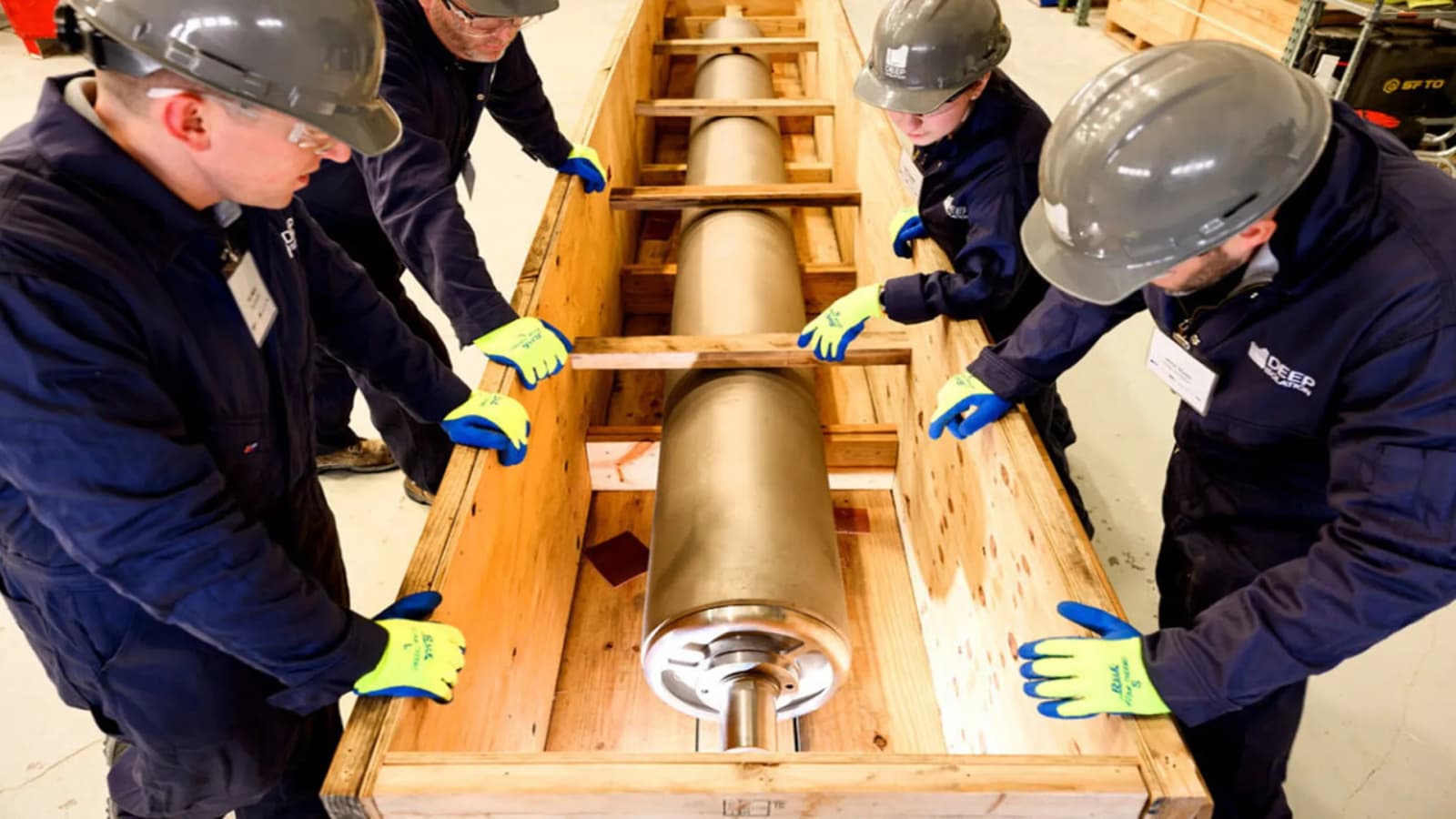
Deep boreholes could provide a safe and relatively low-cost way to permanently dispose of radioactive waste left after used nuclear fuel is recycled, according to results from a three-year US Department of Energy-funded project.
Deep Isolation evaluated multiple disposal scenarios involving waste from recycled nuclear fuel. Its analysis found that every scenario studied was projected to cost less than the program’s target of 0.1 cent per kilowatt-hour of electricity generated.
Long-term safety modeling also found that all scenarios under expected conditions met the study’s safety criteria. In most cases, projected radiation doses to the public were orders of magnitude below the 10 millirem-per-year regulatory benchmark used in the analysis.
The research was conducted under the Department of Energy’s ARPA-E CURIE program with Argonne National Laboratory, Oklo and Case Western Reserve University. Deep Isolation was responsible for studying how recycling waste could be packaged and permanently isolated underground.
Burying recycled nuclear waste
The company’s approach uses deep boreholes drilled into geologically suitable rock formations. The project considered its Universal Canister System in both horizontal and vertical borehole configurations.
Researchers examined the full disposal process, including the characteristics of waste produced during fuel recycling, how that material could be packaged, repository design, long-term safety and disposal economics.
“This project shows the value of designing recycling and disposal systems together rather than treating waste management as a downstream consideration,” said Jesse Sloane, executive vice president of engineering at Deep Isolation.
The work is designed to complement emerging approaches that aim to extract additional value from used nuclear fuel rather than treating all of it as waste.
Oklo, one of the project partners, is developing a fuel strategy involving used-fuel recycling, fuel fabrication and power generation. Its planned process would use pyroprocessing to recover usable fuel materials, fabricate them into new fuel and use that fuel in advanced fast reactors.
Even after recycling, however, radioactive material requiring permanent disposal remains. The CURIE project examined whether deep boreholes could provide that final disposal pathway without undermining the economics of recycling.
Canisters link fuel cycle
A key part of Deep Isolation’s approach is its Universal Canister System, or UCS. The triple-purpose system is being developed to handle spent fuel and high-level radioactivewaste during storage, transportation and eventual disposal.
The company says the design could accommodate waste streams from both existing and advanced reactors. The CURIE analysis considered how the canisters could be placed in either vertical or horizontal deep borehole repositories.
“Closing the fuel cycle is about unlocking the full value of used nuclear fuel — recovering its energy potential and extracting isotopes, while safely and permanently managing what remains,” said Ed Petit de Mange, vice president of fuel recycling at Oklo.
The findings could also inform the Department of Energy’s Nuclear Lifecycle Innovation Campuses, where fuel recycling is being explored alongside other parts of the nuclear fuel cycle.
Deep Isolation is separately working toward real-world deployment of its technology. In January 2026, the company launched a full-scale, at-depth commercialization pilot in Cameron, Texas, aimed at demonstrating its deep-boreholedisposal system.
Source: https://interestingengineering.com/energy/deep-borehole-nuclear-waste-recycling-disposal
Related articles

OpenAI wants to consult elite mathematicians about how to not fumble again
After turning a string of spectacular mathematical results into a reputational crisis, OpenAI is consulting human mathematicians to help it figure out a less disastrous path forward.
US team to build offshore system for industrial-scale uranium recovery from seawater
SuperCritical Materials has partnered with the University of Michigan to engineer and test offshore systems...
US Army tests 30mm combat vehicle with counter-drone and target-sharing systems
BAE Systems has delivered two new AMPV 30 concept infantry fighting vehicles to the US...


Rabbit’s new AI agent doesn’t need an R1 to run
Rabbit, the company behind the underwhelming R1 device, is rolling out a standalone AI agent that you don't need its hardware to use, as reported earlier by Wired.
US military orders 4,000 one-way attack UAVs with single-operator drone swarm control
Swarm Defense Technologies has received an order from the US Department of War for 4,000...