
Deep-sea ‘doomsday fish’ could inspire the next generation of stealth submarines
Sometimes nature can be the best inspiration even for robots. Cornell engineering professor Rob Shepherd...
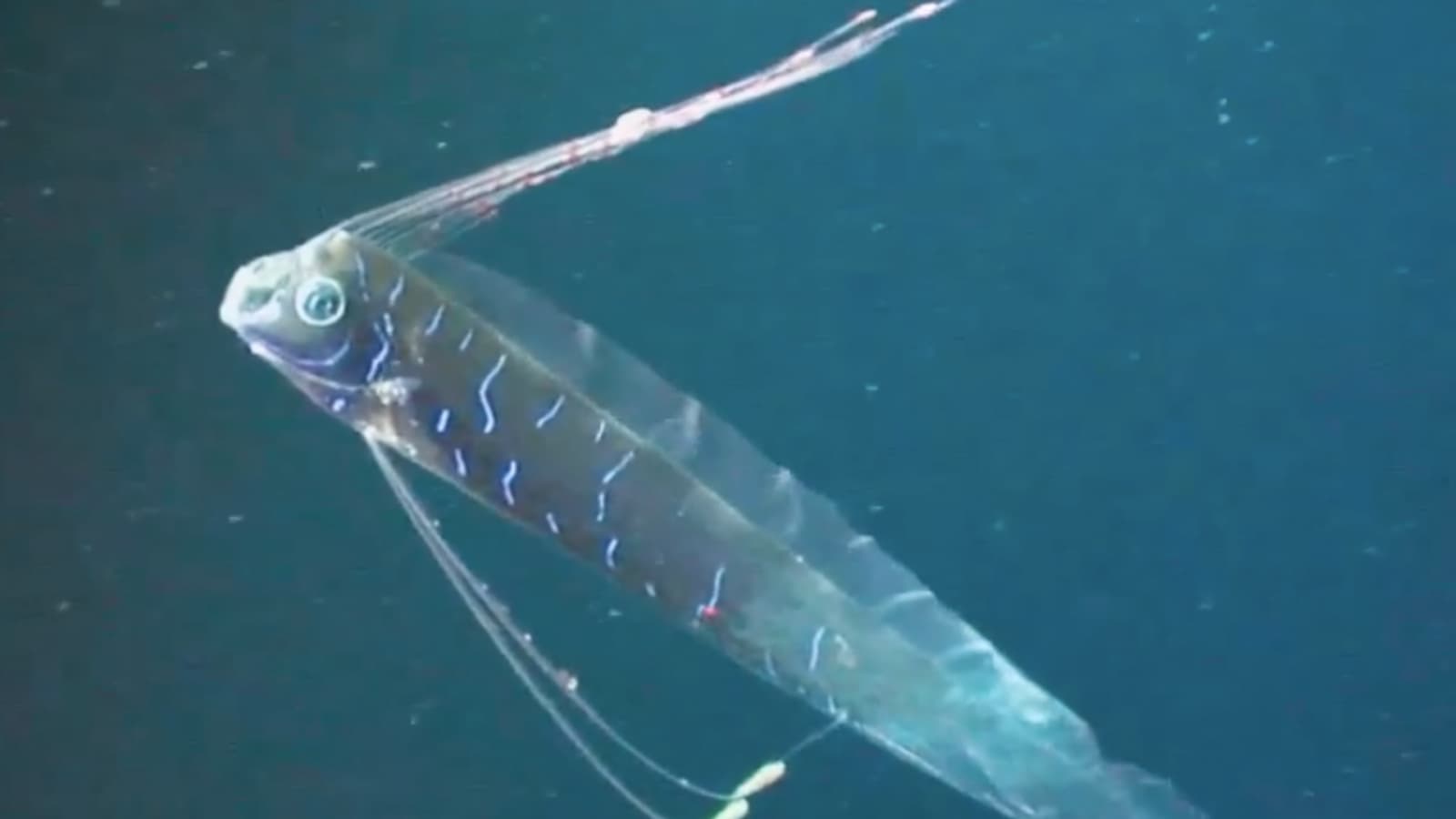
Sometimes nature can be the best inspiration even for robots. Cornell engineering professor Rob Shepherd sought to design a large, silent underwater robot to monitor ocean health without startling marine life. He looked to the rare, deep-sea oarfish for inspiration due to its unique swimming mechanics.
The goal was to understand how the oarfish, which are the longest bony fish alive, move.
Biomimetic propulsion creates a smooth laminar flow, enabling stealthy underwater mapping and long-term marine life monitoring.
A silent ghost in the water
Naval propellers roar underwater. Fish run away.
To build a stealthy ocean-monitoring platform for the Office of Naval Research, Professor Shepherd needed a propulsion system that would not startle marine life. He found his inspiration in the mysterious, ribbon-like oarfish, which can grow up to 26 feet long and are also known as a “doomsday fish.”
While most long-bodied marine creatures swim like eels by flexing their whole bodies, the oarfish remains almost perfectly still. It relies entirely on a single, continuous dorsal fin to glide forward and backward silently.
“If you swim in Cayuga Lake in the summer and a boat goes by, it’s really loud,” Shepherd noted. “A more biomimetic approach would make it better for playing along with fish.”
To understand how the creature achieves this feat, Shepherd teamed up with retired Cornell ichthyologist Willy Bemis.
Studying an intact oarfish is remarkably difficult because their bodies typically disintegrate into brittle segments upon death. Using CT scans, X-rays from the Smithsonian Institution, and detailed dissections, the research team dissected the mechanics behind the fish’s long dorsal ridge.
Joysticks under the skin
What they discovered was an astonishing natural engine hidden beneath the creature’s skin. Hundreds of individual bone-like fin rays sit atop specialized ball-and-socket joints, operating much like miniature “joysticks” along the length of its back.
Dedicated sets of muscles and cartilage power each individual ray, giving every single segment full 360-degree rotational freedom. The connecting membrane can send propulsion waves in opposite directions at the same time. This unique mechanics grants the oarfish exceptionally precise control, allowing it to adjust speed and direction instantly without ever bending its body posture.
“They’re continuously able to change the pattern of those dorsal fin rays and do it very quickly,” Bemis said. “The fin rays are incredibly mobile.”
While ribbon-fin swimming has evolved independently in bony fishes roughly ten times, this is the first study to document spinning, joystick-like fin rays in the species.
Engineers are now taking these biological blueprints off the page. By mimicking the oarfish’s fluid control, Shepherd’s team aims to construct large, silent robotic monitors capable of observing fragile ocean ecosystems without ever disturbing the wildlife inside them.
Nature offers millions of years of evolutionary testing, providing roboticists with battle-tested mechanical designs, energy-efficient propulsion, and adaptive behaviors. Researchers have designed various biomimetic robots in the past.
Geckos scale smooth vertical surfaces without adhesives or suction cups thanks to microscopic hairs on their feet called setae. These microstructures generate molecular-level van der Waals forces that bind the foot pads to surrounding surfaces.
Stanford roboticists applied this concept to build Stickybot, a climbing robot featuring synthetic foot pads modeled after gecko toes. The specialized material enables robotic grippers to cling securely to glass, smooth panels, and space equipment without leaving sticky chemical residue.
The new study was published in the journal Ichthyology and Herpetology.
Related articles

Who Controls the Critical Minerals Powering AI?
AI’s rapid growth depends on critical minerals. Here’s which countries dominate production of gallium, rare earths, and tantalum.

Steam Deck 2: Is AMD Gainsborough the chip Valve’s been waiting for?
The Steam Deck is four and a half years old, and handheld gamers are eagerly awaiting a Steam Deck 2 - but Valve has consistently said it needs a new chip with a "generational leap" in performance…

US Navy adds M-Code GPS to shield carrier landings from jamming threats at sea
BAE Systems has secured a $16 million award to modernize GPS guidance aboard U.S. Navy...

Judge dismisses antitrust lawsuits over Google’s AI Overviews
A federal judge has dismissed a pair of antitrust lawsuits filed by Chegg and Rolling Stone parent company Penske Media Corporation, which accused Google of driving away web traffic with its…

MindOn’s new Mind-1 model brings human-speed execution to robots
MindOn has unveiled Mind-1, a new physical AI model designed to make robots perform everyday...

Airbus A350F takes maiden flight with 111-ton payload and 5,400-mile range
Airbus’s A350F cargo jet has taken to the skies for the first time and completed...