
Engineers use tiny light beam to rewrite magnetic memory at high speed
For decades, magnetic data storage has depended on the general idea of using a magnetic...
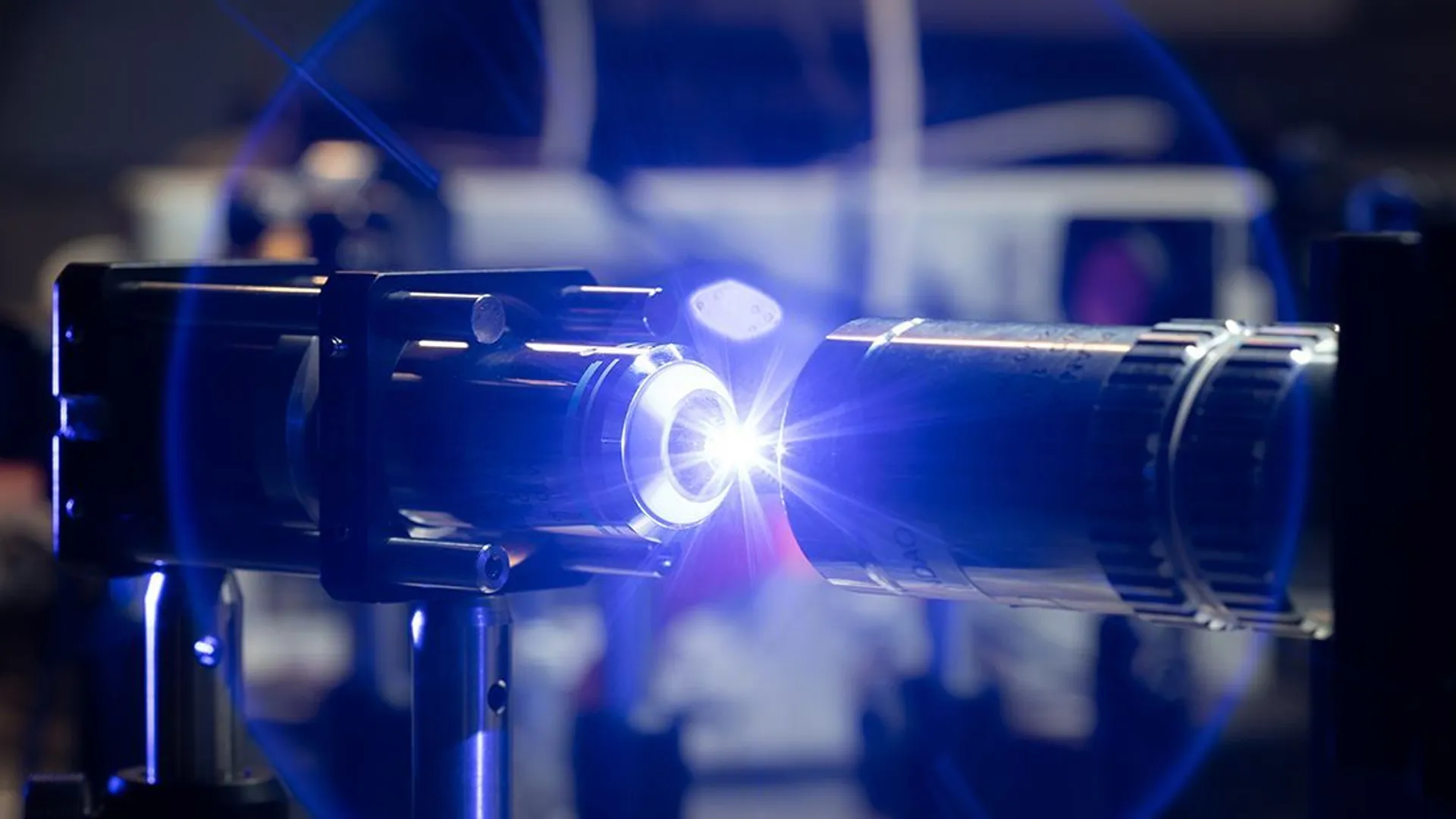
For decades, magnetic data storage has depended on the general idea of using a magnetic field to flip tiny regions of a material between states representing 1s and 0s. However, magnetic fields consume energy and limit how quickly those bits can be switched.
Now, engineers at the University of California San Diego (UCSD) have demonstrated a different route using specially engineered light to rewrite magnetic information.
Their experiments show that optical switching can work in a magnetic material far thicker than previously demonstrated, with helicity-independent magnetization reversal. This approach could eventually help make magnetic memory faster, denser, and more energy efficient.
The challenge is that making light switch magnetism has not been straightforward. Earlier experiments showed optical switching only in magnetic stacks containing no more than three layers.
Making the material thicker suppressed the effect, limiting both the physical design of the memory and potentially its ability to retain information. Researchers also had to use a specific polarization of light.
Instead of searching for another material that could overcome these restrictions, the UC San Diego team changed the light itself. “We’ve optically engineered the light to change the physics that’s happening in the material at the micro- and nanoscale,” Muhammad Waleed Khalid, lead researcher and a PhD student at UCSD, said.
Shrinking and reshaping the light
The researchers used an ultrafast laser and engineered its beam so that its energy was concentrated into an extremely small region. When the focused spot was reduced below 1.36 micrometers, the switching became helicity-independent.
By shaping the beam, they could alter both the local heating and optical torques acting on the material, changing how its magnetization responds to the light.
They tested the approach on a magnetic material made from nine alternating layers of platinum and cobalt. This was substantially thicker than the three-layer limit seen in earlier experiments.
The researchers found that the material could undergo helicity-independent magnetization reversal, overcoming a major constraint of earlier approaches.
How the magnetic switch works
The switching itself happens through a sequence of ultrafast laser pulses. The first pulses concentrate enough energy into a tiny spot to heat a small region and create a reversed magnetic area. Additional pulses then cause that switched region to expand until it reaches a stable state.
“Working with a specialized laser allowed us to optically engineer the beam to have a certain shape and size. That gave us the room to explore more fundamental physics, which cannot be done with conventional beam lasers,” Khalid added.
The researchers estimate that optical switching could ultimately be more than 1,000 times faster than methods that use external magnetic fields. Also, since the switched region is determined by where the tightly focused light deposits its energy, shrinking the beam could allow magnetic information to be packed more densely.
“The smaller the size of the beam, the smaller and more dense the optical memory,” Abdoulaye Ndao, senior researcher and a professor at UCSD Jacobs School of Engineering, said.
The unusual results were not immediately easy to establish. The team repeatedly tested the experiments because the effects appeared so different from what researchers had previously observed.
“The effects we were seeing were so new and unusual that we had a difficult time convincing others in the field that our discovery was not a one-time fluke. We spent a lot of time and effort repeating and verifying our experiments to substantiate our work to the optics community,” Khalid said.
A new way to control magnetism
Rather than redesigning the magnetic material to make optical switching possible, the researchers demonstrated that carefully shaping the light could change how the material responds.
“Instead of designing a new material to enable optical switching, we redesigned the light itself and showed new properties that were not previously thought to be possible,” Ndao notes.
However, the proposed technology is still far from being used in commercial storage devices. The specialized ultrafast laser currently required is difficult to integrate into computer chips.
The researchers are therefore exploring magnetic materials that could produce similar effects with lasers more compatible with electronic systems.
They also want to shrink the beam further, potentially to a few hundred nanometers, using optical structures that can confine light into even smaller spaces. If successful, that could provide a way to study and eventually control magnetism at scales far smaller than those accessible with conventional magnetic switching.
The study is published in the journal Nature Communications.
Source: https://interestingengineering.com/science/engineers-shrink-light-for-denser-magnetic-memory
Related articles

Scientists build a palladium membrane to keep water out of green ammonia reactors
For years, scientists have tried to make ammonia without relying on fossil-fuel-derived hydrogen, but they...

18-detector neutrino system probes rare particle interactions near nuclear reactor
MIT researchers working on an international neutrino experiment have expanded its detector setup from two...

Hafnium oxide stays stable at 1,562°F, boosting future capacitors, memory and cooling
Researchers at the University of Nebraska–Lincoln have found evidence that could change how engineers view...

US scientists take real-time look at spacecraft heat shields that withstand 1,652 °F temperature
Researchers in the United States have got real-time look inside spacecraft heat shields during extreme...

China’s Chang’e 7 delay may have dodged a bullet for US in moon race, says NASA chief
China’s decision to delay its Chang’e 7 lunar mission until early next year has drawn...
New vertical quantum sensor works in magnetic fields 20,000 times stronger than Earth
Researchers at the University of Twente in the Netherlands have built a vertical quantum sensor...