
Scientists build a palladium membrane to keep water out of green ammonia reactors
For years, scientists have tried to make ammonia without relying on fossil-fuel-derived hydrogen, but they...
For years, scientists have tried to make ammonia without relying on fossil-fuel-derived hydrogen, but they couldn’t figure out a way to move hydrogen ions into the reaction chamber without letting water come along with them.
A South Korean research team has now demonstrated a way around this problem using a dense palladium membrane that temporarily turns hydrogen ions into hydrogen atoms, moves them through the metal, and converts them back into ions on the other side.
This approach allowed the researchers to make ammonia using water as the hydrogen source while keeping the water-sensitive reaction compartment largely dry.
“Our study introduces a new ion transport mechanism, expanding the design space for next-generation electrochemical systems that require strict compartmentalization,” the study authors note.
Why water is a problem
Electrochemical ammonia synthesis could use renewable electricity to produce ammonia from nitrogen and water rather than relying on fossil-fuel-derived hydrogen.
However, the researchers used lithium-mediated nitrogen reduction, or Li-NRR, in which nitrogen reacts in a non-aqueous electrolyte.
Even small amounts of water entering this compartment can interfere with the lithium chemistry and form an unwanted solid-electrolyte interphase that eventually hurts the reaction.
The conventional solution is an ion-exchange membrane. These membranes contain water-filled pathways that allow protons to move between the two sides, but those same pathways can also allow water and other molecules to cross.
Trying to make them more selective generally compromises their ability to transport ions quickly, creating a long-standing conductivity-versus-selectivity trade-off. The researchers took a different approach, which is to make the metal itself carry the hydrogen.
The power of palladium
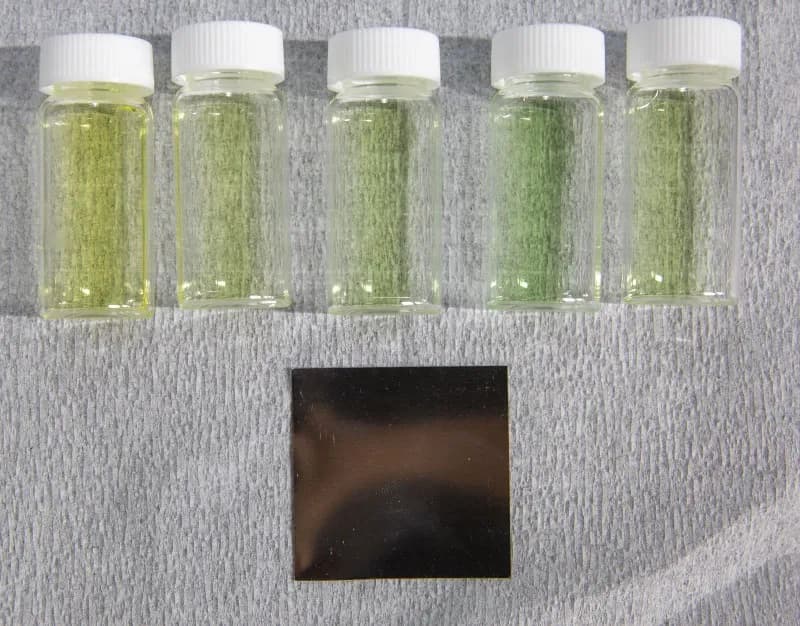
The researchers used a dense palladium foil as a membrane. When hydrogen ions reach one side, an applied electric field causes them to gain electrons and enter the palladium as hydrogen atoms.
Palladium can store hydrogen in its lattice, forming palladium hydride (PdHₓ), allowing those hydrogen atoms to diffuse through the metal. At the opposite surface, they are released as hydrogen ions again.
This hydrogen-storage property is crucial. Experiments with metals such as platinum and nickel did not produce the same proton-shuttling behavior because they cannot store hydrogen in the same way.
In other words, the membrane isn’t simply a dense metal barrier; its ability to temporarily absorb hydrogen is what makes the transport mechanism work.
“We demonstrate a unique proton shuttling mechanism of the bipolar palladium membrane that enables selective proton transport while suppressing molecular crossover,” the study authors added.
The palladium membrane placed alongside different solutions. Source: KOREA INSTITUTE OF ENERGY RESEARCH
The researchers then connected the membrane to a continuous-flow ammonia electrolyzer. Water at the anode underwent the oxygen evolution reaction (OER), generating protons. The palladium membrane transported those protons into a separate, non-aqueous catholyte, where nitrogen underwent Li-NRR and was converted into ammonia.
This allowed water to provide the hydrogen source without exposing the lithium-mediated reaction to the aqueous compartment.
In a 12-hour continuous-flow test, the new system maintained its ammonia performance while the water content of the catholyte remained just 105 parts per million, far below previously reported water crossover through ion-exchange membranes.
“This achievement is significant in that our proposed novel ion-transport mechanism provides an effective solution to the crossover issue, which remains a primary barrier to implementing green ammonia synthesis through electrochemical devices,” Jae-Hyung Kim, one of the study authors and a senior researcher at Korea Institute of Energy Research (KIER), said.
The researchers also tested a less volatile diglyme-based electrolyte for longer operation. The system ran for approximately 79 hours, with ammonia Faradaic efficiency (the share of the electrical current that produced ammonia) still at 50 percent after 72 hours. The experiment eventually stopped when the catholyte gelled and blocked the flow channel.
A membrane with potential beyond ammonia
The results do not yet make the technology ready for industrial ammonia production. The extended experiment revealed several obstacles, including catholyte degradation, changes to the palladium surface, and about 5 ppm of dissolved palladium after prolonged operation.
The researchers say future work will need to improve the electrolyte, flow-cell design, and stability of the palladium membrane.
Still, the significance of the work extends beyond ammonia. By moving hydrogen through a metal lattice instead of transporting hydrated protons through a water-filled polymer, the approach offers a new way to keep chemically incompatible environments separated inside electrochemical devices.
“The developed technology holds high potential for broader applications across various electrochemical devices that demand even stricter mass separation than ammonia synthesis,” Kim said.
The study is published in the journal Advanced Science.
Related articles

18-detector neutrino system probes rare particle interactions near nuclear reactor
MIT researchers working on an international neutrino experiment have expanded its detector setup from two...

Hafnium oxide stays stable at 1,562°F, boosting future capacitors, memory and cooling
Researchers at the University of Nebraska–Lincoln have found evidence that could change how engineers view...
US scientists take real-time look at spacecraft heat shields that withstand 1,652 °F temperature
Researchers in the United States have got real-time look inside spacecraft heat shields during extreme...

China’s Chang’e 7 delay may have dodged a bullet for US in moon race, says NASA chief
China’s decision to delay its Chang’e 7 lunar mission until early next year has drawn...
New vertical quantum sensor works in magnetic fields 20,000 times stronger than Earth
Researchers at the University of Twente in the Netherlands have built a vertical quantum sensor...

256-qubit quantum computer heads to Florida for research across health and energy
US quantum computing company IonQ will install a 256-qubit trapped-ion quantum computer at Florida International...