New vertical quantum sensor works in magnetic fields 20,000 times stronger than Earth
Researchers at the University of Twente in the Netherlands have built a vertical quantum sensor...
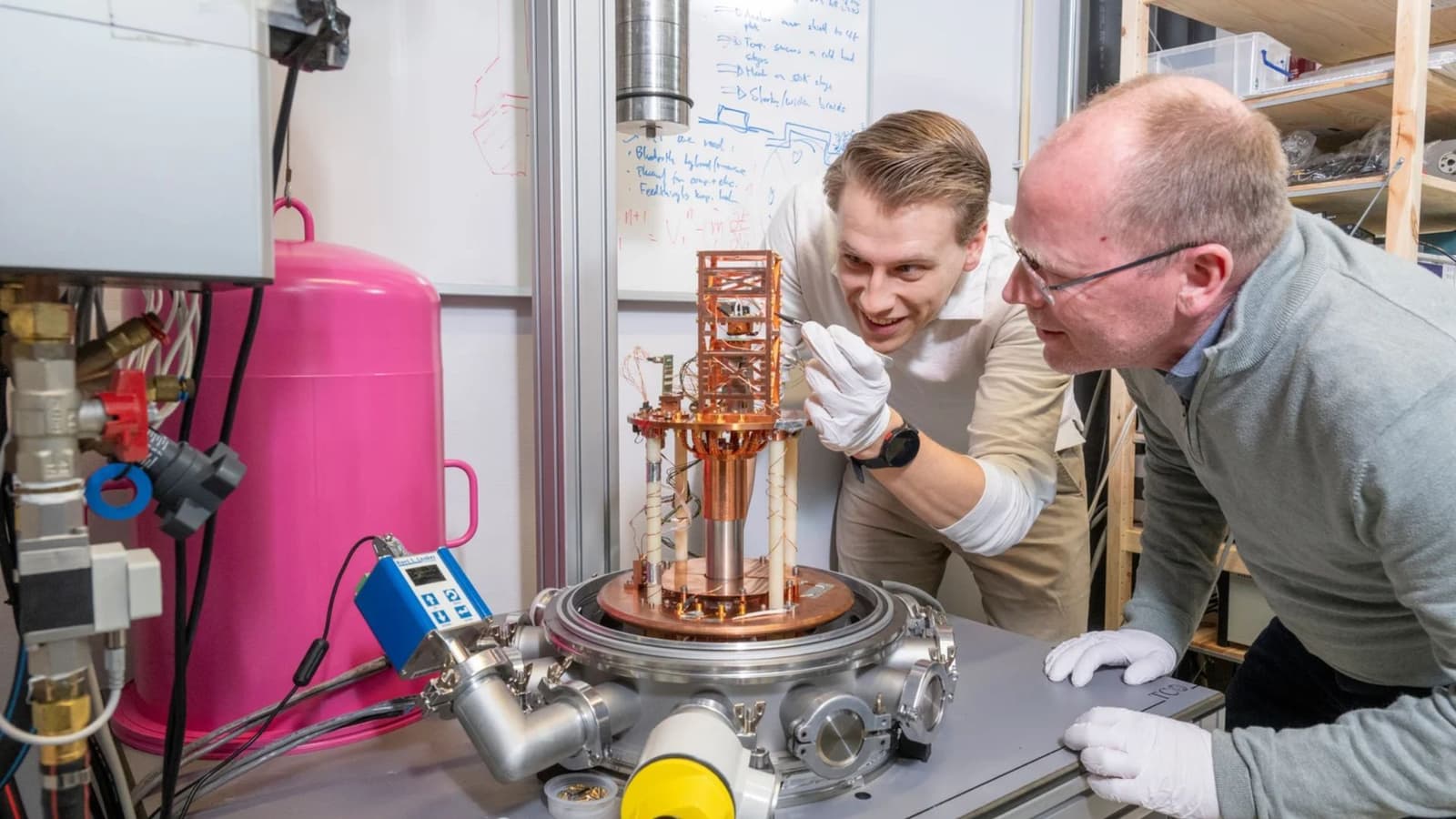
Researchers at the University of Twente in the Netherlands have built a vertical quantum sensor that can measure nanoscale patterns in quantum materials and works in a magnetic field of 1 Tesla, which is 20,000 times stronger than that of the Earth.
Recent advancements in our understanding of quantum technologies and the properties of quantum materials have led to rapid advancements in new applications. To further refine these applications and bring them into the real world, scientists need to understand further how currents and magnetic fields operate in these materials.
Since quantum technologies run at nanoscales, scientists also need to build sensors that can work at these scales. A Superconducting QUantum Interface Device (SQUID) is an ultra-sensitive magnetometer that can measure extremely weak magnetic fields. However, magnetic fields weaken with distance, so the sensor must stay very close to the material to make measurements.
A sensor lying flat in the plane of a quantum chip cannot capture details of the magnetic fields several micrometers away. So, a research team led by Hans Hilgenkamp, a professor of Applied Physics and Nanotechnology at the University of Twente, built a vertical sensor by putting it on a pyramid and bringing it as close to quantum chips as possible to see whether quantum materials do their work.
How was the sensor built?
Instead of building the pyramid, the research team hollowed it out from a slice of silicon. To do this, they used a liquid to etch out pits shaped like pyramids and placed a thin film of glass-like material on it. When the film is removed, the material remains only at the edges. The technique is known as corner lithography and leaves only a frame of extremely thin wires running along the edges of the pyramid.
When the surrounding silicon is removed, the pyramid is left standing upright at the end of a thin arm. The researchers then added a layer of niobium, a superconducting metal, over the wires and then split the two constrictions on top into a ring using a beam of charged particles to complete the sensor.
Conventionally, chips are made in flat planes, and while stacking is becoming more common, it can only be achieved layer by layer. The building of the quantum sensor shows that three-dimensional structures with working electronics inside them can also be made.
Advantages of the sensor
Quantum material research often takes place in areas with strong magnetic fields. However, this does not work well for a superconducting sensor since strong magnetic fields destroy its superconductivity, making them rather useless when you really need them.
The pyramid sensor works reliably at 1 Tesla, which is 20,000 times stronger than the Earth’s magnetic field. Another advantage is that the sensor frame has four wires but needs only two for magnetic field measurements. The researchers use the other two tips for steer the sensor and tune it sensitivity during the scanning process.
Much of the work in building a SQUID sensor has been done by hand so far. This research shows that building these sensors at scale from a silicon wafer, much like computer chips are made, is also now possible. The researchers added that hundreds of these sensors could be made in a single run, with nearly 90 percent of the chips being usable.
The researchers published the findings in the journal Physical Review Applied.
Source: https://interestingengineering.com/science/scientists-build-vertical-quantum-sensor
Related articles
256-qubit quantum computer heads to Florida for research across health and energy
US quantum computing company IonQ will install a 256-qubit trapped-ion quantum computer at Florida International...