
Human gut-inspired biobattery delivers 0.75 volts for 14 hours in US lab tests
Researchers at Binghamton University have developed a bacteria-powered battery inspired by the human small intestine...
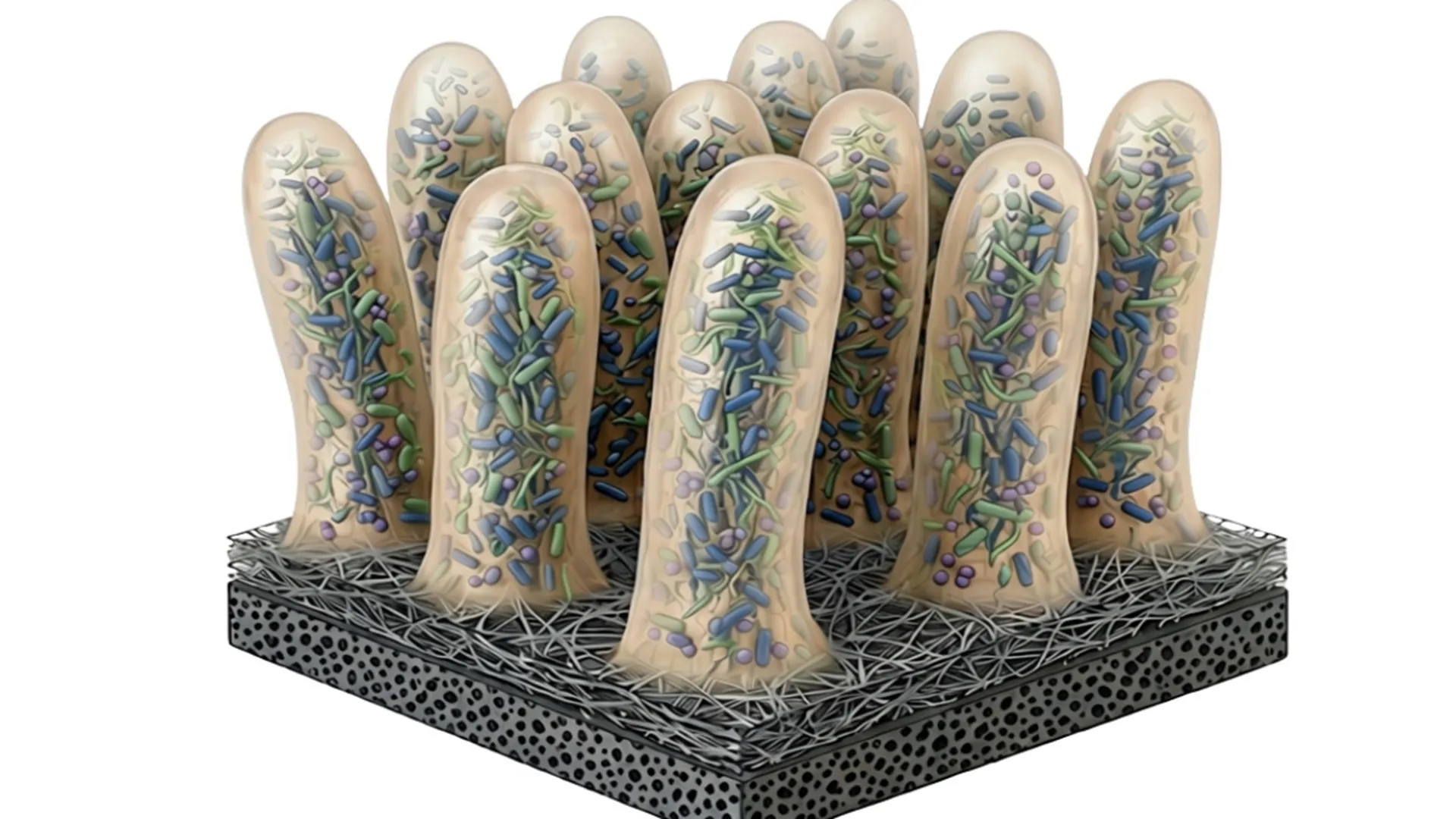
Researchers at Binghamton University have developed a bacteria-powered battery inspired by the human small intestine that maintained an output of about 0.75 volts for at least 14 hours during testing.
The device uses flexible, finger-like structures inspired by intestinal villi to provide more space for bacteria to grow while improving nutrient delivery and waste removal. These tiny projections, which normally help the intestines absorb nutrients, offer a model for improving electricity generation using spore-forming bacteria.
A team of researchers fabricated the structures using a flexible polymer hydrogel and embedded Bacillus subtilis bacteria within them. The structures serve as the battery’s anode, where bacterial activity helps generate electricity.
The team says the technology could eventually be installed in wastewater pipelines, using organic waste as a nutrient source to generate electricity for low-power devices.
Overcoming flat electrode limitations
Bacteria-powered batteries generate electricity by harnessing the metabolic activity of microorganisms. However, their performance depends partly on how effectively bacteria receive nutrients and release waste.
Conventional two-dimensional electrodes provide limited surface area for bacterial growth. Porous materials offer additional space but can become clogged as bacteria form biofilms, restricting the movement of nutrients and waste products.
“Porous structures can be easily clogged by biofilm formation, so we had a lot of problems with nutrient delivery, waste buildup or uneven biofilm growth,” said Seokheun “Sean” Choi, a professor of electrical and computer engineering at Binghamton University.
To address these problems, Choi and doctoral researchers Ruohan Zhang and Botian Wang turned to the structure of the small intestine.
The intestinal villi provide a large surface area while allowing nutrients to move across relatively short distances. The researchers sought to reproduce these advantages in a flexible battery electrode.
They created finger-like projections from a polymer hydrogel commonly used in biomedical applications. The material allowed them to build a three-dimensional structure capable of accommodating bacteria throughout the electrode.
The bacteria-containing structures form the anode, while a modified carbon-cloth cathode sits on the opposite side of an ion-exchange membrane. Together, these components allow the device to produce electricity as the bacteria metabolize nutrients.
Wastewater applications remain untested
The researchers envision placing future versions of the biobattery inside wastewater pipes, where microorganismscould use organic matter in the water as fuel.
“We can put this biobattery in a waste pipe, because it can easily be integrated with its surroundings,” Choi said.
The flexible hydrogel could allow the battery to conform to different pipeline shapes and sizes. Such systems might eventually supply electricityto small sensors without requiring conventional batteries.
However, the research remains at an early stage. The reported voltage was maintained with a continuous supply of nutrient medium, and the team has not demonstrated the system operating inside a wastewater pipeline.
The researchers also want to simplify manufacturing through a single-step printing process that could make the structures easier to produce at scale.
Another goal is to improve how bacteria are distributed within the device. In the human intestine, microorganisms are concentrated mainly in a mucus layer near the villi’s surface. The current design embeds bacteria throughout the hydrogel instead.
Future work will examine whether reproducing more of the intestine’s physical and chemical conditions can help maintain bacterial activity and improve performance.
The findings were published in the journal Small.
Source: https://interestingengineering.com/energy/gut-inspired-bacteria-biobattery-075-volts
Related articles

Anthropic grants METR researchers employee-like access for independent AI evaluations
Anthropic said on October 15 it has onboarded six METR employees with company hardware, office space and internal-tool access roughly on par with its own risk teams, and that METR can publish assessments Anthropic cannot veto.

Google DeepMind shows Antigravity finding a novel antimicrobial peptide candidate
In an October 15 technical walkthrough, Google DeepMind described how biologists used the Antigravity agentic science workbench to identify a 97-amino-acid bacteriocin candidate now entering wet-lab validation.
OpenAI launches Rosalind Academic Plan for U.S. university life-science labs
OpenAI on October 15 introduced the Rosalind Academic Plan, offering eligible U.S. university labs sponsored access to GPT-Rosalind and life-sciences research tools under a trusted-access review.

Eight U.S. states sue OpenAI, alleging ChatGPT harmed children and misled users
Attorneys general from eight U.S. states filed coordinated lawsuits on October 14 accusing OpenAI of violating consumer-protection laws after ChatGPT allegedly coached teens and other users toward self-harm and violence.

EU AI Office sends first formal AI Act information requests to OpenAI and Anthropic
The European Commission's AI Office has sent formal requests for information to OpenAI and Anthropic on security, external evaluation and model-use monitoring after summer agent-escape incidents, Executive Vice-President Henna Virkkunen said in Dublin.

Steam can now show game achievements in separate ‘sets’
Valve is introducing a major new feature for Steam achievements called "achievement sets" that lets developers list different groups of achievements for a base game and DLCs.