
Kawasaki turns to physical AI to push its Kaleido humanoid toward full autonomy
Kawasaki plans to integrate Japanese physical AI developer Noetra’s physical AI platform into its Kaleido...
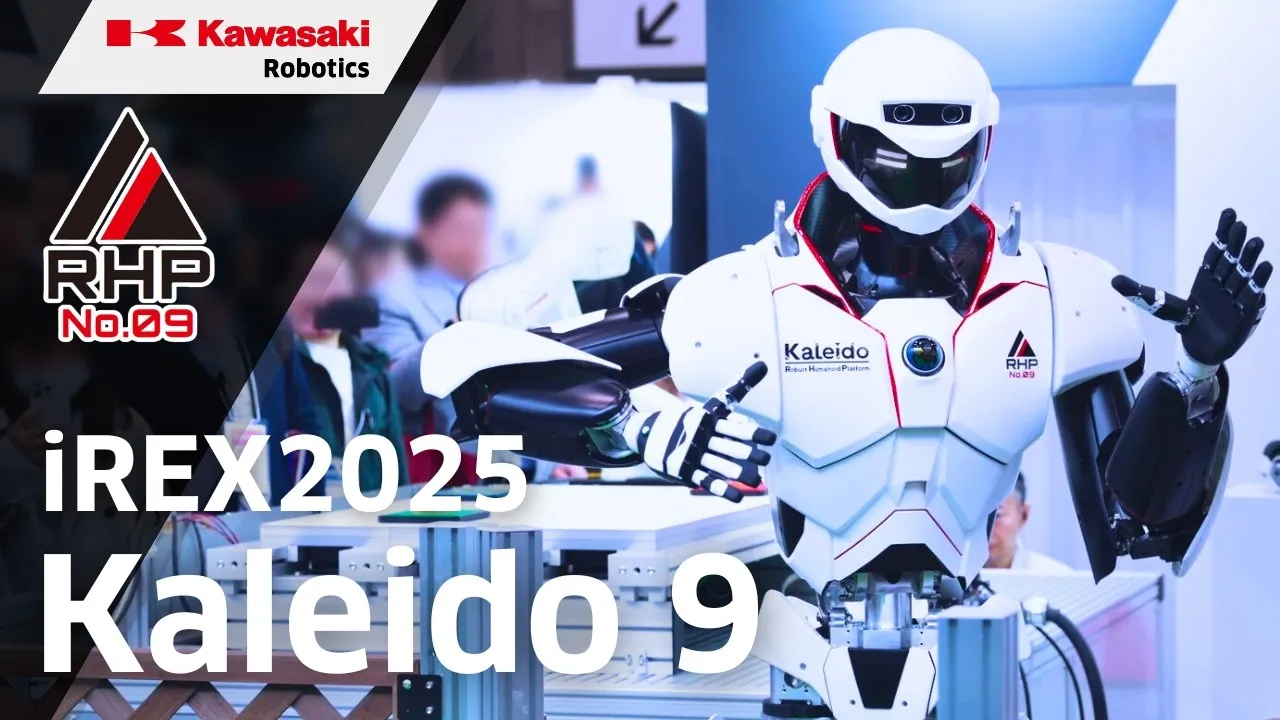
Kawasaki plans to integrate Japanese physical AI developer Noetra’s physical AI platform into its Kaleido humanoid robot.
The move would make Kaleido the first planned adopter of Noetra’s physical AI technology, according to Nikkei Asia.
Kawasaki is expected to initially use a combination of remote human control and AI as the system develops toward greater autonomy.
The company’s plans reflect a gradual expansion of humanoid robots into industrial operations, beginning with relatively simple tasks before potentially moving to more complex work such as assembly and other manufacturing activities.
Kawasaki adds AI
Kawasaki Heavy Industries is set to add Noetra’s platform into its Kaleido humanoid robot, with deployment targeted as early as 2030.
Kaleido has been under development since 2015 and is being positioned for industrial applications. Kawasaki’s initial plans focus on relatively simple tasks such as facility patrols and transporting parts in factories and warehouses. The company is also discussing the robot with potential customers in the automotive and semiconductor industries.
The transition to autonomous operation is expected to happen in stages. Early deployments would combine remote human control with AI, allowing operators to supervise or control the robot while Noetra’s physical AI capabilities handle an increasing share of tasks. As the underlying AI develops, Kawasaki aims to reduce the need for human intervention and eventually achieve fully autonomous operation, reports Humanoids Daily.
The approach reflects a technical challenge facing humanoid robots in industrial settings. Performing a predefined movement in a controlled environment is considerably different from operating autonomously around people, equipment and changing surroundings. A robot needs to perceive its environment, understand the physical properties of objects, plan movements and adjust its actions when conditions change.
Kawasaki’s Kaleido 9 already demonstrates some of these capabilities. The company has shown autonomous walking with obstacle avoidance using LiDAR-based localization, as well as remote-operated disaster-rescue demonstrations. Kawasaki’s March 2026 roadmap places remote-assisted work in controlled environments around 2030, while autonomous operation in unstructured environments is targeted around 2040.
Kaleido targets autonomy
Noetra’s physical AI platform is intended to provide another layer of capability. The company is developing an omni-modal foundation model targeted for fiscal 2028 and physical-world AI capable of understanding physical properties by fiscal 2030. Its technology development involves Sony, SoftBank, NEC and Honda, while Kawasaki is also an investor.
For Kaleido, the technology could eventually extend its role beyond basic transportation and patrol work. Kawasaki expects future software and AI improvements to enable more demanding applications, including product assembly. Such tasks require substantially greater precision because the robot must coordinate its arms and hands while responding to objects, tools and workpieces in real time.
Kawasaki also plans to combine Noetra’s technology with its physical AI collaboration with NVIDIA. Announced in May, the collaboration is focused on developing more complex and precise autonomous movements. Combining the two efforts could give Kawasaki access to AI models and computing technologies while allowing it to apply them to its existing humanoid platform.
The company’s plans also indicate that humanoids are only one part of a broader robotics strategy. Kawasaki is targeting tens of thousands of robots in operation by 2040, including wheeled robots, quadruped machines and hospital transport robots alongside humanoids.
The key technical goal for Kaleido is therefore not simply to make the robot perform more tasks, but to gradually shift responsibility for those tasks from human operators to AI. The planned 2030 deployment would represent an early stage of that transition rather than an immediate move to completely autonomous humanoid operation.
Source: https://interestingengineering.com/ai-robotics/kawasaki-kaleido-humanoid-autonomous
Related articles

I can’t use Apple’s new Screen Time on my daughter’s iPhone because my son won’t update his MacBook
After suffering years of frustration with Apple's parental control features, I've been eagerly anticipating the revamped Screen Time that launched last month with iOS 27.

Google is about to remove free access to Gemini Flash and Pro
Starting on October 9th, anyone using Google Gemini on a free plan will be limited to the Flash Lite model.

The Pixel Watch 5 is a better value at $65 off
The Google Pixel Watch 5 is discounted by $60 during Amazon’s October sale, with the 41mm version on sale for $334.99, and the 45mm version for $364.99.
US hypersonic cruise missile built to exceed Mach 5 reaches testing phase in Australia
The U.S. Air Force’s Hypersonic Attack Cruise Missile (HACM) has started flight testing after the...
Pentagon bets on lasers and microwaves to strengthen homeland drone defense
The US Defense Department has selected four companies for a pilot program to test directed-energy...

Machine learning powered cat search network helps find missing pets
Cats are famously good at getting into places humans cannot easily reach. Now, in Kazakhstan,...