
Newly developed MK 82 Penetrator can breach over 3.2 foot of reinforced concrete
The United Arab Emirates has completed development of an aircraft munition designed to penetrate hardened...
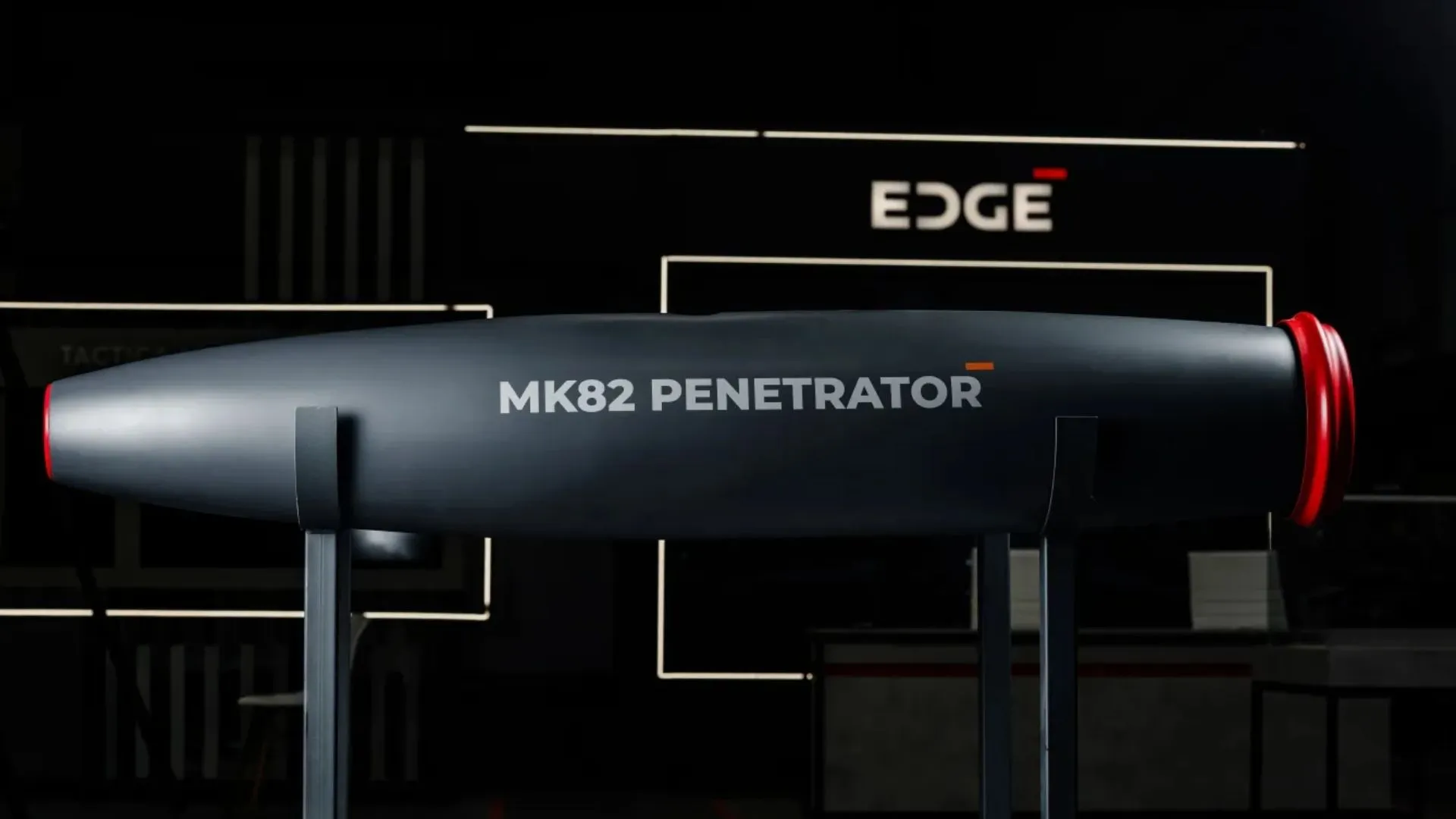
The United Arab Emirates has completed development of an aircraft munition designed to penetrate hardened targets, with its manufacturer reporting that the weapon can breach more than one meter of reinforced concrete during testing.
Developed and manufactured by LAHAB, a munitions subsidiary of Emirati defense group EDGE, the MK 82 Penetrator is intended for attacking fortified positions and bunkers. The weapon builds on the familiar MK 82 general-purpose bomb format, allowing operators to add a hardened-target capability without introducing an entirely separate aircraft-weapons system.
A new role for a familiar aircraft munition
According to EDGE, the development program concluded with performance trials against multiple hardened target types and environmental qualification testing. The company said the munition penetrated reinforced concrete more than one meter thick while avoiding what it calls the “J” effect, in which a weapon deviates from its intended trajectory during impact.
The reported result suggests that the weapon is designed to maintain a more consistent path through a hardened structure. However, EDGE has not publicly detailed the full test conditions, including the concrete’s precise composition, the impact velocity, or the munition’s performance against different types of fortified structures. The published penetration figure should therefore be understood as a manufacturer-reported test result rather than a universal measure of battlefield performance.
LAHAB CEO Mohammed Arbabi said the weapon was developed to expand customer capabilities while retaining familiarity and ease of use. The company has positioned the MK 82 Penetrator as an option for hardened, reinforced targets and bunkers.
The weapon’s compatibility with existing aircraft and guidance equipment is another central part of its design.
Designed to work with existing aircraft and guidance kits
EDGE says the MK 82 Penetrator is compatible with NATO-configuration aircraft across several generations, including fourth- and 4.5-generation multirole fighters, variable-geometry strike aircraft, advanced jet trainers and light attack platforms. The company also lists fifth-generation fighters, subject to the relevant aircraft’s existing compatibility and clearance for MK 82 weapons.
The munition can be paired with precision-guidance kits from EDGE’s AL TARIQ and THUNDER families. These systems are designed to provide guidance capabilities to compatible aircraft weapons, giving operators a way to combine precision guidance with the new penetrator variant.
That approach could reduce the need to introduce a completely separate guidance architecture for customers already using compatible weapons and aircraft. Actual integration, however, depends on the aircraft configuration, weapon certification and the guidance kit selected.
A larger penetrator is already in development
The MK 82 is the first of two planned penetrator variants. EDGE says development of the larger MK 83 Penetrator has reached an advanced stage, although it has not disclosed a completion date or detailed performance specifications for the new variant.
The program also fits into the UAE’s more comprehensive effort to develop and manufacture more defense equipment domestically. Building local expertise in munition design, testing and qualification can give the country greater control over production and support while creating products for potential export customers.
EDGE has announced the reported concrete-penetration result and aircraft compatibility, but has not publicly provided detailed independent test data or disclosed which armed forces will field the weapon first. The planned MK 83 variant suggests the company intends to extend the concept beyond a single munition, creating a broader family of weapons for targets protected by reinforced structures.
Related articles

Arturia adds proper sound design tools to its AstroLab synths
Arturia's AstroLab series was already amongst the best stage keyboards out there.

The stylish Nothing Headphone 1 are cheaper than ever
There’s no denying that Nothing knows how to make eye-catching headphones.

Vinod Khosla bets on ex-DeepMind engineer’s Wajo to win the agent race on trust
As Muse, Dots and Instinct crowd the personal-agent market, investor Vinod Khosla argues Shivani Poddar’s Wajo Fo agent is architected for trust and safety from day one.

Meta and Microsoft curb Claude use as Anthropic prepares for a blockbuster IPO
Reports say Meta halved Claude Code users and Microsoft cut employee AI spending caps from about $100,000 to $10,000 a month, testing Anthropic’s growth just as IPO scrutiny rises.

South Korea plans $3.5 billion frontier AI model program from 2027
Seoul’s science ministry outlined a 4.7 trillion-won ($3.5 billion) equity-backed push to build a frontier AI model starting as early as March 2027, alongside a separate industrial-deployment track.

OpenAI, Anthropic, Google and Meta testify under oath at NYC Council AI hearing
New York City Council leaders put frontier AI labs under oath on rogue-agent risks and local bills that could require third-party validation and human shut-down switches.