NVIDIA’s largest-ever 104-qubit simulation models realistic quantum hardware errors
NVIDIA has announced that JUPITER, Europe’s first exascale supercomputer, has completed a record-breaking quantum computing...
This story was prepared automatically by software.
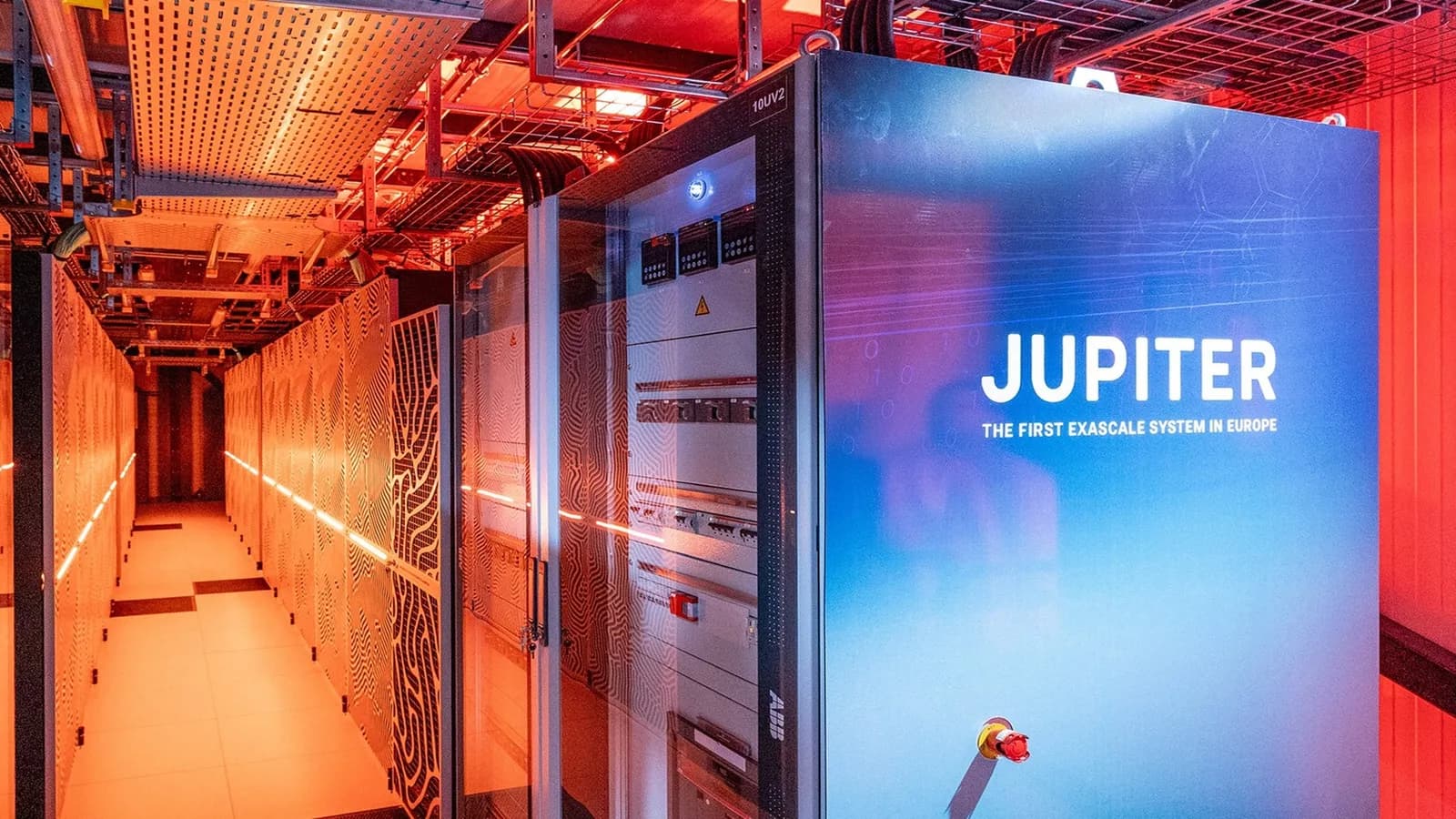
NVIDIA has announced that JUPITER, Europe’s first exascale supercomputer, has completed a record-breaking quantum computing simulation, allowing researchers to explore and validate magic state cultivation.
The 104-qubit simulation, described by NVIDIA as the largest comprehensive simulation of a fault-tolerant quantum computing system to date, ran on NVIDIA GH200 GPUs at the Jülich Supercomputing Centre in Germany.
Magic states are essential for performing complex calculations on fault-tolerant quantum computers. However, producing them with sufficiently low error rates remains a major challenge.
Traditional methods require substantial hardware resources, with some estimates suggesting that up to 95 percent of a quantum computer’s physical qubits could be dedicated to producing these states, leaving relatively few available for calculations.
NVIDIA’s announcement comes days after Google reported that its Willow quantum processor achieved a 40-fold reduction in errors while preparing specialized quantum states.
Unlike NVIDIA’s work, which uses classical supercomputing hardware to simulate quantum processes, Google’s experiment involved preparing magic states on an actual quantum processor. The two approaches address different challenges in developing fault-tolerant quantum computers, with simulations helping researchers evaluate designs before testing them on physical hardware.
Simulating real-world quantum errors
Last year, JUPITER simulated a full 50-qubit universal quantum computer under ideal, noiseless conditions, surpassing the previous 48-qubit record established by Jülich researchers in 2019 on Japan’s K computer.
The latest 104-qubit simulation, however, accounts for realistic hardware noise, allowing researchers to examine how errors affect magic state cultivation.
Unlike ideal simulations, which assume quantum operations can be performed without errors, the new work models the disturbances that physical quantum processors encounter during calculations. This provides a more realistic way to assess whether proposed methods can operate reliably under practical conditions.
Germany knows how to build, and now it’s bringing that expertise to industrial AI.
Tonight in Berlin, @JensenHuang and Chancellor @_FriedrichMerz discussed combining German engineering with NVIDIA AI to advance manufacturing and automotive.
We’re also backing Germany’s… pic.twitter.com/9uwH0rYYLk
— NVIDIA (@nvidia) October 19, 2026
By simulating the process under these conditions, NVIDIA researchers validated an advanced magic state cultivation approach, providing a way to test future improvements. The results could also help identify weaknesses in proposed designs and guide researchers toward more efficient methods before committing resources to building quantum hardware.
Scaling across 8,192 GPUs
For the new project, NVIDIA researchers first developed and tested their methods on a GB200 NVL72 system at the company’s Accelerated Quantum Research Center.
They scaled testing from four GPUs to hundreds before moving to 8,192 GPUs on JUPITER. According to NVIDIA, the development work helped reduce simulation efforts from weeks to days.
The team used NVIDIA’s cuQuantum software to optimize simulation performance and its CUDA-Q platform to model the fault-tolerant quantum circuit.
The detailed simulation could allow researchers to predict how future quantum computing designs might perform before building physical hardware. This could reduce the need for repeated hardware testing and help accelerate the development of quantum applications in drug discovery, financial modeling and materials science.
“Useful quantum computing will require fantastically complex, fault-tolerant systems — and understanding how they behave at scale is essential to building them,” said NVIDIA CEO Jensen Huang. “Our results from Jülich show how quantum processors and GPU supercomputers can work together to tackle research that would otherwise be out of reach, accelerating the discovery of transformative quantum applications.”
Source: https://interestingengineering.com/science/nvidia-104-qubit-quantum-simulation-jupiter
Related articles