
Quantum sensor could shrink chemical and biological threat detection to laptop size
Scientists at Johns Hopkins Applied Physics Laboratory (APL) are developing a quantum sensing platform that...
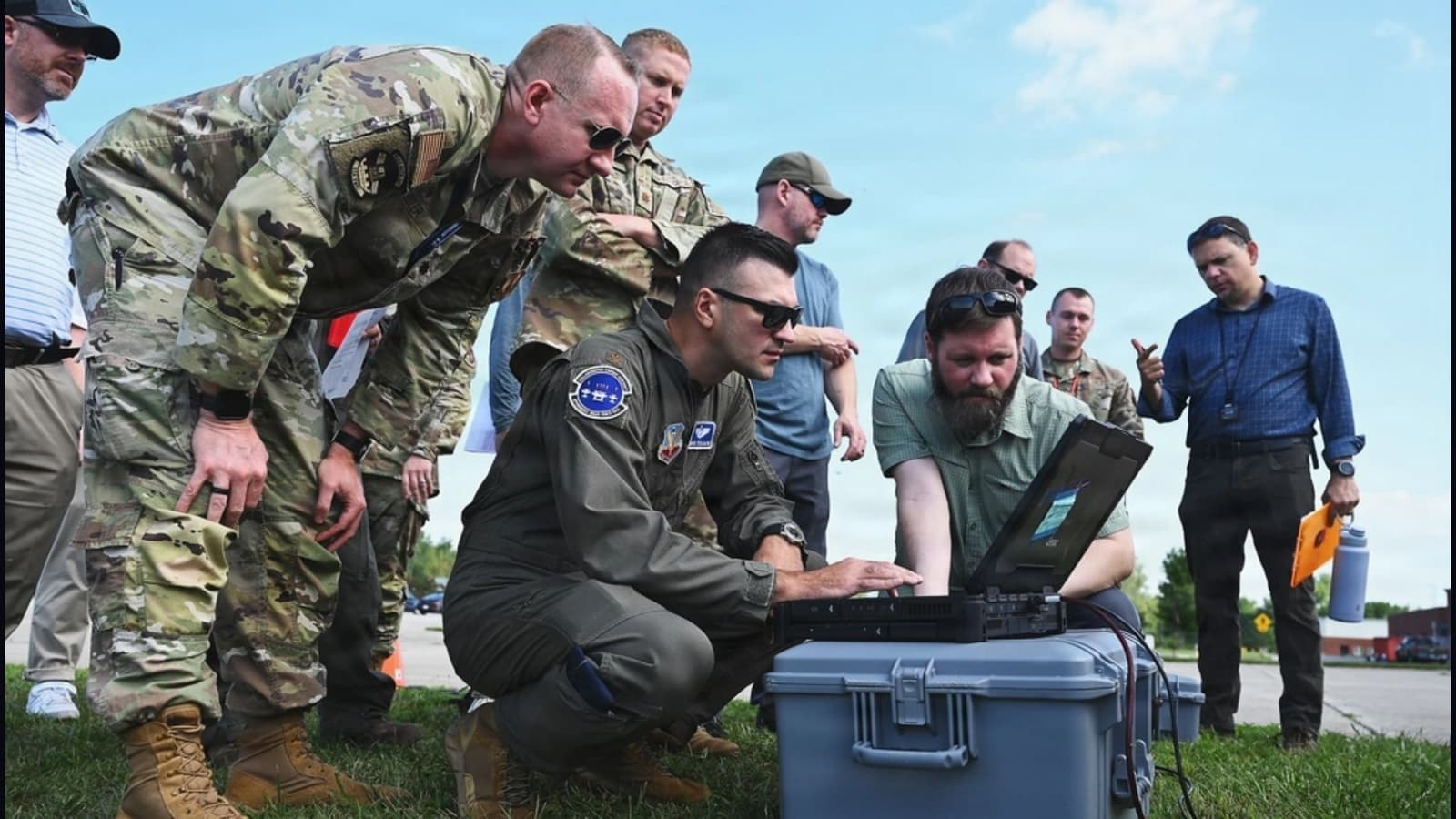
Scientists at Johns Hopkins Applied Physics Laboratory (APL) are developing a quantum sensing platform that could eventually let warfighters detect chemical and biological threats with a device small enough to carry into the field.
The system is designed to combine the broad detection capabilities of nuclear magnetic resonance (NMR) spectroscopy with the portability of a much smaller sensor. APL researchers envision a fieldable device roughly the size of a laptop that could analyze extremely small samples of potentially hazardous substances.
Shrinking NMR with quantum sensors
NMR spectroscopy uses magnetic fields to manipulate the spins of atomic nuclei. The resulting signals contain information about the structure of molecules, allowing researchers to distinguish between different substances.
The technique is already widely used in laboratories, but conventional NMR systems are difficult to take into the field. They typically require powerful superconducting magnets, cryogenic cooling equipment, and relatively large sample volumes.
APL experimental physicist Isaiah Gray and his team are pursuing a different approach based on nitrogen-vacancy (NV) centers in diamond.
An NV center is created when a nitrogen atom replaces a carbon atom in a diamond and a neighboring carbon atom is missing. This creates a quantum system that responds to surrounding magnetic fields.
When illuminated with green laser light, the NV center emits red light. By measuring that light, researchers can determine the NV center’s spin state and use it to infer information about nearby molecular structures.
The approach can potentially work with samples containing only tens or hundreds of atoms, dramatically reducing the amount of material required compared with conventional NMR.
The nano-container challenge
The concept is promising, but sensitivity remains a major obstacle. Nuclear spins at the diamond’s surface need to remain measurable for sufficient time to produce a useful signal. Gray’s team has proposed physically confining those spins in tiny structures, described by the researchers as “nano-containers,” fabricated directly on the diamond surface.
Computer simulations indicate that one of the geometries studied by the team could improve NMR sensitivity and accuracy by roughly an order of magnitude. The researchers are now working to fabricate the nano-container structure and test whether they can achieve the predicted improvement experimentally.
The team has already constructed a working proof-of-concept that measures magnetic fields by reading the spin states of the NV centers. The next challenge is achieving enough resolution to identify chemicals in extremely small fluid samples.
From laboratory equipment to the battlefield
A fieldable version could eventually give personnel a portable way to assess unknown substances without transporting samples to a laboratory. APL says the goal would not necessarily be to replicate the precision of laboratory chemistry.
Instead, the sensor could help answer practical questions in the field, such as whether an unknown substance presents a threat and what level of protective equipment may be required. The technology could potentially distinguish between chemically similar substances and identify biological threats, although the current work has not yet demonstrated those capabilities in a field-ready device.
The researchers are also exploring applications beyond chemical and biological detection. NV-based quantum magnetometers could potentially be used for environmental monitoring, magnetic-field mapping for GPS-denied navigation, and low-frequency radio communications. APL researchers have also discussed possible applications aboard satellites and inside cryogenic systems.
The current focus is on proving that nanoscale NMR can achieve the sensitivity needed for meaningful chemical detection. If the team succeeds, the result could transform a technology normally associated with large laboratory instruments into a compact quantum sensor that can be carried where the threat actually is.
Related articles

OpenAI wants to consult elite mathematicians about how to not fumble again
After turning a string of spectacular mathematical results into a reputational crisis, OpenAI is consulting human mathematicians to help it figure out a less disastrous path forward.
Deep boreholes could slash disposal costs for nuclear fuel recycling waste, study finds
Deep boreholes could provide a safe and relatively low-cost way to permanently dispose of radioactive...
US team to build offshore system for industrial-scale uranium recovery from seawater
SuperCritical Materials has partnered with the University of Michigan to engineer and test offshore systems...

US Army tests 30mm combat vehicle with counter-drone and target-sharing systems
BAE Systems has delivered two new AMPV 30 concept infantry fighting vehicles to the US...


Rabbit’s new AI agent doesn’t need an R1 to run
Rabbit, the company behind the underwhelming R1 device, is rolling out a standalone AI agent that you don't need its hardware to use, as reported earlier by Wired.