Ranked: The Most and Least Trusted Professions in 2026
Discover the most trusted professions in 2026, from doctors and scientists to politicians and social media influencers.
Which Professions Do People Trust the Most?
Key Takeaways
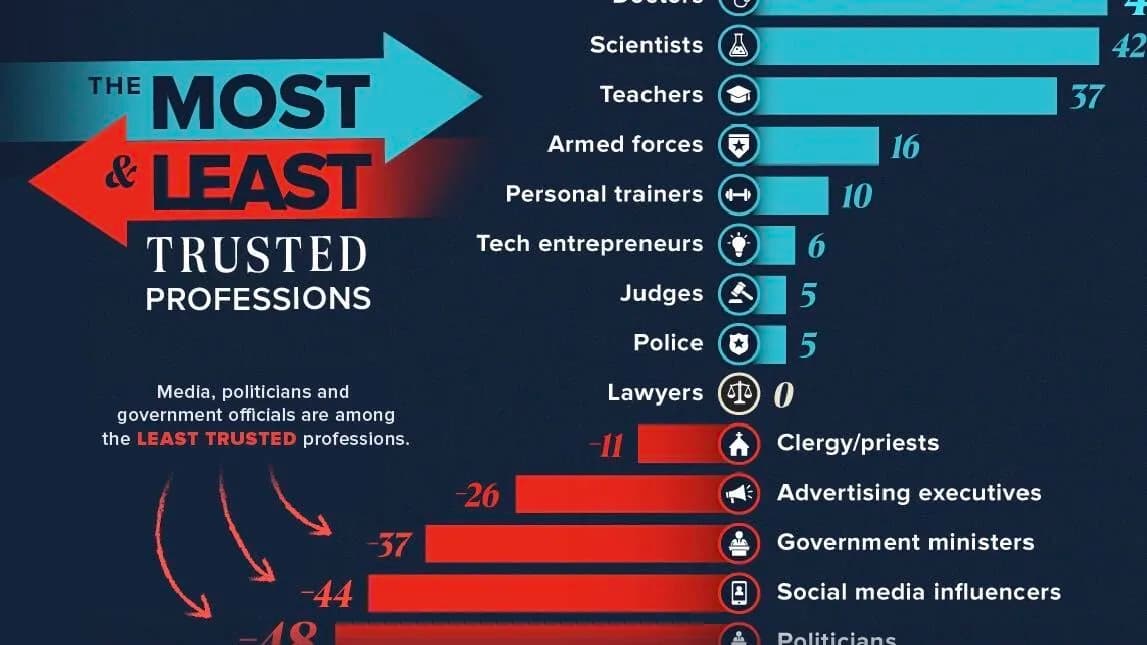
Doctors, scientists, and teachers lead the trust rankings, with net trust scores of +43, +42, and +37 percentage points, respectively.
Politicians (-48) and social media influencers (-44) have the lowest net trust scores among the 20 professions surveyed.
Trust varies sharply within government, with civil servants (-9) scoring 28 percentage points higher than government ministers (-37).
People rely on doctors, teachers, politicians, and other professionals every day. But how much do they actually trust them?
Global attitudes towards 20 professions reveals a sharp divide in public trust, with some groups inspiring far more confidence than others. The results also highlight striking differences between professions working in similar fields.
This visualization ranks the most and least trusted professions using data from the Ipsos Global Trustworthiness Index 2026, based on a survey of 23,537 online adults across 31 countries.
Doctors and Scientists Lead the Trust Rankings
Doctors lead the rankings with a net trust score of +43 percentage points, followed closely by scientists at +42 and teachers at +37.
The pattern is remarkably consistent across countries. According to Ipsos, these three professions occupy the top three positions in 27 of the 31 countries surveyed.
The gap to the next profession is substantial. The armed forces rank fourth at +16, a full 21 percentage points behind teachers.
RankProfession or groupCategoryNet trust (percentage points)
1DoctorsHealth and knowledge43
2ScientistsHealth and knowledge42
3TeachersHealth and knowledge37
4Armed forcesPublic institutions16
5Personal trainersHealth and knowledge10
6Tech entrepreneursBusiness and finance6
7JudgesPublic institutions5
8PolicePublic institutions5
9LawyersProfessional services0
10PollstersProfessional services-2
11TV news anchorsMedia-3
12Business leadersBusiness and finance-8
13Government officials / civil servantsPublic institutions-9
14JournalistsMedia-10
15BankersBusiness and finance-10
16Clergy/priestsReligion-11
17Advertising executivesBusiness and finance-26
18Government ministersPolitics-37
19Social media influencersMedia-44
20PoliticiansPolitics-48
Personal trainers (+10) and tech entrepreneurs (+6) also receive positive net trust scores. Judges and police both score +5, while lawyers sit at zero, meaning the shares expressing trust and distrust are equal.
Politicians and Influencers Face the Greatest Distrust
At the opposite end of the rankings, politicians have a net trust score of -48 percentage points, making them the least trusted group surveyed.
Social media influencers follow at -44, while government ministers rank third from the bottom at -37.
For politicians, the underlying survey responses reveal the scale of the distrust: just 13% of respondents consider them trustworthy, compared with 61% who consider them untrustworthy.
Skepticism extends beyond politics. Advertising executives (-26) also rank near the bottom, while journalists (-10) and bankers (-10) receive more negative than positive trust ratings.
The contrast with doctors is particularly stark, with a 91-percentage-point gap between the two professions.
Trust Gaps Within Politics and Media
Trust also differs considerably between professions operating within the same institutions or industries.
Government officials and civil servants score -9, compared with -37 for government ministers. This 28-point difference suggests that respondents distinguish between public administration and political leadership.
In media, TV news anchors (-3) score slightly higher than journalists (-10). Social media influencers (-44), however, fall much further behind both groups, highlighting a substantial divide in perceptions of different media roles.
For a broader perspective, our visualization of global trust in government and public institutions explores how public confidence varies across countries.
How Is Net Trust Measured?
The survey asked respondents whether different professions and groups were trustworthy or untrustworthy in their country.
Net trust is calculated by subtracting the percentage who consider a group untrustworthy from the percentage who consider it trustworthy.
A positive score means trust exceeds distrust, while a negative score means the opposite. For example, a score of +43 represents a 43-percentage-point advantage for trust, not a 43% trust rate.
The figures represent an equal-weight average across 31 surveyed countries, rather than a population-weighted global estimate. Fieldwork took place from June 19 to July 3, 2026.
Learn More on the Voronoi App
If you enjoyed this visualization, check out Ranked: High-Paying Jobs Growing the Fastest in America on the Voronoi app.
Related articles