Robot maker delivers 10,000th force-controlled arm and puts five humanoids to work
A Chinese robotics firm has delivered its 10,000th humanoid force-controlled robotic arm, marking a milestone...
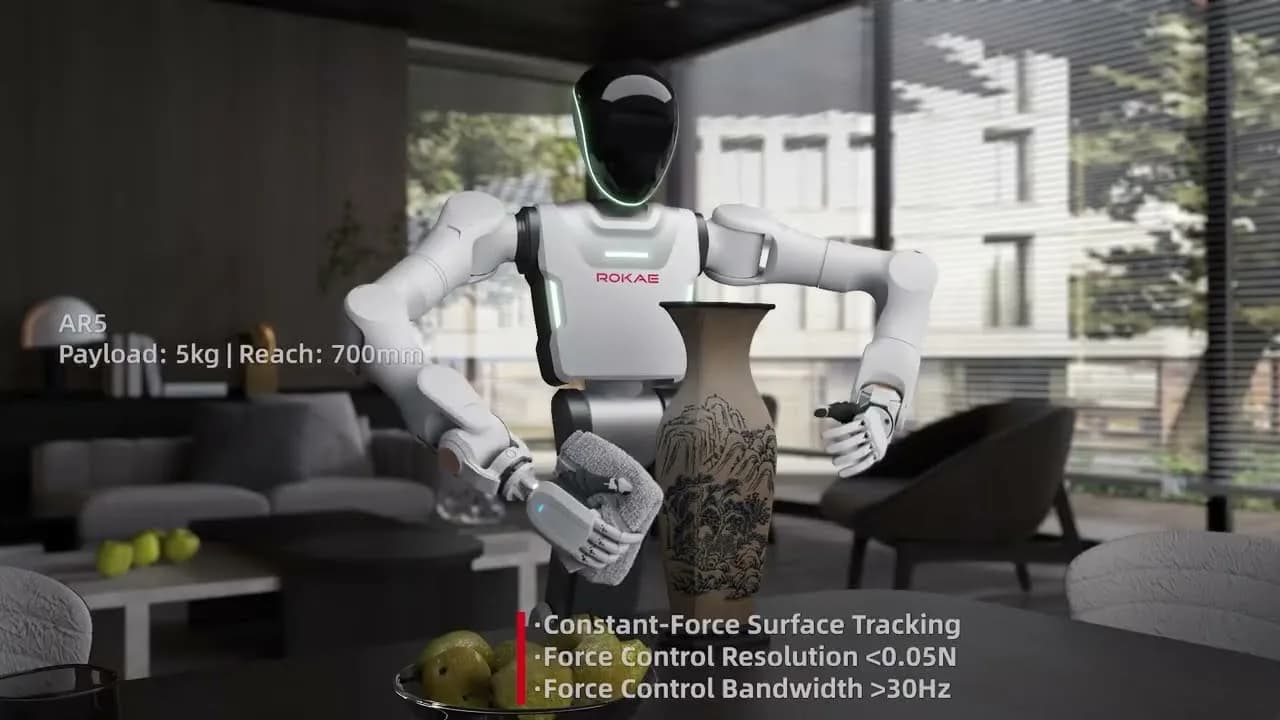
A Chinese robotics firm has delivered its 10,000th humanoid force-controlled robotic arm, marking a milestone in its industrial robotics business. ROKAE said the unit left its production line in September, and the announcement also identified five Helios wheeled humanoid robots operating at Schaeffler’s factory in Taicang, China.
The robots are equipped with ROKAE’s AR Series arms and deployed on a component-assembly line. The announcement highlighted the growing role of robotics suppliers in Schaeffler’s efforts to use automated systems in its factories while manufacturing components for the emerging humanoid robotics industry.
Scales force-controlled robotics
ROKAE has delivered its 10,000th humanoid force-controlled robotic arm, marking a production milestone for its industrial automation technology.
It also reported that five of its Helios wheeled humanoid robots, equipped with AR Series arms, are operating at Schaeffler’s manufacturing facility in Taicang, China, a German industrial supplier. The robots perform tasks including parts handling, assembly, and inspection on a production line for humanoid robot components.
The company announced the milestone on October 26, stating that the 10,000th arm rolled off its manufacturing line in Shandong Province in September. The figure refers specifically to its humanoid force-controlled arm product line, rather than the total number of complete humanoid robots it has produced or delivered.
Force control is a central feature of the technology. Unlike systems that rely solely on predetermined movements, force-controlled robotic arms can regulate the forces applied during physical interactions. This capability is relevant to tasks that require robots to handle components, make contact with objects, and perform assembly operations with controlled pressure.
ROKAE’s AR Series arms provide force control at each joint, according to the company. This allows the system to manage physical interactions throughout the arm’s range of movement. The technology is designed for applications where precise and responsive handling is required, including industrial assembly and inspection.
The arms use the company’s MAC controller, a compact unit measuring 213 × 145.5 × 45 millimeters. Depending on the configuration, the controller can manage all seven joints of a single arm, all 14 joints of a two-arm system, or more than 20 joints across a humanoid robot. This arrangement allows the control system to coordinate multiple joints within a robotic platform.
Humanoids enter factory production
ROKAE said more than 80 industrial partners have integrated its humanoid force-controlled arms into production applications. Its broader portfolio also includes HSA Series integrated force-controlled joints, the iNex embodied AI control system, and Helios wheeled humanoid robots.
At Schaeffler’s Taicang facility, the Helios robots combine wheeled mobility with the manipulation capabilities of the AR Series arms. According to ROKAE, the machines support parts handling, assembly, and inspection on a component-production line. Their deployment shows how mobile robotic platforms and force-controlled manipulators can be combined for manufacturing tasks.
The installation is part of Schaeffler’s wider effort to use humanoid robots in its own manufacturing operations while producing components for the robotics industry. The company previously described six humanoids working across five stations at the Taicang facility, which produces components including linear and rotary actuators. ROKAE’s latest announcement identifies five Helios robots specifically, but does not explain the difference between the two reported counts.
The companies have not disclosed detailed operating figures for the ROKAE deployment, including production rates, human intervention requirements, or quantified productivity improvements. These measurements would help establish how effectively the robots perform in sustained industrial operations.
Related articles