
Single-actuator drone modeled on maple seeds flies with 43.5% less error, study finds
A flying robot with just one moving part may sound simple. Controlling one precisely is...
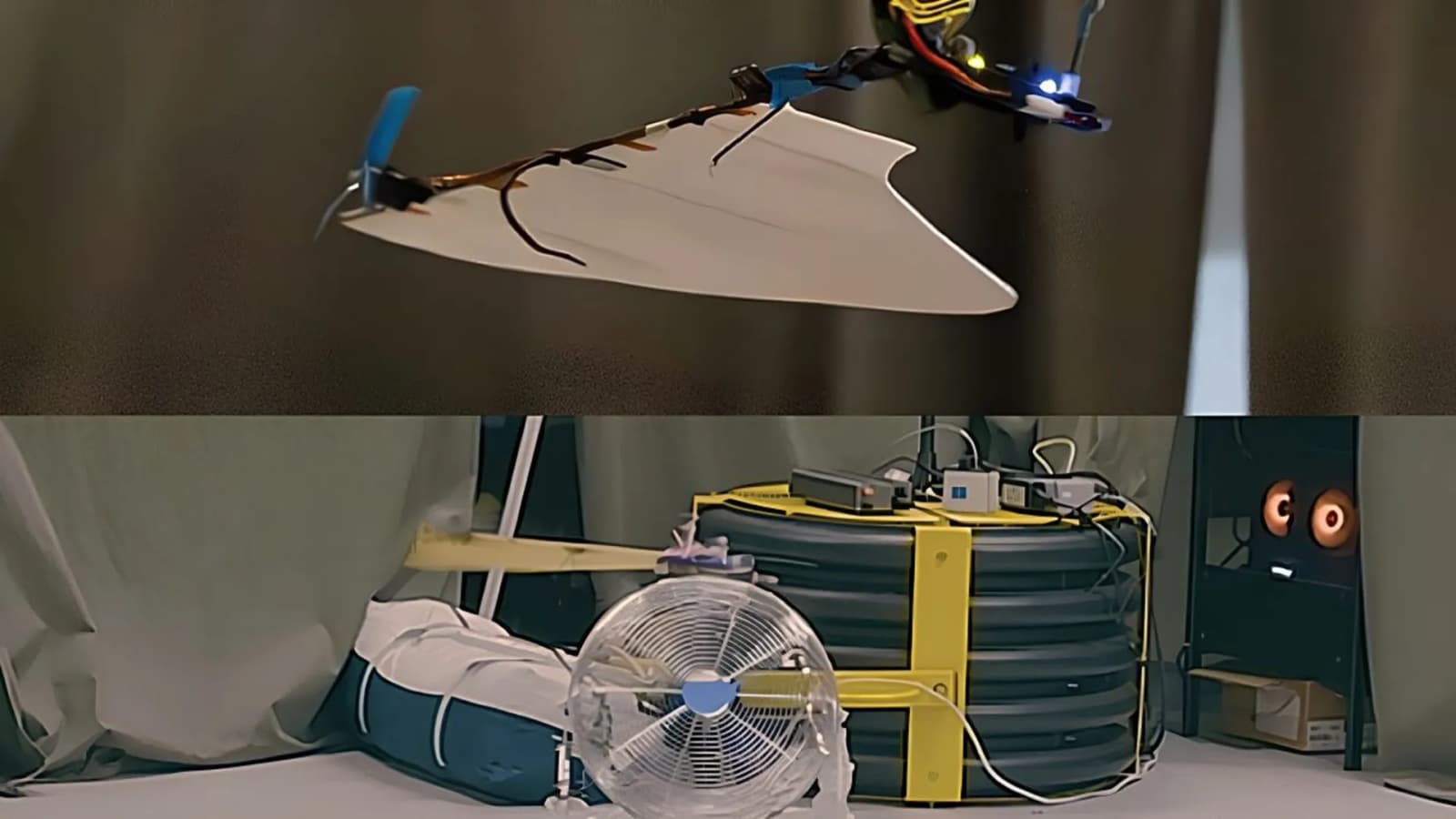
A flying robot with just one moving part may sound simple. Controlling one precisely is anything but.
Most drones use several rotors to control how they rise, turn and move. A robot with only one actuator has far fewer ways to correct itself when it drifts off course or hits a disturbance.
Researchers at the Singapore University of Technology and Design (SUTD) have developed a control method that lets such a minimalist flying robot anticipate its next movements. The approach was demonstrated on SAM, short for Samara Seed-Inspired Single-Actuator Monocopter, the same maple-seed-inspired platform whose lab previously set a 26-minute flight-endurance record.
Predicting Motion Ahead
Inspired by the autorotating motion of a falling maple seed, SAM spins rapidly to generate lift while using just one actuator for both lift and directional control. That compact design comes with a tradeoff. With only one actuator controlling its motion, precise trajectory tracking becomes especially difficult.
At the center of the new approach is nonlinear model predictive control, or NMPC. Rather than waiting for SAM to drift off its intended path before correcting it, NMPC predicts how the robot is likely to move over the next few moments and plans its actions accordingly.
The researchers combined this with Incremental Nonlinear Dynamic Inversion, or INDI, which uses real-time feedback to make rapid corrections when the robot hits disturbances or modeling errors. The team also built a hybrid model that better captures the interaction between SAM’s spinning and tilting motions.
Testing different wings
To test the method, researchers ran flight experiments using three versions of SAM: short-wing, long-wing and ultralight-wing variants. Each presented a different challenge, including lower lift efficiency, wing flexing and limited thrust.
The short- and long-wing models were tested on circular, figure-eight and elevated circular paths, some demanding more actuator input than the platform could physically provide. They were also tested under fan-generated wind. The ultralight-wing version was evaluated on a circular path and while carrying a 5-gram payload.
Sharper tracking results
Across the experiments, the combined NMPC and INDI approach outperformed a benchmark controller. Positional error was reduced by up to 39.5% for the long-wing SAM and 37.2% for the short-wing version. The ultralight-wing model recorded velocity error reductions of up to 43.5%.
“Because the whole system depends on one actuator, every motor command has to be planned and timed precisely,” said Dr. Emmanuel Tang, lead author of the study. He added that giving the robot a predictive planning horizon lets it fly more accurately even under wind disturbances or added payloads.
Path beyond the lab
The technology remains experimental. Flight tests were conducted indoors using a motion-capture system and offboard computation. Future work will explore reducing SAM’s reliance on external tracking and moving more computation onboard.
Professor Foong Shaohui, associate head of SUTD’s Engineering Product Development pillar, said the platform could eventually support applications such as environmental sensing and climate monitoring, particularly where compact, scalable designs are valuable.
Source: https://interestingengineering.com/ai-robotics/maple-seed-robot-predictive-flight-control
Related articles

New film blocks 99.99% of radar waves, could advance stealth jet technology
A new film, thinner than human hair, has been designed to block 99.9999999 percent of...
World’s first FDA-cleared self-balancing personal exoskeleton launched, offers hands-free upright mobility
A Paris-based company has announced the U.S. commercial launch of Eve, the world’s first FDA-cleared...

Chinese researchers find link between prenatal rare earth exposure and low birthweight
A study of nearly 4,900 pregnant women in China has found an association between prenatal...
World’s first zero-degradation elastocaloric cooling device maintains 1 million operational cycles
Researchers from the Hong Kong University of Science and Technology (HKUST) have unveiled the world’s...

Beijing to Shanghai in 30 minutes: China ready to test its Supersonic TMS-10 plane
China is moving its next-gen supersonic passenger aircraft research into a more demanding phase, with...
MARTAC expands US drone boat production with 100 more Devil Rays per year
MARTAC partners with SŌLACE Boats to increase production of its Devil Ray autonomous vessels by 100 units per year to meet growing demand from U.S. and allied governments.